Naval aviation is usually imagined from the deck of a carrier, where a few thousand feet of steel support the entire strike package. The shore-based half operates at a completely different scale. The six largest US Naval Air Stations by land area together control close to 1.45 million acres, a footprint that dwarfs every aircraft carrier and amphibious assault ship in service combined, and the distribution is far from uniform. One Mojave Desert installation accounts for roughly three-quarters of the total, while the smallest entry on the list controls about 1 percent of it. That imbalance is the most revealing fact in the ranking, because land area measures mission diversity rather than operational importance. The top of the table is not a list of the Navy’s busiest flight lines; it is a catalogue of the safety margins, test corridors, and simulated battlefields that make carrier aviation possible in the first place, and the bases that host the aircraft themselves rank lower simply because they were deliberately built close to the sailors who fly them.
The figures reflect the total land area under each installation’s control, including associated ranges, annexes, and detached test properties that form part of the facility’s official mission. That convention matters enormously at NAS Fallon, where the airfield occupies a modest parcel of Nevada desert but the Fallon Range Training Complex surrounding it sprawls across more than 200,000 additional acres of instrumented ranges and simulated surface targets. Applying the same logic at NAS Whidbey Island pulls in outlying field properties that provide the water access needed for electronic warfare training against maritime emitters. Comparing raw acreage without that context makes the rankings look arbitrary, since a base with a single runway can legitimately claim more territory than a major commercial airport.
How Land Area Defines The Largest US Naval Air Stations
Any serious analysis of the largest US Naval Air Stations by land area has to separate three functional categories of aviation installation, because each buys land for reasons that have nothing to do with the others. The master jet base is a high-tempo operational hub where fighter squadrons cycle through maintenance and carrier work-ups; it needs long runways, arresting gear, and ramp space, but it sits near population centers where thousands of sailors live, which caps how much territory it can acquire. The test and evaluation station evaluates unproven aircraft, sensors, and weapons against instrumented targets, and it must control vast, sparsely populated airspace so that a malfunction at supersonic speed produces data rather than casualties. Those safety buffers translate directly into enormous acreage, and they explain why the two desert installations that dominate this list were chosen for reasons of emptiness rather than strategic elegance.
The third category is the training complex, where carrier air wings rehearse large-force missions involving fighters, jammers, airborne early warning platforms, and helicopters before deploying. Realistic rehearsal demands simulated enemy air defenses, mock airfields, convoys, and urban target sets spread across terrain wide enough that aircraft are not constantly in one another’s way, and only desert and mountainous regions offer that combination at affordable cost. A fourth factor compounds all three: the noise and encroachment restrictions that govern supersonic flight, night operations, and live ordnance. A base that cannot expand into adjacent private land eventually hits a ceiling on capacity, so the Navy treats unencroached desert as a strategic asset. Installations that reached their current size decades ago, when surrounding communities were smaller and land was cheap, now hold an advantage no purchase price could recreate, and that gap is what the ranking’s steep drop between first place and sixth ultimately documents.
6. NAS Oceana: Virginia’s Master Jet Base At 10,000 Acres
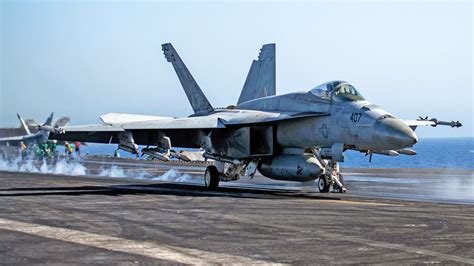
Naval Air Station Oceana occupies a little over 10,000 acres across its primary facilities in Virginia Beach and the associated Dam Neck Annex, making it the smallest installation on this list and the most operationally significant per acre. Oceana is the Navy’s premier East Coast master jet base, the facility that supports the carrier air wings assigned to the Atlantic Fleet, and virtually every strike fighter squadron that deploys aboard those carriers traces its hangars and maintenance lines back to the Virginia coast. The installation’s runways and ramp space were built for the sortie rates that carrier work-ups generate, and the local airspace includes offshore warning areas over the Atlantic where units conduct simulated carrier approaches and ordnance deliveries without flying over neighborhoods.
The Dam Neck Annex contributes several thousand of Oceana’s acres and hosts facilities for Naval Air and Space Technical Data Operations along with fleet combat training centers that develop tactical doctrine for the surface force, a portfolio with little to do with flying aircraft but firmly part of the installation’s landholding, which is why Oceana’s administrative footprint reaches well beyond the runways most observers picture. Oceana’s fleet is dominated by the Boeing F/A-18E/F Super Hornet and the carrier-capable F-35C Lightning II, and the base hosts fleet replacement squadrons whose instructors train newly winged aviators in carrier-borne strike warfare before those pilots join operational units. Proximity to Naval Station Norfolk, the world’s largest naval base, and to Atlantic Fleet headquarters keeps aircraft, spare parts, and aircrew flowing through a short commute rather than a cross-country transit. Oceana earns its place here not because it is large but because it is dense, and the contrast with the desert installations above it on the list captures the essential trade-off of shore-based naval aviation: a base close enough to the fleet to keep aircraft flying pays for that proximity with the acreage it can never acquire, and density is precisely what a master jet base requires.
5. NAS Patuxent River: Testing Tomorrow’s Naval Aircraft On 14,500 Acres
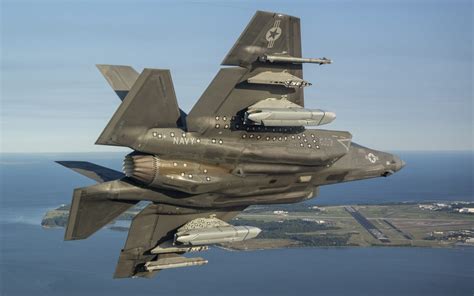
Naval Air Station Patuxent River, known as Pax River, controls more than 14,500 acres along Maryland’s Chesapeake Bay and serves as headquarters for the Naval Air Systems Command, the organization that writes requirements, manages contracts, and certifies the airworthiness of every aircraft the Navy buys. The base’s most valuable asset is not its ramp space but its airspace. Pax River controls restricted airspace over the Chesapeake region extending into the thousands of square miles, a volume large enough for test crews to evaluate performance, avionics behavior, radar cross-section, and weapons separation where engineers can recover instrumentation and where a failure does not endanger civilian communities below, and where an aircrew can repeat the same profile hundreds of times to build the statistical sample that certification requires.
Nearly every modern naval aircraft has passed through Pax River at some stage, and its test squadrons operate a fleet spanning the entire inventory. F-35 Lightning II aircraft evaluate software releases and mission systems before fleet-wide updates, P-8A Poseidon crews validate antisubmarine tactics and sensor fusion, CMV-22B Osprey detachments certify the tiltrotor’s ability to carry the F-35’s engine modules to carrier decks, and MQ-25 Stingray programs have advanced toward the first carrier-based unmanned aerial refueling capability in naval history. Rotary-wing test squadrons add upgrades for the MH-60 community alongside experimental vertical lift concepts. That institutional role gives Pax River outsized influence far beyond its acreage, because decisions made there determine whether a platform enters service and what limitations the fleet must accept when it deploys. Easy access to Washington, DC keeps test leadership in constant contact with the program offices that fund the work, shortening the loop between flight test and procurement decision.
4. NAS Lemoore: The Pacific Fleet’s Fighter Hub On 29,800 Acres
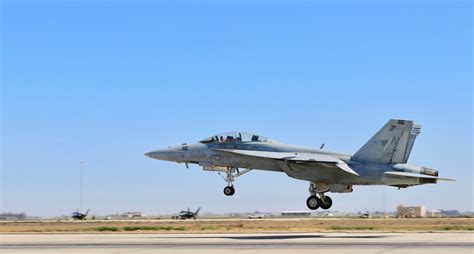
Naval Air Station Lemoore covers approximately 29,800 acres in California’s Central Valley and holds a distinction that shapes the Pacific Fleet: it is the principal operating base for both the Boeing F/A-18E/F Super Hornet and the Lockheed Martin F-35C Lightning II on the West Coast. When the Navy consolidated its West Coast strike fighter force at the end of the previous century, Lemoore absorbed squadron after squadron from closing installations, and the base now supports more than 200 frontline fighters organized into multiple carrier air wings and the training organizations that feed them. Aircraft based there deploy aboard carriers operating across the Pacific, and the base’s simulators, maintenance depots, and ordnance facilities sustain those deployments through the full cycle of work-ups, cruise, and recovery.
Lemoore’s isolation within the agricultural landscape around Kings and Fresno counties gives the installation something its San Diego-area counterparts never had: room to expand and airspace comparatively free of encroachment. The base has repeatedly added runways, hangars, and ramp space as its inventory grew, and the local economy adapted around the base rather than fighting it, a relationship that keeps supersonic noise and landing patterns away from the litigated airspace that afflicts newer coastal installations. The later arrival of the F-35C made Lemoore one of the Navy’s first operational Lightning II centers, which required new hangars, secure maintenance facilities, and training infrastructure on land the base already controlled. That combination of scale, airspace, and existing infrastructure is why Lemoore anchors West Coast carrier strike power, and why its flight line can absorb the arrivals and departures of an entire carrier air wing without the congestion that slows operations at bases hemmed in by cities, and it explains why a base with nearly three times Oceana’s acreage exists to serve a similar mission on a different ocean.
3. NAS Whidbey Island: Electronic Attack On 55,000 Acres
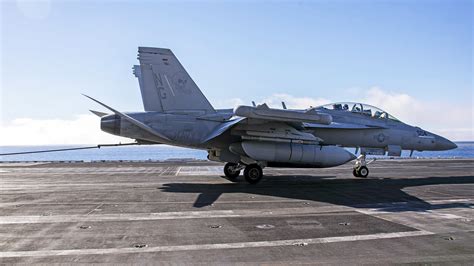
Naval Air Station Whidbey Island controls more than 55,000 acres once associated training properties are included, making it the third-largest installation here and a case study in how a specialized mission reshapes land requirements. The base sits in Washington’s Puget Sound region and is home to essentially the entire EA-18G Growler community, the Navy’s electronic attack force, including the fleet replacement squadron that trains every new electronic warfare officer and pilot before they reach an operational unit. The Growler, derived from the two-seat F/A-18F Super Hornet, exists to suppress or destroy enemy air defenses by jamming radars, disrupting communications networks, and firing AGM-88 High-Speed Anti-Radiation Missiles at emitters that reveal themselves.
That mission demands training infrastructure no other naval installation duplicates. Electronic warfare crews must practice against simulated threat emitters that mimic the radar signatures and operating patterns of foreign air defense systems, and they must do so in airspace large and isolated enough to avoid interfering with civilian spectrum users. The base’s outlying properties, which reach toward the Strait of Juan de Fuca and the evergreen terrain of the Olympic Peninsula, contribute acreage and electromagnetic isolation far beyond what the main airfield at Ault Field offers, and those forests, coastlines, and airspace support jamming runs, threat-simulation exercises, and the low-level navigation that trains crews to survive in contested electromagnetic environments. As adversaries field denser, more integrated air defense networks, the ability to blind or deceive those networks becomes a precondition for any strike package reaching its target, and every Growler squadron traces its training pipeline through Whidbey Island, which gives the base a concentration of electronic warfare expertise found nowhere else in naval aviation. The base’s Pacific Northwest position also shortens transit to Alaskan and Pacific training ranges, so a Growler crew can rehearse a mission in the morning and return to the same ramp by afternoon rather than losing days to cross-country movement.
2. NAS Fallon: Training Air Wings On 240,000 Acres
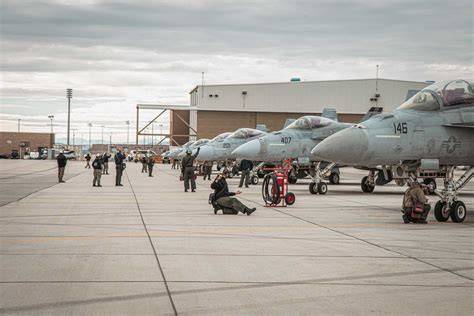
Naval Air Station Fallon, together with the Fallon Range Training Complex, controls more than 240,000 acres of Nevada desert and ranks as the largest traditional Naval Air Station in the United States. The airfield occupies a fraction of that total, but the surrounding range complex supplies simulated airfields, instrumented bombing ranges, mock convoys, and terrain that lets aircrews practice every mission set they might face on deployment, from air-to-air combat and precision strike to electronic warfare and large-force integration. Fallon is home to the Naval Aviation Warfighting Development Center, the organization that includes the TOPGUN strike fighter tactics course and runs advanced training for entire carrier air wings before they deploy.
Popular culture often reduces TOPGUN to dogfighting instruction, but the center’s real product is integration: fighters train alongside Growlers, E-2D Hawkeyes, MH-60 helicopters, and adversary aircraft flown by the center’s aggressor squadrons, which simulate enemy tactics against visiting units. Exercises at Fallon rehearse the sequence a deployed air wing will face, beginning with suppression of enemy air defenses and moving through strike, close air support, and combat search and rescue inside a single scenario. The desert makes this possible with more than 300 flyable days per year, one of the longest runways in the Navy inventory, and uninterrupted airspace where jets maneuver at high speed without regard for the traffic patterns and noise complaints that constrain operations near coastal cities. Marine Corps and Air Force units routinely deploy there for joint training, and the range’s remoteness lets crews use live ordnance against realistic targets instead of relying on simulated deliveries alone, a distinction that separates genuine combat readiness from skill at flying a computer simulation.
1. NAWS China Lake: One Million Acres Of Naval Weapons Testing
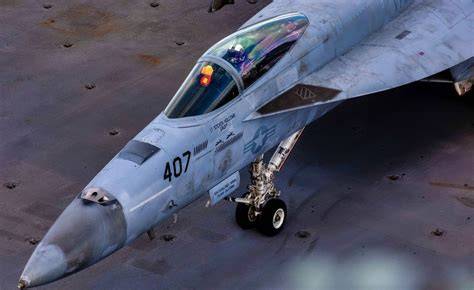
Naval Air Weapons Station China Lake controls more than 1.1 million acres in the Mojave Desert, making it not only the largest naval aviation installation in the United States but the Navy’s largest single landholding anywhere in the world. That acreage exceeds the land area of several US states, and the installation’s restricted airspace adds a second measurement just as striking: roughly 20,000 square miles of controlled airspace overhead, where test crews fly weapons profiles, sensor evaluations, and high-energy experiments that would be impossible near a population center, and where a range control officer can hold a firing corridor open for hours without consulting a single civilian air traffic control facility, a level of authority that no installation surrounded by homes and highways can claim. The base sits within the Randsburg Wash and North China Lake ranges, a combination of high desert, dry lakebeds, and mountains offering clear weather and long sight lines for telemetry.
China Lake was established during World War II as a weapons development site and evolved into the home of the Naval Air Warfare Center Weapons Division, the organization responsible for developing, integrating, and evaluating air-launched munitions. Much of the Navy’s air-to-air and air-to-ground weaponry passed through its laboratories and ranges, including the AIM-9 Sidewinder family, the AGM-88 anti-radiation missiles carried by Growlers, and successive generations of precision-guided bombs and long-range strike weapons. Its flight line serves a different purpose from those at fleet bases: instead of operational squadrons preparing to deploy, the ramp hosts test aircraft, research platforms, and evaluation units alongside F/A-18 Super Hornets, F-35 Lightning IIs, and unmanned systems flown to certify hardware before it reaches the fleet. The scale of China Lake is the direct cost of the safety buffers that live-fire testing demands, and those buffers are the reason the Navy can certify a weapon system without evacuating a neighborhood, since a weapon that can detonate at supersonic speed requires ranges measured in dozens of miles rather than hundreds of feet.
What The Largest Naval Air Stations By Land Area Reveal About Naval Aviation Power
The ranking is, at its core, a map of where land is cheap and where it is not, and the resulting figure is an imperfect proxy for capability. China Lake alone accounts for roughly 75 percent of the acreage among these six installations, yet no operational fighter squadron deploys from its runway. Oceana, with one-seventieth of China Lake’s land, supports the carrier air wings that project power from the Atlantic. Fallon’s ranges produce readiness and tactics rather than flying squadrons, while Lemoore and Whidbey Island convert infrastructure into deployable aircraft and crews, and Pax River turns airspace and airmanship into the requirements that shape the Navy’s future inventory. The contrast is between two models of naval aviation infrastructure, one organized around bringing ordnance and aircrew access to the sea, the other around the space required to make a new weapon or untested aircraft safe and certifiable.
The ratio of total installation acreage to primary airfield acreage is equally revealing. At Fallon the ratio approaches fifty to one, and at China Lake it exceeds a hundred to one, a pattern showing that the Navy buys most of its land not for parking aircraft but for creating a margin around them. Some of that margin guards people, and some guards the electromagnetic spectrum and noise envelope that keep a testing complex useful for decades. Those considerations are why the 6 largest US Naval Air Stations by land area were sized long before anyone could anticipate the encroachment limits that now bind every installation. Land acquired in the 1940s and 1950s at desert prices cannot be recreated today at any price, and the installations that secured it hold an asset no appropriations cycle can purchase, which is why this ranking is likely to remain stable for decades, long after the aircraft on those flight lines have been retired.