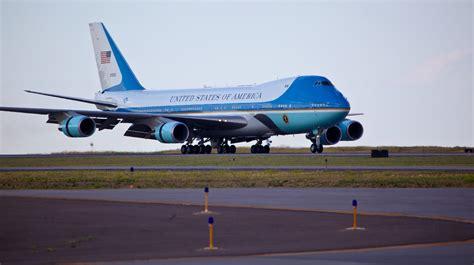
Air Force One is far more than a luxurious presidential aircraft. Beneath its iconic blue-and-white exterior lies one of the most heavily fortified and technologically sophisticated aircraft ever built. While it shares the same Boeing 747 foundation as many commercial jumbo jets, the similarities end quickly once the panels come off. One of the most astonishing differences is hidden deep inside the aircraft’s structure: Air Force One contains nearly twice as much wiring as a normal Boeing 747.
The current VC-25A aircraft — the military designation for the presidential fleet — contain roughly 238 miles of wiring, while the upcoming VC-25B replacements are expected to push that figure closer to 250 miles. For comparison, a standard commercial 747 uses roughly half that amount. That enormous increase is not about luxury lighting or extra entertainment systems. It exists because Air Force One functions as a flying White House, military command center, emergency bunker, and survivable wartime communications hub all at once.
The aircraft must remain operational under conditions that would instantly disable ordinary airliners. Every critical system onboard depends on a dense network of protected cabling capable of surviving electromagnetic attacks, maintaining secure global communications, and supporting advanced military defenses in real time.
The scale of that infrastructure is staggering. Thousands of individual wires snake through the floors, ceilings, bulkheads, and fuselage compartments, linking encrypted communications systems, defensive countermeasures, radar-warning equipment, navigation systems, satellite uplinks, and redundant backup controls.
Air Force One Functions as a Flying Military Fortress
A commercial Boeing 747 is designed primarily for passenger transportation. Air Force One, however, is engineered to ensure presidential survival and command continuity during a national crisis. That single mission changes everything about the aircraft’s internal design.
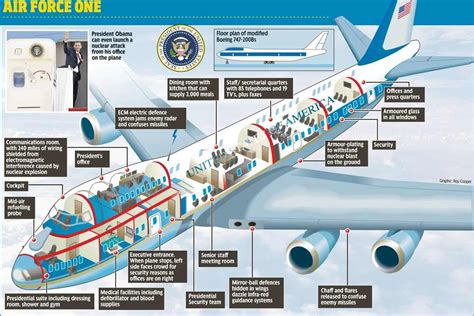
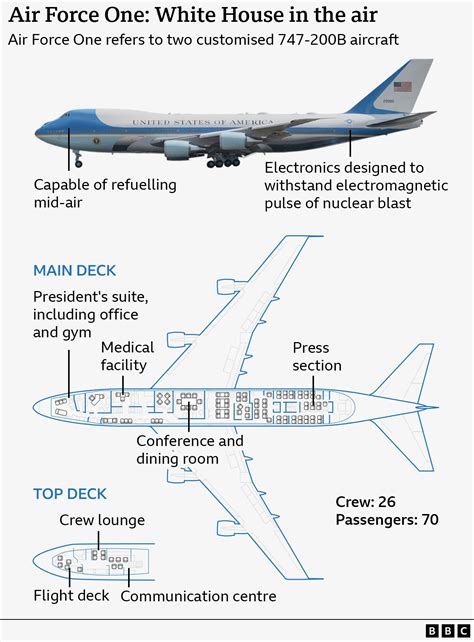
The VC-25A contains approximately 4,000 square feet of interior space spread across three levels. Inside are conference rooms, presidential offices, secure communications suites, medical facilities, food galleys, sleeping quarters, and operational stations for military personnel. Each of these spaces requires dedicated electrical systems and backup connections.
What truly drives the wiring complexity is the aircraft’s communications capability. Air Force One includes dozens of secure telephones, multi-frequency radios, encrypted data systems, classified military communication terminals, satellite communication arrays, and real-time intelligence equipment. The President must be able to communicate with military commanders, nuclear forces, global embassies, and allied governments from anywhere on Earth.
Unlike civilian aircraft systems, these networks require extensive redundancy. Critical functions cannot rely on a single cable path. Multiple backup routes are installed throughout the aircraft so systems remain operational even if portions of the plane suffer damage during an attack.
Electromagnetic Pulse Protection Demands Massive Shielding
One of the most important reasons Air Force One requires so much wiring is the extraordinary protection surrounding every electronic component onboard. The aircraft is specifically hardened against electromagnetic pulses, commonly known as EMPs.
An EMP generated by a nuclear detonation can instantly destroy unprotected electronics across a vast area. A conventional passenger jet would likely lose critical systems under such conditions. Air Force One is designed to survive them.
To achieve this, virtually every cable inside the aircraft is heavily shielded. The plane effectively operates as a giant airborne Faraday cage, a protective conductive enclosure that blocks damaging electromagnetic energy from reaching sensitive electronics.
Even more impressive, Air Force One reportedly incorporates layered protection systems. External shielding protects the aircraft as a whole, while internal shielding isolates individual mission-critical systems inside additional protective enclosures. That dual-layer architecture dramatically increases the amount of specialized cabling required throughout the aircraft.
Defensive Systems Add Another Layer of Complexity
Air Force One is officially classified as a military aircraft because it possesses capabilities civilian jets simply do not carry. Much of its defensive technology remains classified, but publicly known systems already reveal why the wiring load is so enormous.
The aircraft reportedly carries advanced electronic countermeasures capable of jamming hostile radar systems. Infrared defense systems help confuse heat-seeking missiles, while chaff and flare dispensers can disrupt incoming threats. These systems constantly exchange information between sensors, processors, warning receivers, and deployment mechanisms.
Every defensive layer requires power distribution, secure signal transmission, redundancy circuits, and hardened shielding. Unlike civilian aviation electronics, military-grade survivability systems cannot afford failure during combat conditions.
The aircraft itself is powered by four General Electric CF6 engines generating 56,700 pounds of thrust each, allowing the massive jet to maintain a range of roughly 7,800 miles and speeds exceeding 630 mph. Supporting that performance while simultaneously powering an airborne command center demands a highly sophisticated electrical backbone.
The Evolution of Presidential Air Travel
Presidential aviation has evolved dramatically since Franklin D. Roosevelt became the first sitting U.S. president to fly while in office during World War II. The famous “Air Force One” call sign emerged during the Eisenhower administration and became permanently associated with presidential aircraft in the early 1960s.
Since then, each generation of presidential aircraft has become more technologically advanced and more survivable. The upcoming VC-25B fleet will continue that evolution with even more advanced communications infrastructure, cybersecurity systems, and hardened electronics.
What appears from the outside to be a modified Boeing 747 is, in reality, one of the most sophisticated airborne command platforms ever constructed. Its maze of shielded wiring is not excess engineering — it is the hidden nervous system that allows the United States government to remain connected, protected, and operational under the most extreme circumstances imaginable.