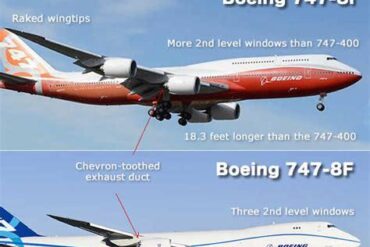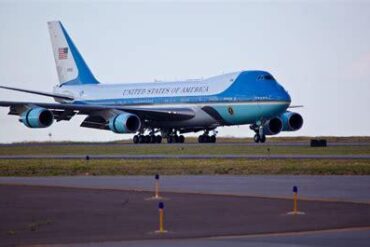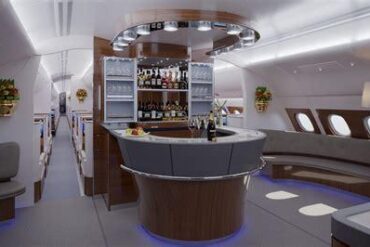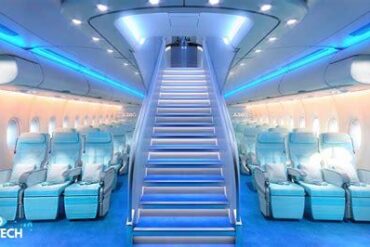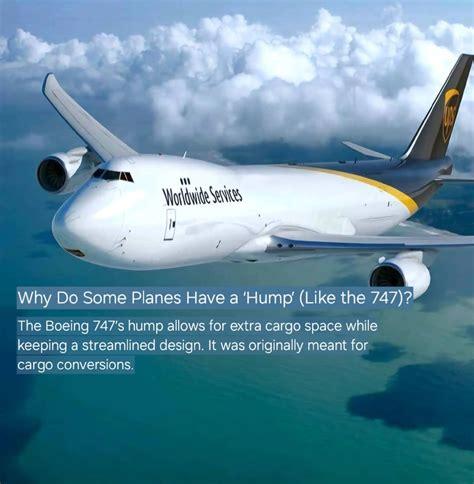
The Boeing 747 and Airbus A380 stand as two of aviation’s most recognizable giants, yet they embody fundamentally different philosophies. The A380’s graceful full-length upper deck gives it the profile of a true airborne leviathan, while the 747 retains its instantly recognizable hump—an unmistakable symbol of long-haul travel. Understanding why Boeing never extended that hump into a complete second level requires returning to the 1960s, when the 747 was designed not as a passenger Goliath but as an aircraft shaped expressly for the cargo era and a future that many expected to be dominated by supersonic jets.
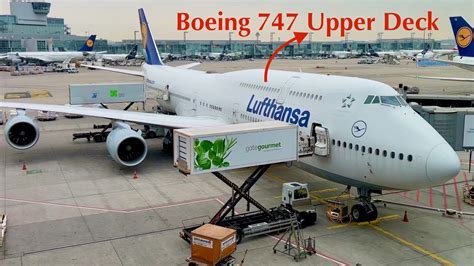
The 747’s partial upper deck originated from a simple operational requirement: Boeing needed to create an aircraft capable of front-loading cargo through a hinged nose. This design choice forced engineers to place the cockpit above the main deck, resulting in a raised fairing that naturally evolved into the familiar hump. That structure was never intended to serve as a full cabin. It was the engineering residue of an aircraft whose creators believed it would spend most of its life hauling freight once SSTs overtook long-haul passenger flying.
As a result, a complete upper deck was far beyond the program’s mission and carried substantial structural penalties that did not justify the limited seating gains available at the time.
The Supersonic Assumption That Shaped the 747
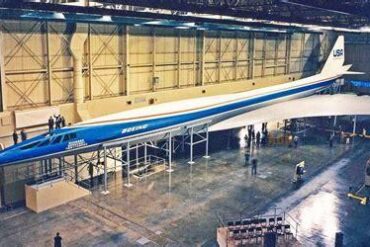
When Boeing launched the 747 program, industry leaders and policymakers were certain that supersonic airliners—led by Concorde and Boeing’s own planned 2707—would dominate intercontinental travel. Subsonic aircraft were expected to shift toward cargo service, where capacity and efficiency were paramount. Boeing’s design team made adaptability the core of the 747’s identity, giving it the ability to transition seamlessly from passenger service to freight operations without major structural changes.
This expectation shaped every major design decision. The aircraft needed a flat, unobstructed cargo floor with a standard container height. Adding a second full-length deck would have forced Boeing to raise the lower deck or compress its volume, permanently crippling its freight potential. Passenger airlines of the 1960s had no appetite for a 500-seat aircraft anyway; the 747’s capacity already exceeded market demand. Rather than chase theoretical scale, Boeing focused on pragmatic versatility.
Structural Loads, Weight, and the Limits of 1960s Engineering
A full-length upper deck demanded far more than simply stretching the existing hump. It required a complete redesign of the fuselage, wing box, and internal structural members. A double-deck aircraft introduces significant vertical loads, redistribution of stresses, and new bending moments across the entire body. The technology and materials of the time made such an undertaking prohibitively heavy and expensive.
The aerodynamic profile would also have required a fresh start. A taller fuselage increases frontal drag and disrupts airflow over the wing root, forcing Boeing to re-engineer both wing geometry and engine performance assumptions. The 747 was already the largest and most audacious commercial aircraft ever attempted; adding further layers of structural complexity would have jeopardized the program and delayed its entry to market.
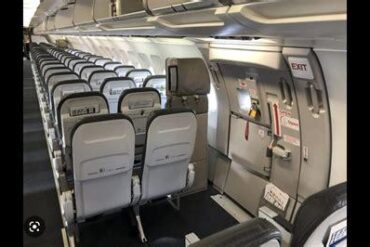
Evacuation requirements added another obstacle. A true two-deck aircraft needs additional exits, slides, and carefully distributed emergency routes—difficult to integrate into a design whose primary mission was not high-density passenger service. Airbus later solved these problems with a clean-sheet approach on the A380, but Boeing had neither the mandate nor the engineering freedom to do so in the 1960s.
Why Stretching the Main Deck Was Always More Efficient
Economic logic played a decisive role. Adding a full upper deck would have offered fewer revenue seats compared to simply stretching the main fuselage—a path Boeing pursued in later variants such as the 747-300, 747-400, and 747-8. The wider lower deck allowed airlines to generate more revenue with far less additional weight. A narrow upper deck, arranged in a 2-2 configuration, delivered poor returns for its structural penalties.
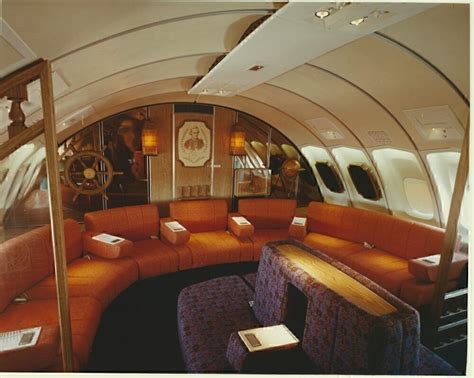
Airlines proved the point themselves. Early 747s used the upper deck not for seating but for lounges, dining rooms, and prestige spaces. Only after the 1973 oil crisis did carriers convert the deck into additional seating, and even then, Boeing opted for modest extensions rather than wholesale redesigns. The market never pushed for more; by the 1980s, airlines were moving toward efficient twin-engine widebodies, not ever-larger quad-jets.
Airbus Took a Different Path—and Built the A380 for an Entirely Different Purpose
Airbus approached the A380 with none of the 747’s constraints. By the 1990s, the industry understood that supersonic airliners were not the future. Airbus pursued a clean-sheet superjumbo tailored exclusively for passenger capacity on mega-hub routes. Without a nose cargo door, designers could sculpt a continuous double-deck fuselage optimized for maximum volume.
The engineering calculations only made sense because Airbus committed to the aircraft from day one as a passenger-centric giant. The 747 was, and always remained, a hybrid: part freighter, part flagship, part cautious hedge against a supersonic future that never materialized. These diverging origins produced two giants that resemble each other in scale yet diverge dramatically in purpose.
Boeing Studied a Double-Deck 747—But Abandoned It for Good Reasons
Boeing revisited the idea of a full-length double deck several times, most seriously in the 1980s. Internal studies showed that the extra deck did not add enough capacity to justify the structural overhaul. The lower deck was too wide for a proportional upper-level equivalent; the resulting aircraft would carry more weight than revenue. The engineering penalties outstripped the modest seating gains.
By the time Airbus unveiled the A380, Boeing had already concluded that the future lay elsewhere. Airlines worldwide were reshaping their networks around point-to-point flying with long-range twins. The business case for a superjumbo was shrinking, not expanding. The partial upper deck remained the 747’s sweet spot: iconic, aerodynamically efficient, cargo-compatible, and uniquely flexible.
An Engineering Accident That Became a Global Icon
The 747 never needed a full-length deck to secure its place in aviation history. Its silhouette became instantly recognizable not because of monumental scale, but because of engineering pragmatism that blossomed into elegance. The hump was a byproduct that evolved into a symbol—proof that functional necessity can define an era as powerfully as deliberate design.
Even as the age of mega-jets fades and the industry transitions toward fuel-efficient twins, the 747’s legacy endures. Cargo operators still rely on the short-hump design because it remains unmatched for nose-loading operations. Passenger versions continue to inspire nostalgia and admiration. The absence of a full deck is not an omission but a reflection of the aircraft’s original purpose: versatility first, capacity second.
The Airbus A380, in contrast, represents the pinnacle of a different vision—one centered on scale, spectacle, and the belief that global travel would consolidate around massive hubs.
Both aircraft succeeded in their own ways. Both left indelible marks on aviation. But only the 747 turned a structural compromise into one of the most iconic shapes the world has ever flown.