The arrival of the Airbus A380 reshaped expectations of what a passenger aircraft could be. When the superjumbo entered commercial service in 2007, it didn’t merely expand the capacity of long-haul travel—it fundamentally changed how space inside an airliner could be used. For nearly four decades before its debut, the concept of a double-deck aircraft had been dominated by the Boeing 747, whose distinctive hump-shaped upper deck became one of aviation’s most recognizable silhouettes.
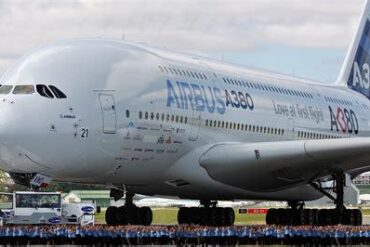
Yet the A380 introduced a completely different philosophy. Rather than adding a small second level as a structural compromise, Airbus designed the aircraft from the outset as a true full-length double-deck airliner. This decision produced an upper deck that feels less like a loft perched atop an airplane and more like a second widebody cabin stacked above the first.
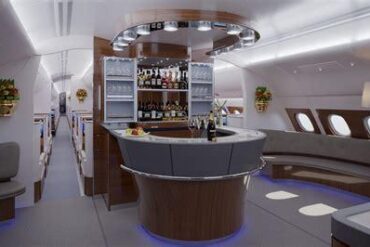
The result is an interior environment unlike anything that had existed in commercial aviation. With nearly 50% more usable floor space than a 747-400, the A380 allowed airlines to introduce amenities that once belonged only to fantasy: walk-up lounges, onboard showers, and suites with closing doors.
Understanding why the A380’s upper deck feels so different requires examining its architecture, structural design, and operational philosophy—all of which diverge dramatically from earlier double-deck aircraft.
A380 vs. Traditional Double-Deck Aircraft: A Different Design Philosophy
The difference between the A380 and earlier double-deck aircraft becomes clear the moment one studies the fuselage profile.
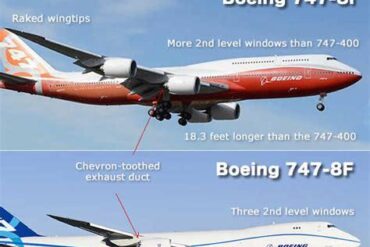
The Boeing 747 was originally designed with cargo operations in mind. Engineers placed the cockpit above the main deck so the aircraft could feature a hinged nose door, allowing cargo to be loaded directly into the fuselage. That raised cockpit created extra space behind it, which airlines later converted into a small passenger lounge and eventually a compact upper deck cabin.
This design decision produced the famous 747 hump, but it also meant the upper deck was never intended to function as a full passenger level.
By contrast, Airbus approached the A380 as a passenger-first aircraft from the beginning. The company envisioned a jet that could move enormous numbers of travelers between the world’s busiest airports while staying within the infrastructure limits of existing gates.
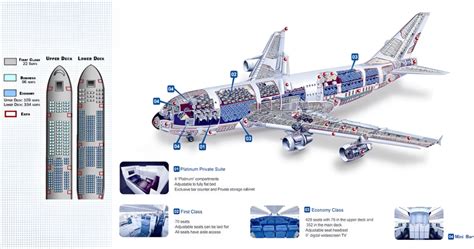
Instead of creating a partial second floor, Airbus engineers built a fuselage capable of supporting two complete decks running almost the entire length of the aircraft.
This required a radical shift in structural engineering. The A380’s fuselage uses an ovoid cross-section, rather than the near-circular tube common in most airliners. That shape distributes pressurization loads across two passenger decks while maintaining structural strength.
The result is an aircraft that effectively functions as two widebody cabins stacked vertically, something no previous commercial jet had attempted at this scale.
A Widebody Cabin in the Sky: The Extraordinary Width of the Upper Deck
One of the most striking differences passengers notice on the A380’s upper deck is how wide it feels.
On a Boeing 747-400, the upper deck measures about 11 feet 4 inches in width. That relatively narrow space restricts airlines to seating configurations such as:
- 2-2 layouts in business class
- 3-3 economy seating
Although cozy, the cabin often feels like a narrowbody aircraft attached to a widebody fuselage.
The A380 changes that equation completely. Its upper deck stretches to approximately 19 feet wide, making it wider than the main deck of some widebody jets, including the Airbus A330.
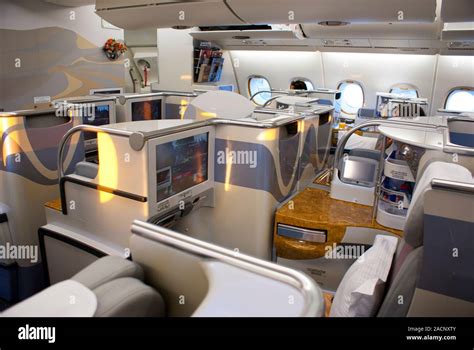
This extra width transforms how airlines configure the cabin.
Instead of a constrained loft, the A380’s upper level can support layouts such as:
- 2-4-2 economy seating
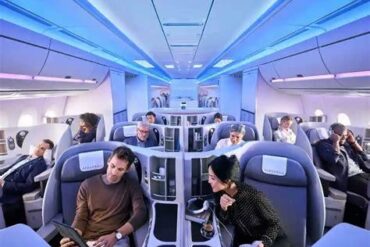
- 1-2-1 business class with direct aisle access
- luxury first-class suites
Because the fuselage does not taper sharply toward the nose, the cabin width remains relatively consistent from front to back. Passengers seated near the nose experience nearly the same lateral space as those further aft—something impossible on aircraft with strongly tapered forward sections.
For airlines designing premium cabins, that consistency opens the door to architectural creativity rarely seen in aviation.
Vertical Walls and the Illusion of Space
A subtle but important feature of the A380’s upper deck lies in the shape of its cabin walls.
On aircraft such as the Boeing 747, the curved fuselage creates walls that slope inward as they rise toward the ceiling. Window-seat passengers often feel the roof closing in above their heads.
The A380’s ovoid fuselage allows engineers to maintain much more vertical sidewalls, dramatically changing the interior perception of space.
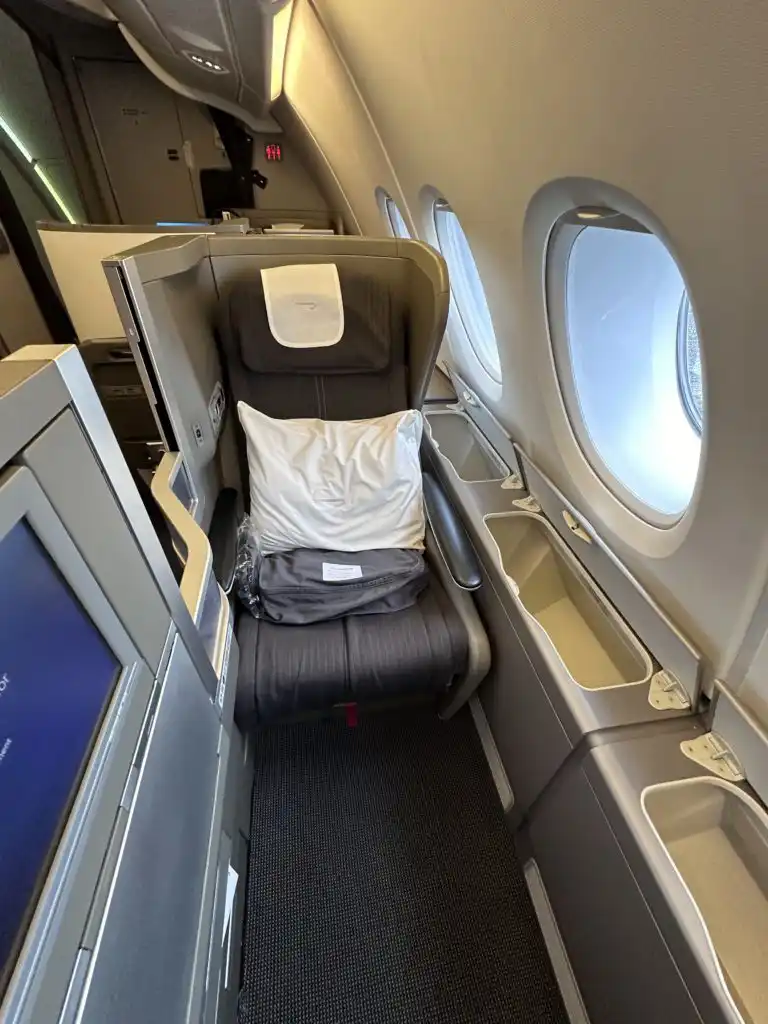
This design produces several advantages:
First, the cabin feels larger than it actually is. Human perception of space depends heavily on vertical lines; straighter walls create a room-like environment rather than a tunnel-like one.
Second, Airbus used the extra space between the seat rows and the fuselage to install deep side storage compartments. These bins are large enough to hold laptop bags, blankets, or personal items, freeing the overhead bins for larger carry-ons.
For passengers, this creates an experience closer to a train compartment or lounge, rather than a conventional aircraft cabin.
Why the A380 Upper Deck Is Exceptionally Quiet
Noise levels inside aircraft cabins typically fall between 75 and 80 decibels during cruise. That constant hum may seem normal to frequent flyers, but it places a surprising amount of stress on the human brain during long flights.
The A380’s upper deck breaks this pattern.
Measurements regularly show sound levels around 68 decibels, making it one of the quietest passenger spaces ever created in a commercial aircraft.
This quiet environment emerges from simple physics rather than a single technological breakthrough.
The upper deck sits farther from the engines than passengers on most aircraft. The massive Rolls-Royce Trent 900 or Engine Alliance GP7200 engines hang beneath the wings, several meters below the upper deck floor.
This additional distance reduces:
- direct engine noise
- vibration transmitted through the fuselage
- turbulence noise generated near the wing roots
The A380’s large fuselage also spreads airflow across a broader surface area, which reduces the high-frequency wind hiss sometimes heard near the nose of narrower aircraft.
For long-haul travelers, the result is striking. Conversations can occur at normal speaking volume, and the reduced noise significantly lowers fatigue on flights lasting 12 to 15 hours.
The Boarding Experience: Entering a Second Floor in the Sky
Designing a full-length upper deck introduced logistical challenges far beyond the aircraft itself.
Traditional airport gates were built to handle aircraft with one passenger level, meaning jet bridges typically connect to doors located roughly four meters above the ground.
The A380 changed that calculation.
Its upper deck doors sit approximately 7.86 meters (25.8 feet) above the tarmac, far beyond the reach of conventional jet bridges.
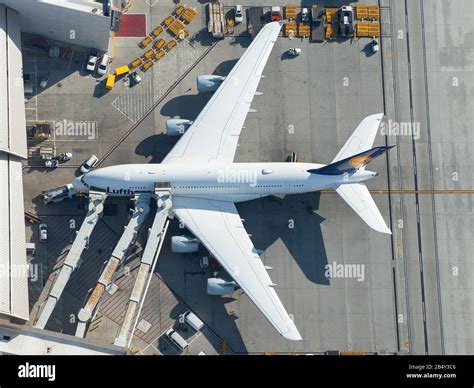
To accommodate the aircraft, airports around the world built Code F gates equipped with dual-level boarding bridges. These allow passengers to enter the aircraft directly onto the upper deck while others board the lower level simultaneously.
This arrangement delivers several operational advantages.
Airlines can separate passenger flows, sending premium travelers to the upper deck while economy passengers board below. The system also prevents bottlenecks that would otherwise occur when loading more than 500 passengers onto a single aircraft.
Without multi-level boarding, the A380’s enormous capacity would make turnaround times impractical.
Why Luxury Features Are Usually Installed Upstairs
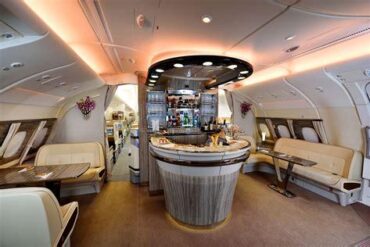
The A380 quickly became famous for onboard amenities rarely seen in commercial aviation. Airlines introduced cocktail lounges, social bars, and even shower spas, turning long-haul flights into floating hotels.
Interestingly, many of these features appear almost exclusively on the upper deck.
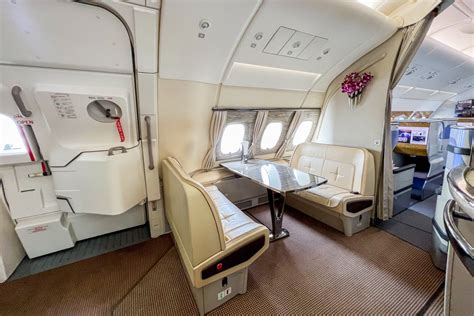
The reason lies in both economics and engineering.
Although the upper deck spans nearly the entire fuselage length, it still contains slightly less total floor area than the main deck due to the aircraft’s curved shape. Airlines therefore prefer to place low-density premium products in that space.
Luxury features consume large areas but serve relatively few passengers. Installing them upstairs allows airlines to preserve the high-capacity seating arrangements required on the main deck.
Structural considerations also play a role. The A380’s interior floors are supported by carbon-fiber reinforced plastic beams, capable of carrying heavy amenities like water tanks used for onboard showers.
Engineers carefully distribute these weights to maintain the aircraft’s center of gravity, ensuring that additional plumbing or fixtures do not disrupt flight stability.
The separation between decks also provides an acoustic benefit. Noise generated in social areas on the upper level is naturally muffled before reaching passengers seated below.
The Staircases That Connect Two Worlds
Moving between decks on the A380 feels remarkably different from earlier aircraft.
On the Boeing 747, the upper deck is accessed via a narrow spiral or straight staircase designed primarily for crew movement. Passengers often ascend one at a time, creating a natural bottleneck.
The A380 replaces this with two large staircases: one near the front of the aircraft and another near the rear.
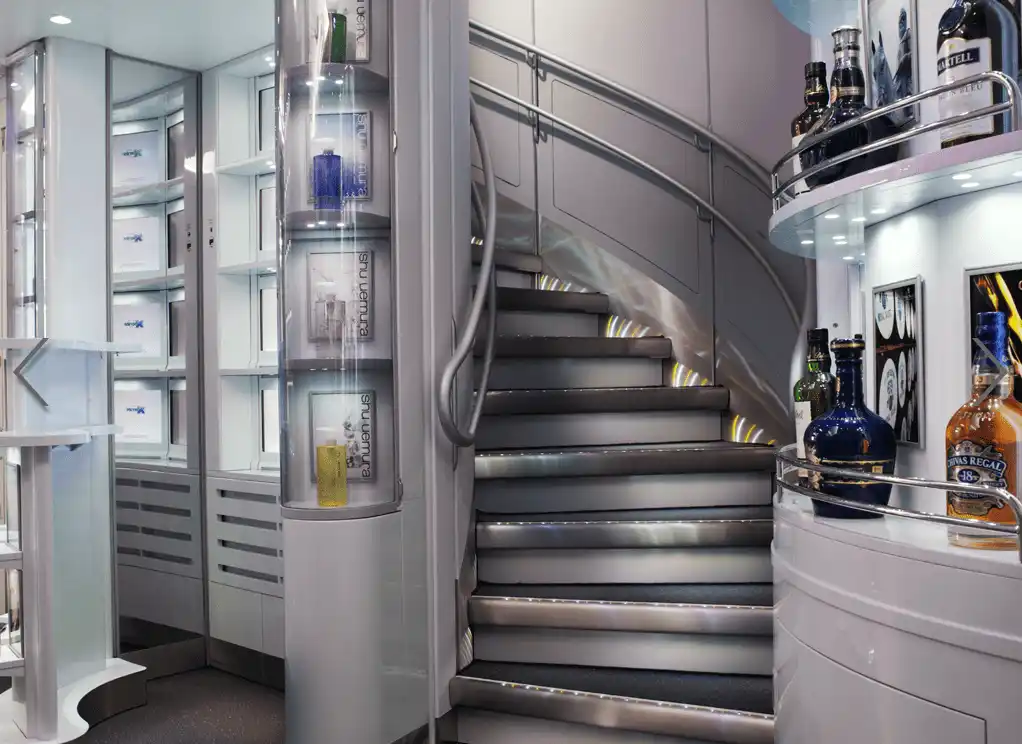
These staircases serve several purposes.
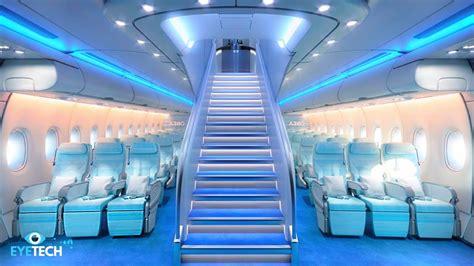
They allow flight attendants to move service carts between decks efficiently while also enabling passengers to transition between levels without crowding. The forward staircase is wide enough for two people to pass comfortably, reinforcing the sense that the aircraft contains multiple floors rather than a single cabin.
The dual staircases also enhance safety. In emergency situations, passengers on the upper deck have multiple routes to reach exits, complementing the aircraft’s specialized evacuation slides designed to deploy from extreme heights.
From an architectural perspective, these staircases became one of the A380’s defining design elements. Many airlines turned them into dramatic visual centerpieces, using curved shapes, lighting, and polished surfaces to create the impression of a luxury hotel atrium.
A380 Upper Deck vs. Modern Twinjets
Despite the A380’s extraordinary passenger experience, the aviation industry has shifted toward large twin-engine aircraft such as the Airbus A350 and Boeing 777X.
These newer jets offer significantly improved fuel efficiency, thanks to advanced composite materials and ultra-high-bypass turbofan engines.
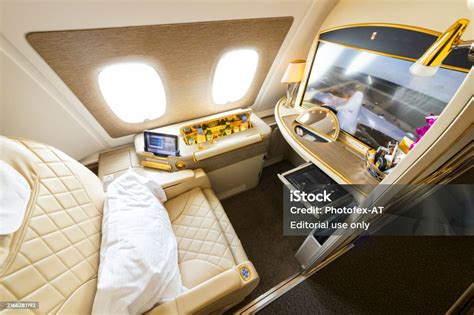
Yet even the most modern twinjets cannot replicate the unique spatial environment created by the A380’s upper deck.
Aircraft like the A350 and 787 maintain single passenger levels. While their cabins may be technologically advanced—with higher humidity, larger windows, and improved lighting—their interiors remain fundamentally constrained by the geometry of a single fuselage tube.
The A380 remains the only commercial airliner ever built with a full-length double passenger deck capable of carrying more than 500 people.
A Unique Chapter in Aviation Design
The A380’s upper deck represents the culmination of a particular era in aviation thinking—one that assumed passenger demand between major global hubs would continue to grow indefinitely.
Airbus believed airlines would increasingly rely on massive aircraft operating between mega-airports, transporting hundreds of travelers at once. In that world, maximizing passenger space within existing airport infrastructure made perfect sense.
While market trends ultimately shifted toward smaller, more flexible long-range aircraft, the A380 remains a remarkable achievement of engineering and architectural design.
Its upper deck is not simply a second level inside an airplane. It is a fully realized passenger environment, one that merges the scale of a building with the physics of flight.
For travelers fortunate enough to experience it, the sensation is unforgettable. Instead of climbing into a cramped loft above the main cabin, passengers step into something that feels like an entire aircraft hidden above another aircraft.
In the long arc of aviation history, that singular design may never be repeated.