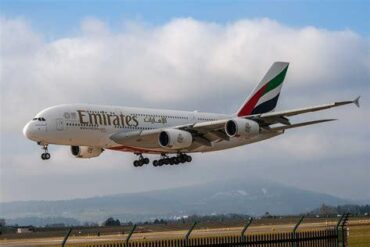
The Airbus A380 has always been more than an aircraft; it is a statement of intent. Nowhere is this more evident than in the way Emirates designed and deployed the upper deck of its A380 fleet. What might appear, at first glance, as an indulgent use of space is in fact a carefully engineered blend of aeronautical logic, brand strategy, and experiential marketing. By examining the aircraft’s physical constraints, the airline’s commercial ambitions, and Dubai’s broader economic narrative, we can understand why Emirates’ Airbus A380 upper deck layout is widely regarded as one of the most extraordinary cabin designs ever flown.
From the moment passengers enter the aircraft, the contrast between the lower and upper decks becomes apparent. The lower deck, while spacious and tastefully finished, remains recognizable as a commercial airliner interior. The upper deck, by contrast, feels like a deliberate departure from conventional airline thinking. This separation is not accidental. It reflects a philosophy that treats premium travel not as a marginal upgrade, but as a central pillar of the airline’s identity. The A380 gave Emirates the physical canvas to express that philosophy at scale, something no other aircraft before or since has allowed.
Unlike smaller widebody aircraft, the Airbus A380 offers an enormous volume of internal space, including areas that cannot be efficiently used for standard seating. Emirates’ decision to transform those areas into showers, lounges, and expansive premium cabins was not merely an aesthetic choice. It was a strategic move designed to make the aircraft itself a destination, ensuring that the journey would be discussed, photographed, and remembered long after landing.
The Architectural Logic Behind the Upper Deck Configuration
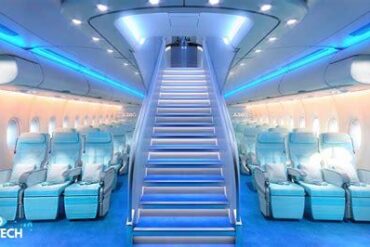
To understand the upper deck layout, we must first consider the structural realities of the Airbus A380. The upper deck is narrower than the lower deck, a constraint that limits seating density but enhances exclusivity. On most widebody aircraft, premium cabins compete for space with economy seating on a single level. On the A380, Emirates chose a different path by concentrating all first and business class seats upstairs, leaving the lower deck to maximize high-density economy seating.
This configuration allows the airline to extract the greatest possible revenue from both ends of the market. The lower deck accommodates up to ten seats per row in economy class, while the upper deck supports an eight-abreast layout more suitable for premium cabins. By physically separating these experiences, Emirates reinforces a psychological divide between mass transport and luxury travel, even though both coexist on the same aircraft.
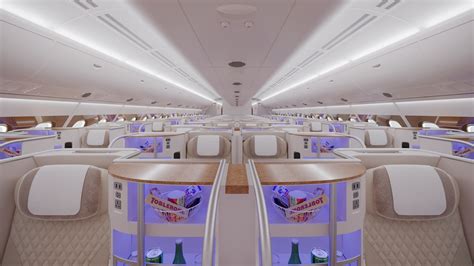
The upper deck’s design also benefits from reduced noise and smoother ride characteristics, as it sits farther from the engines and landing gear. These subtle advantages enhance the perception of refinement, making the upper deck feel calmer and more private. Emirates capitalized on these attributes by pairing them with lavish materials, warm lighting, and distinctive wood finishes that evoke the atmosphere of a private jet rather than a commercial airliner.
First Class as a Spatial Statement
At the forward section of the upper deck lies Emirates’ iconic first class cabin. With just fourteen suites, the airline delivers a visually striking environment defined by high walls, sliding privacy doors, and rich wood accents. While the individual suites are not the largest in the industry, their presentation is meticulously crafted to project exclusivity and opulence.
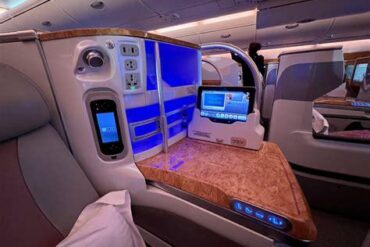
Each suite features a personal minibar, a vanity mirror, and an expansive entertainment screen, all arranged to create a sense of personal territory. The density of the layout is a calculated compromise. By fitting fourteen suites where some competitors might install fewer, Emirates achieves higher revenue per flight while maintaining the visual drama that defines the cabin. The result is a first class product that prioritizes theatrical impact as much as physical space.
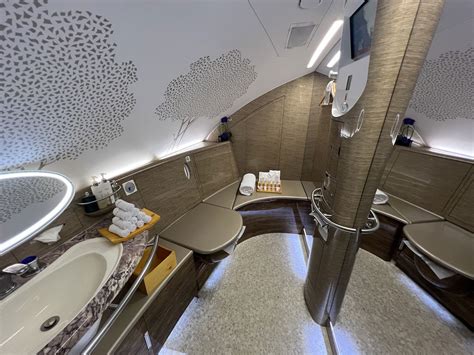
What truly elevates the first class experience, however, lies beyond the seating itself. Ahead of the cabin, in the aircraft’s forward crown area, Emirates installed two full-size shower suites. These facilities occupy space that cannot be used for seating due to structural limitations, transforming what would otherwise be wasted volume into one of the most talked-about amenities in aviation history.
The Business Class Cabin as a Social Space
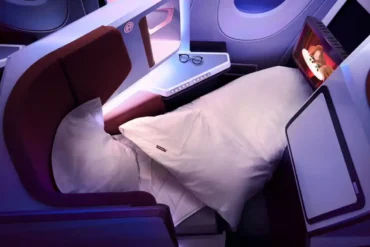
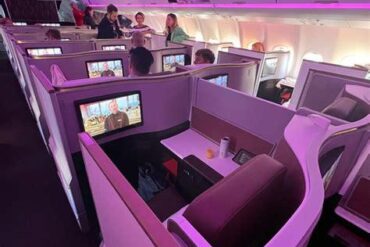
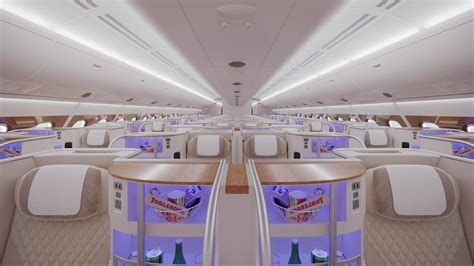
Behind first class, the upper deck transitions into a business class cabin that extends across the majority of the aircraft’s upper level. Configured in a 1-2-1 layout, the cabin offers direct aisle access for every passenger, aligning with modern expectations of premium travel. Yet, as with first class, the seats themselves are only part of the story.
The defining characteristic of Emirates’ A380 business class is its atmosphere. Wood-trimmed sidewalls, illuminated storage areas, and carefully designed lighting create a cohesive visual language that distinguishes the cabin from competitors. The environment feels curated rather than utilitarian, reinforcing the sense that passengers are entering a premium space designed for comfort and social interaction.
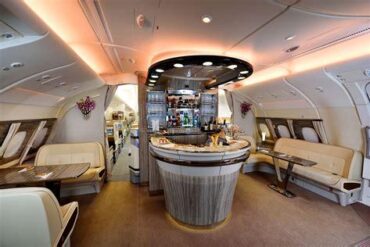
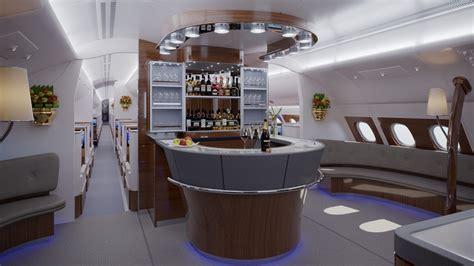
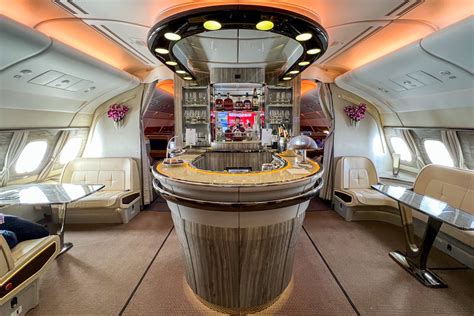
This philosophy reaches its peak at the rear of the upper deck, where Emirates installed its now-famous onboard bar. More than a novelty, the bar serves as a communal area where business and first class passengers can gather, converse, and relax. The presence of a dedicated bartender and lounge-style seating transforms the flight into a shared experience, encouraging passengers to associate Emirates with sociability and indulgence rather than isolation and routine.
Brand Differentiation Through Excess Space
The decision to allocate such a significant portion of the upper deck to non-revenue-generating amenities may seem counterintuitive in an industry obsessed with yield optimization. However, Emirates’ strategy hinges on the long-term value of brand differentiation rather than short-term seat economics.
The shower suites and onboard bar occupy areas that could otherwise accommodate additional business class seats. Yet the aircraft already carries seventy-six business class passengers, a figure that far exceeds most competitors. The marginal revenue lost by removing a handful of seats is outweighed by the global marketing impact of offering amenities no other airline can replicate at scale.
Every photograph of a passenger showering at 40,000 feet or sipping cocktails at an airborne bar functions as organic advertising. These images circulate endlessly on social media, travel blogs, and mainstream news outlets, reinforcing Emirates’ reputation as a luxury airline even among passengers who may never experience these features firsthand.
The Halo Effect on Emirates’ Global Reputation
The Airbus A380 plays a disproportionate role in shaping public perception of Emirates as an airline. Despite operating a large fleet of Boeing 777 aircraft with comparatively outdated business class layouts, the airline consistently ranks among the world’s most admired carriers. This paradox is largely explained by the halo effect generated by the A380’s upper deck experience.
Passengers often generalize their impressions of the A380 to the airline as a whole, assuming a level of quality and innovation that may not be uniformly present across the fleet. Emirates has leveraged this cognitive bias by placing the A380 at the center of its marketing efforts, ensuring that the aircraft remains synonymous with the brand.
This strategy has proven remarkably effective. Even as competitors introduce more advanced seats and cabin technologies, Emirates maintains its premium image through the emotional resonance of its A380 product. The upper deck, in particular, serves as a physical embodiment of the airline’s promise of glamour, scale, and ambition.
Dubai’s Influence on Cabin Philosophy
Emirates’ ownership by the government of Dubai provides additional context for the airline’s design decisions. As the primary global ambassador for the city, Emirates functions as an extension of Dubai’s brand. The airline’s emphasis on luxury, spectacle, and excess mirrors the city’s own development strategy, which prioritizes tourism, hospitality, and international business.
The A380 upper deck reflects this symbiotic relationship. By offering an onboard experience that feels uniquely extravagant, Emirates reinforces Dubai’s image as a destination of superlatives, where the largest, tallest, and most luxurious experiences are the norm. The aircraft becomes a flying introduction to the city’s ethos, shaping passengers’ expectations before they even arrive.
This alignment between airline and city amplifies the value of the upper deck layout. It is not merely a commercial asset, but a tool of soft power that enhances Dubai’s global standing and economic diversification.
Engineering Constraints as Creative Opportunities
One of the most compelling aspects of Emirates’ A380 upper deck is how it transforms engineering constraints into creative opportunities. The aircraft’s massive size includes structural areas that cannot be monetized through seating alone. Rather than accepting these limitations, Emirates reimagined them as spaces for experiential features that redefine what is possible onboard.
The forward crown area, unsuitable for passenger seats, becomes a shower spa. The rear upper deck, where overhead bins would feel intrusive, evolves into a lounge. These choices demonstrate a willingness to prioritize long-term brand equity over immediate operational efficiency, a philosophy rarely seen in commercial aviation.
The Challenge of Replacing the A380 Experience
As the Airbus A380 gradually approaches retirement, the question of how Emirates will replicate its upper deck experience looms large. The airline’s future fleet, centered around the Boeing 777-9, offers improvements in efficiency and range but lacks the sheer volume that made the A380’s amenities feasible.
While Emirates plans to introduce advanced first and business class products on its next-generation aircraft, the absence of space comparable to the A380’s upper deck crown will likely preclude features such as shower suites. Even a hypothetical stretched variant of the 777 would struggle to match the spatial generosity of the A380.
This reality underscores the uniqueness of the A380 era. The aircraft’s upper deck is not simply a design choice that can be replicated at will; it is the product of a specific convergence of technology, economics, and ambition that may never occur again.
A Flying Manifesto of Luxury Strategy
Ultimately, the reason Emirates’ Airbus A380 has such an extraordinary upper deck layout lies in the airline’s holistic approach to aviation. The upper deck is not an isolated feature, but a manifestation of a broader strategy that values storytelling, symbolism, and emotional impact as much as operational performance.
By dedicating the upper deck to premium travel and experiential amenities, Emirates transformed the A380 into a global icon. The aircraft became a stage on which the airline could perform its brand narrative, captivating audiences far beyond the cabin itself. In doing so, Emirates demonstrated that, under the right conditions, excess space can be the most powerful asset an airline possesses.
The A380’s upper deck stands as a reminder that aviation, at its best, is not merely about transportation. It is about imagination, aspiration, and the ability to turn engineering possibility into unforgettable experience.