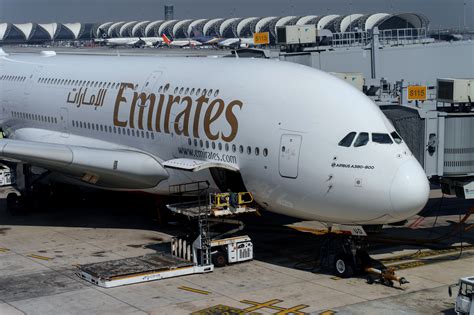
The Airbus A380 is less an aircraft and more a flying ecosystem — a double-decker leviathan engineered to bend long-haul travel into something approaching civilised. When Emirates, the world’s largest A380 operator, layers its business class product onto this already extraordinary machine, the result is not simply transportation but orchestration — a carefully staged journey where physics, design, and hospitality collaborate at 40,000 feet.
For travelers stepping aboard the upper deck, the experience begins long before wheels leave the runway. The A380’s sheer physical scale — nearly 80 meters of wingspan and a fuselage length rivaling two blue whales nose-to-tail — creates spatial opportunities no smaller aircraft can replicate. Emirates exploits that volume with architectural ambition, transforming what could have been dense seating into lounges, pods, and social spaces that feel improbably expansive for something airborne.
By the time the aircraft pushes back, passengers are already several steps removed from the conventional logic of commercial flying.
Upper Deck Exclusivity: Space As A Luxury Commodity
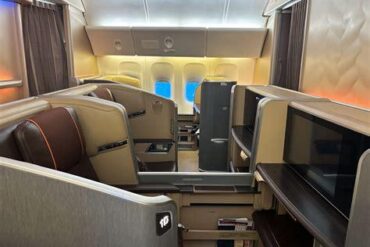
Business class on Emirates’ A380 resides entirely on the upper deck, a placement that does more than separate cabins — it reshapes the psychological texture of the flight. Fewer seats mean fewer bodies, fewer queues, and a measurable reduction in ambient noise. The physical distance from the aircraft’s four GP7200 or Rolls-Royce Trent 900 engines further softens the acoustic environment, producing a quieter cabin that feels insulated from the brute mechanics of flight.
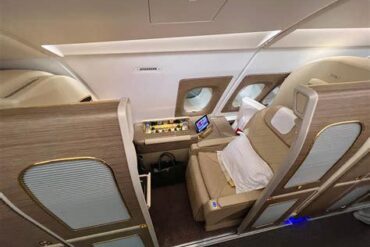
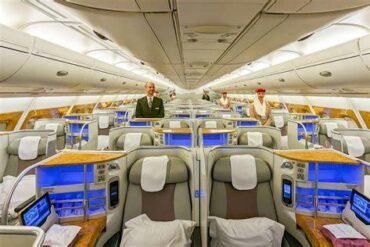
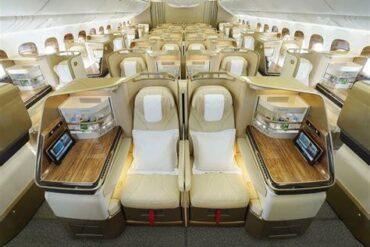
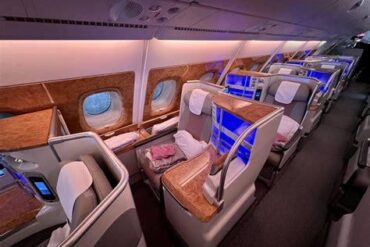
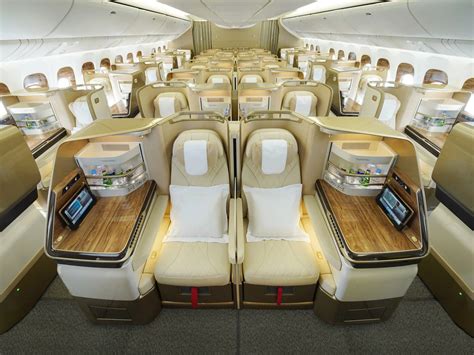
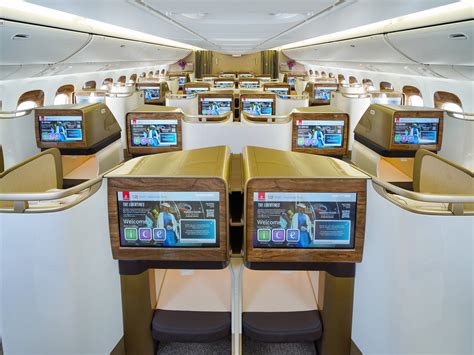
The seating configuration follows a 1-2-1 layout, ensuring direct aisle access for every passenger. This eliminates the awkward midnight gymnastics of climbing over sleeping strangers — a small logistical detail that becomes enormous on overnight sectors.
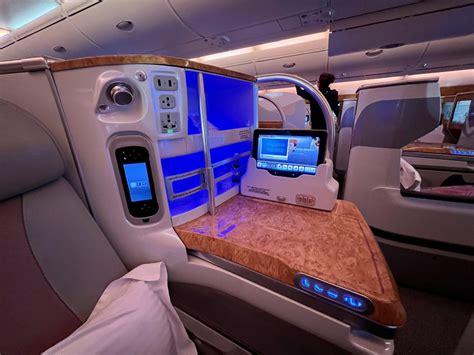
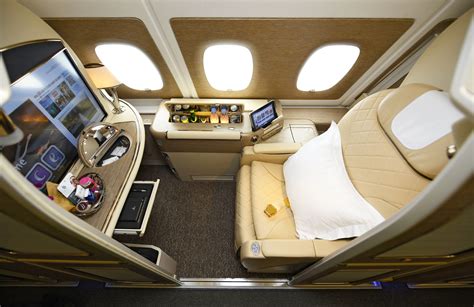
Each seat exists within a semi-private pod, framed by high shells and adjustable privacy dividers. Middle seats can transform into paired “honeymoon” spaces or sealed cocoons depending on passenger preference. Storage compartments are positioned within arm’s reach, meaning laptops, headphones, and travel documents remain accessible without overhead bin acrobatics.
Spatial design here is not decorative — it is functional psychology. When humans feel less crowded, stress hormones drop. Emirates quietly leverages neuroscience through square footage.
Lie-Flat Beds And The Science Of Sleeping At Altitude
Sleep on aircraft is usually a negotiation between discomfort and exhaustion. Emirates business class converts that negotiation into something closer to a treaty.
Seats recline into fully flat beds stretching roughly two meters, supported by mattress pads and plush bedding. The ergonomic design distributes body weight to reduce pressure points — critical when sleeping in low-humidity, reduced-pressure cabin environments that already tax the body.
Lighting systems simulate circadian rhythms through adjustable mood illumination. Combined with noise-canceling headphones and reduced cabin traffic, passengers can achieve REM cycles — genuine sleep rather than fragmented dozing.
On ultra-long routes like Sydney to Dubai, this physiological advantage matters. Arriving with cognitive function intact is not indulgence; it is operational efficiency for business travelers expected to perform on landing.
The Onboard Lounge: Social Gravity At 40,000 Feet
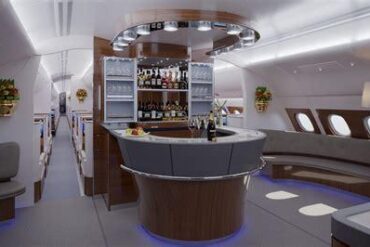
One of the A380’s architectural trump cards is space for communal areas, and Emirates deploys it with theatrical flair through its onboard lounge.
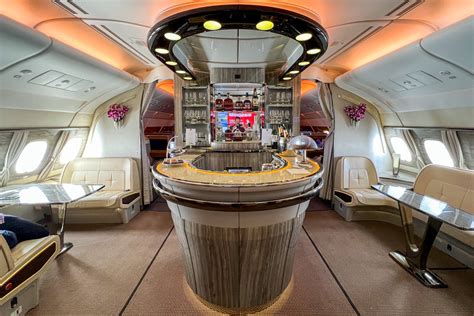
Positioned at the rear of the upper deck, the lounge functions as a hybrid bar, café, and networking salon. Leather seating wraps around cocktail tables while a curved bar serves champagne, spirits, and barista-style coffee.
Passengers drift in and out — some to stretch, others to socialize, others simply to experience the novelty of standing in a flying bar crossing continents at Mach 0.85.
From an experiential design standpoint, this space breaks the monotony of long-haul immobility. Movement improves circulation, reduces stiffness, and psychologically compresses perceived travel time.
Dining Above Restaurant Grade
Airline food carries an unfair reputation forged in economy cabins. Business class on Emirates’ A380 dismantles that stereotype through a dining model closer to on-demand fine dining than scheduled meal service.
Passengers can pre-select meals weeks before departure. Menus rotate regionally, featuring dishes such as seared beef tenderloin, Arabic mezze, or pan-Asian seafood plates. Presentation matters: table settings include linen, proper glassware, and multi-course sequencing.
The culinary logistics behind this are staggering. Thousands of meals must be prepared, chilled, loaded, reheated, and plated without degradation — all within aircraft galley constraints. Emirates mitigates this through advanced catering partnerships and precise reheating technologies that preserve moisture and texture.
Paired wines and premium spirits elevate the sensory experience, while dine-on-demand service allows passengers to eat according to body clocks rather than airline timetables.
Ground Experience: Luxury Before Boarding
The Emirates business class experience begins long before the jet bridge.
Chauffeur-drive service — available within roughly 70 miles of many airports — transports passengers between home, hotel, and terminal. This removes one of modern travel’s most friction-heavy variables: ground logistics.
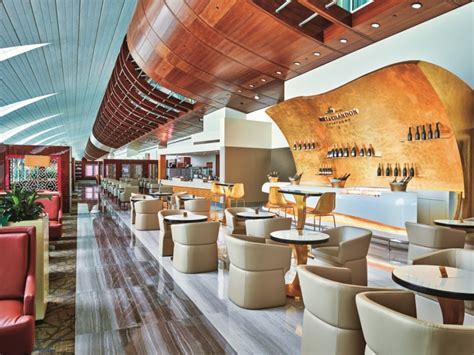
At the airport, dedicated check-in counters streamline formalities. Business lounges then extend the premium bubble with buffet dining, shower suites, workstations, and quiet zones.
In Dubai, Emirates’ flagship hub, the lounge can span entire terminal levels, allowing passengers to board directly from the lounge floor.
The journey becomes continuous rather than segmented — a seamless corridor from front door to aircraft seat.
Baggage, Flexibility, And The Economics Of Convenience
Ticket price differentials between economy and business class are substantial, but the fare structure bundles tangible benefits beyond seat comfort.
On routes such as London Gatwick to Dubai, business passengers receive baggage allowances up to 40 kilograms, roughly 10 kilograms more than many economy tiers. For corporate travelers carrying equipment or extended-stay wardrobes, this eliminates excess baggage fees that accumulate quickly.
Seat selection is complimentary, enabling passengers to secure preferred pods without added cost. Flexible fare tiers allow date changes or refunds, though fully flexible tickets command higher prices — sometimes nearing £2,962 on the Gatwick–Dubai sector.
These policies convert uncertainty into optionality — valuable in corporate scheduling ecosystems where meetings shift like tectonic plates.
Inflight Entertainment And Digital Ecosystems
Emirates’ ICE (Information, Communication, Entertainment) system is frequently ranked among aviation’s most comprehensive.
Seatback screens — large, high-definition displays — deliver thousands of channels spanning films, television, music, podcasts, and live news. Interface responsiveness matters; laggy systems erode immersion, but ICE operates with tablet-like fluidity.
Wi-Fi connectivity allows messaging and email, enabling passengers to remain digitally tethered while crossing hemispheres.
At-seat minibars — stocked with soft drinks and water — add another layer of personal convenience, reducing reliance on cabin crew call cycles.
Fleet Scale And Operational Expertise
Emirates operates over 100 Airbus A380s, dwarfing competitors. This scale produces operational advantages.
High fleet numbers enable consistent scheduling, frequent departures, and refined maintenance ecosystems. Routes between the UK and Dubai alone can operate more than 140 times weekly — volume that drives both pricing competitiveness and service standardization.
By contrast, airlines such as British Airways or Singapore Airlines operate far smaller A380 fleets, limiting scheduling density and sometimes driving higher fares on equivalent routes.
Comparing Emirates And British Airways Business Class
On paper, business class across major carriers shares baseline features: lie-flat beds, lounge access, premium dining. The differentiation emerges in execution.
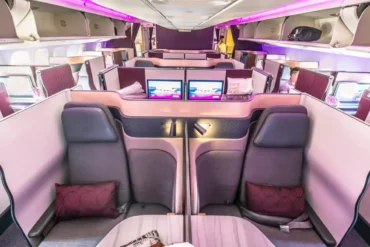
British Airways’ A380 business cabin uses a 2-4-2 layout in some configurations — denser than Emirates’ 1-2-1 arrangement. More seats mean less privacy and more aisle disruption.
BA does offer lounge access and amenity kits, plus baggage services in select markets. However, Emirates layers additional elements: onboard lounge access, chauffeur transfers, and a quieter all-upper-deck business cabin.
Price comparisons sharpen the contrast. As of early 2026, Heathrow–Dubai business fares on BA’s A380 could exceed £3,500, while Emirates offered comparable routes from roughly £1,920 — a gap driven partly by Emirates’ massive route frequency and hub economics.
Value, therefore, is not purely experiential but mathematical.
Refurbishment Programs And Aircraft Aging
No fleet escapes time’s entropy. Emirates introduced its earliest A380s in 2008, meaning some airframes show cosmetic aging.
Passenger reviews often distinguish between refurbished and non-refurbished cabins. Retrofitted aircraft feature refreshed upholstery, updated finishes, and enhanced premium economy sections.
The airline is mid-way through a large-scale modernization program, gradually harmonizing cabin standards across the fleet. Even older cabins, however, retain strong “soft product” elements — service, dining, lounge access — that sustain overall satisfaction.
Hardware ages; hospitality compensates.
Cost Versus Experience: The Psychological Equation
The leap from roughly £400 economy fares to £1,900+ business tickets provokes an inevitable question: is the experience worth five times the cost?
The answer depends on how one values time, comfort, and physiological resilience.
For leisure travelers, economy on Emirates is already well regarded — comfortable seating, solid entertainment, and attentive service. The marginal gain of business class may feel indulgent rather than essential.
For business travelers, however, the calculus shifts. Sleep quality, workspace comfort, lounge productivity, and schedule flexibility translate into performance outcomes on arrival.
In that sense, the premium buys not luxury but functional capability.
Limitations Of The A380 Platform
Even giants have constraints.
The A380’s four-engine architecture is less fuel-efficient than newer twin-engine aircraft like the Airbus A350 or Boeing 787. Environmental and operational cost pressures have led some airlines to retire the type early.
Airworthiness directives from regulators such as the European Union Aviation Safety Agency have increased maintenance scrutiny, though safety standards remain stringent.
Passengers rarely feel these macro-industrial dynamics onboard, but they shape the aircraft’s long-term viability.
Hub-And-Spoke Reality: The Dubai Connection
Emirates’ network revolves around Dubai. For many itineraries, this necessitates a connection rather than nonstop travel.
For some passengers, Dubai International Airport is a destination in itself — vast duty-free zones, luxury boutiques, and cavernous lounges. For others, connections introduce travel time and logistical complexity.
Business lounge access softens the inconvenience, but nonstop alternatives on other carriers may appeal to travelers prioritizing speed over spectacle.
The Pre-Takeoff Champagne Effect
Few experiences signal transition into premium travel more clearly than pre-departure champagne.
Settling into a private pod, sipping chilled bubbles while the cabin hums through boarding procedures — it reframes the psychological start of the journey. Stress dissipates. Travel becomes event rather than obligation.
Add chauffeur transfers, lounge dining, lie-flat sleep, and inflight social spaces, and the journey transforms into a layered hospitality experience stitched across ground and sky.
Do The Benefits Justify The Price?
Measured purely in square meters, service ratios, and amenity counts, Emirates’ A380 business class delivers substantial value relative to many competitors — especially given pricing advantages on certain routes.
Yet the deeper benefit is experiential coherence. Every stage — car pickup, lounge entry, boarding, seating, dining, sleeping — is designed as a continuous narrative of comfort.
For travelers who view the journey as integral rather than incidental, the investment often feels rational.
Economy gets you there. Business class changes how “there” begins.
And aboard the world’s largest commercial aircraft — a machine already engineered to defy ordinary scale — that difference becomes magnified, suspended somewhere between aerospace engineering and airborne civilization.