For senior airline pilots, the difference between earning $470,000 and approaching $700,000 in a strong year is rarely explained by the published hourly rate alone. At the major US airlines, widebody captains already occupy one of the highest-paid positions in commercial aviation, with top contractual rates reaching roughly the mid-$400s per flight hour. Yet the headline rate is only the starting point. The much larger question is how a captain uses seniority, bidding rights, aircraft assignments, premium flying, credited hours, and company compensation programs to turn that rate into a much larger annual figure.
A captain sitting at the top of a widebody pay scale can therefore have an exceptional base salary without necessarily producing exceptional total compensation. Another captain with comparable seniority can make dramatically different decisions every month and create a substantially larger annual result. The distinction is not simply about working harder. It is about understanding the economics of the bid sheet and recognizing which schedules produce the greatest financial return under the applicable contract.
Base Salary Is Only the Starting Point
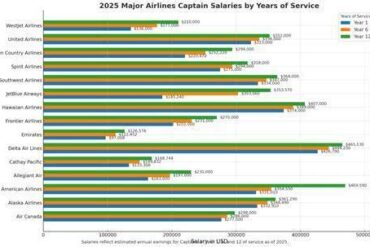
At major carriers such as Delta Air Lines, United Airlines, and American Airlines, the highest-paid widebody captains can command hourly rates of approximately $465 to $483, depending on aircraft, contract year, and other applicable pay provisions. Those rates are extraordinary compared with the broader airline pilot market, but multiplying an hourly rate by a simple annual number of hours does not fully describe how airline pilot compensation works.
Monthly contractual guarantees commonly provide approximately 75 credited hours, establishing a substantial guaranteed earnings floor. At the upper end of the widebody captain scale, that can translate into a base salary in the neighborhood of $420,000 to $470,000 per year before additional compensation is considered. The US Bureau of Labor Statistics’ reported median airline pilot wage, around $226,600 in the reference material, provides useful context for just how far above the broader profession these senior positions sit.

The crucial point is that a pilot earning near the published base salary is not necessarily maximizing total compensation. Base pay represents the foundation, not the ceiling. Additional credited flying, premium assignments, international per diem, holiday pay, profit sharing, and employer retirement contributions can all increase the final value of a captain’s compensation package.
That is why a tax statement can look dramatically different from a pay-rate table. Two captains can have nearly identical hourly rates while producing very different annual totals because their schedules generate different amounts of credit and additional compensation.
Aircraft and Route Bidding Can Change the Economics
The first major decision often occurs before a captain ever looks at an individual trip. It begins with aircraft and base bidding.
Seniority can allow experienced pilots to move into desirable widebody fleets and international operations. Those positions can provide access to longer sectors, larger amounts of trip credit, international per diem, premium opportunities, and scheduling patterns that would be unavailable elsewhere on the seniority list.
A long-haul flight to Europe, Asia, South America, or the Pacific is therefore not simply a question of where the pilot wants to travel. From a compensation perspective, we have to examine the entire pairing. How many credited hours does it produce? How many days does it keep the pilot away from base? Does it qualify for international per diem? Does the pairing contain premium provisions? Could it interact favorably with the pilot’s remaining monthly schedule?
Those questions can make a significant difference over twelve months.
International per diem is a relatively small component when viewed on an individual flight, but repeated international assignments can make the amount meaningful. In the reference material, Delta’s domestic per diem is approximately $2.85 per hour, compared with roughly $3.30 internationally. United’s international rate is cited at approximately $3.45 per hour. The difference is not enough by itself to transform a $470,000 salary into $700,000, but it illustrates how multiple smaller advantages can accumulate around a carefully constructed schedule.

The strongest bidding strategy therefore looks beyond the destination printed on the schedule. A financially sophisticated captain evaluates the total value of the pairing, including credit, premium provisions, time away from home, per diem, and opportunities created elsewhere in the month.
Credited Hours Create the Biggest Lever
Among all the variables available to a senior captain, monthly credited hours can be one of the most powerful.
Airline pilots are not simply compensated according to the amount of time the aircraft spends in the air. Collective bargaining agreements use contractual credit systems that can include guarantees, duty-related credit, minimum pay provisions, premium pay, and other mechanisms. Consequently, the most financially valuable schedule is not necessarily the one containing the most block hours.
Consider two captains at the same hourly rate. One builds a schedule that remains close to the monthly guarantee of approximately 75 credited hours. The other consistently finds legal opportunities to produce 90 or 100 credited hours. At a rate approaching $470 per hour, those additional hours become substantial.
An extra 15 credited hours in a month represents roughly $7,050 at a $470 hourly rate. Sustained over twelve months, that theoretical difference reaches more than $84,000 before considering other compensation effects. Twenty-five additional credited hours in a month would represent approximately $11,750 at the same rate, or roughly $141,000 across a full year if the additional credit could consistently be generated.
The actual outcome depends on the airline’s contract, scheduling rules, taxes, premium provisions, and whether those hours are genuinely available. We should therefore treat these figures as illustrations rather than guaranteed earning formulas. The underlying principle, however, remains powerful: small monthly credit differences can become enormous annual differences at senior captain pay rates.
Experienced pilots also learn to distinguish between schedules that look busy and schedules that are financially efficient. A pairing that keeps a captain away from home for several days may not be attractive if its credit is weak. Another trip could generate considerably more credit for a similar amount of duty time.
That is where seniority becomes more than simply a number on a list. It becomes a tool for selecting among competing economic opportunities.
Open Time Can Turn a Good Month Into a Great One
The awarded monthly schedule is not necessarily the final schedule.
Airlines constantly experience changes caused by sick calls, vacations, training, aircraft substitutions, schedule disruptions, and operational requirements. As a result, open-time flying can appear throughout the month. Some of those trips may carry premium compensation, making them particularly attractive to pilots who have the flexibility to accept additional work.
This is where an experienced captain can revisit the schedule after the initial bid has been awarded. Rather than simply accepting the original roster, the pilot monitors available flying and determines whether a particular opportunity produces enough additional compensation to justify taking it.
Holiday periods can be especially valuable. Airlines have to operate through Thanksgiving, Christmas, New Year, and other high-demand periods, even when staffing becomes more difficult. Depending on the applicable collective bargaining agreement, certain assignments may receive enhanced compensation.
The important distinction is that premium flying is not free money. It consumes time, energy, and personal flexibility. A captain who continuously accepts every available trip may increase gross compensation while simultaneously destroying the quality of life that made seniority valuable in the first place.
The most effective strategy is therefore selective. The goal is not maximum flying at any cost; it is maximum economic value from the flying a pilot is willing to perform.
International Pairings Can Stack Multiple Benefits
Long-haul international flying can become particularly attractive because several compensation mechanisms can overlap.
A single multi-day international sequence may generate substantial trip credit while also producing international per diem. If the trip qualifies for premium compensation, the financial effect becomes greater. If it fills an otherwise low-credit portion of the monthly schedule, the opportunity cost can become even more favorable.
This is why senior captains often evaluate pairings as components of an annual strategy rather than isolated trips. A pairing might not be the absolute highest-paying trip available, but it could fit perfectly into the remaining days of a bid month and push total credited hours into a more lucrative range.
The calculation is ultimately about yield per unit of personal time. A pilot may be willing to spend an additional day away from home if that day produces a substantial increase in compensation. Another captain may value that day at home more highly and decline the opportunity.
Neither decision is objectively wrong. The financial difference emerges because each pilot has assigned a different value to time away from work.
Profit Sharing Magnifies Successful Bidding
Some of the most important compensation effects arrive long after the original bid has been submitted.
Profit sharing is a particularly important example. Delta’s program, for instance, has produced significant payouts in profitable years. The reference material cites a 10.4% profit-sharing distribution for 2024, while previous strong years reached as high as 16.6%.
The important detail is that profit sharing can be linked to eligible earnings. That means a captain who increases eligible compensation through additional credit and premium flying may also increase the amount on which profit sharing is calculated.
In other words, the additional flying can have a multiplier effect.
A captain does not necessarily earn an extra dollar only once. Higher eligible earnings can influence several layers of compensation, potentially including profit sharing and retirement contributions. This is one reason total compensation can move substantially above the published salary scale during particularly strong years.
Retirement Contributions Quietly Add Tens of Thousands
Retirement contributions are another major reason headline salary can underestimate the economic value of a senior airline pilot position.
The reference material cites direct company retirement contributions of approximately 16% to 18% of eligible earnings. At high income levels, that percentage represents a considerable amount of money.
If eligible earnings rise because a captain generates additional credit or premium pay, employer retirement contributions may rise alongside them, depending on the applicable plan and compensation rules. The result is another feedback mechanism: better schedule decisions can increase direct earnings while simultaneously increasing the value of employer-funded retirement benefits.
This compensation is easy to overlook because it does not necessarily appear as spendable cash in the monthly paycheck. Yet from a total-compensation perspective, it is real economic value. Over a career lasting decades, these contributions can become one of the most consequential benefits attached to seniority.
Why Two Senior Captains Can Earn Completely Different Amounts
Seniority gives pilots access to opportunities, but seniority does not automatically maximize earnings.
One senior widebody captain may bid for a predictable schedule, protect weekends, minimize international trips, and remain close to the monthly guarantee. That pilot could still earn around $470,000 and enjoy an excellent work-life balance.
Another captain with similar seniority may intentionally choose high-credit international pairings, accept premium open time, target holiday opportunities, and build schedules that repeatedly generate additional credited hours. If the airline also experiences a strong profit-sharing year and the captain receives substantial retirement contributions, total compensation can approach or exceed $700,000.
The gap is therefore created by a chain of decisions rather than one extraordinary paycheck.
The highest-earning captains understand that every bid has an opportunity cost. Choosing one trip means potentially giving up another. Taking a weekend off can mean declining premium flying. Choosing a lower-credit international sequence can affect the number of additional hours available later in the month. The skill lies in understanding these tradeoffs well enough to make decisions consistently.
The $700,000 Captain Is Usually Playing a Longer Game
The most important lesson is that a $700,000 year does not necessarily come from a $700,000 salary.
It can emerge from a $450,000-plus base, additional credited hours, premium assignments, international per diem, holiday flying, profit sharing, and retirement contributions layered together. The final figure represents the cumulative result of dozens of scheduling decisions made throughout the year.
That is why the difference between a roughly $470,000 widebody captain and one approaching $700,000 can look mysterious from outside the cockpit. Both may fly the same aircraft type. Both may hold the same title. Both may have similar seniority. Yet their annual compensation can diverge sharply because they use their bidding power differently.
Ultimately, the highest-paid captain is not simply the pilot with the highest hourly rate. It is often the pilot who understands how to turn seniority into the most valuable combination of aircraft, routes, credit, premium opportunities, and long-term compensation. The pay scale establishes the ceiling of the opportunity, but the bid sheet determines how much of that opportunity a captain actually captures.