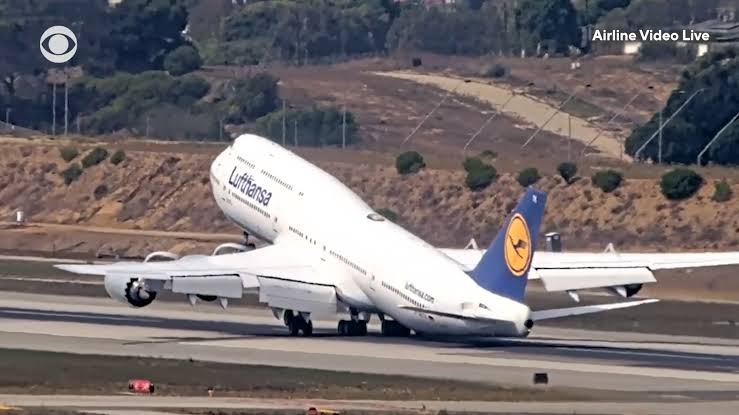
On Saturday, October 10, a Lufthansa Boeing 747-8 operating flight LH456 from Frankfurt Airport (FRA) to Los Angeles International Airport (LAX) came within inches of a catastrophic tail strike during its initial touchdown attempt, forcing the crew to abort the landing and execute a dramatic go-around over Southern California. The alarming sequence, captured live by an airport planespotting livestream, sent the massive widebody quadjet back into the skies for a tense fifteen-minute holding pattern before it finally touched down safely on its second attempt at 1:33 PM local time.
The incident unfolded after the aircraft, bearing registration D-ABYK, had departed Frankfurt slightly behind schedule at 11:18 AM rather than its planned 10:40 AM slot. Despite the late departure, the eleven-and-a-half-hour transatlantic crossing appeared to be heading toward a punctual arrival, with the jet initially touching down at 1:18 PM. However, as the 747-8 approached runway 24R, the aircraft pitched sharply upwards, bringing its aft fuselage perilously close to the runway surface. Planespotters watching the livestream witnessed the tail come within what appeared to be mere inches of striking the tarmac, a scenario that would have caused substantial structural damage and potentially triggered a lengthy removal from service for inspection and repair.
A Lufthansa spokesperson addressed the incident with a measured statement emphasizing the routine nature of the maneuver: “LH456 performed a go-around on October 10 while approaching Los Angeles and landed normally and safely on its second attempt. This is a standard procedure that has been well-rehearsed. Safety is always a top priority at Lufthansa.” The go-around procedure, while uncommon during routine commercial operations, represents a fundamental safety protocol that flight crews rehearse extensively throughout their training. Pilots are trained to recognize unstable approaches and execute immediate go-arounds when landing parameters fall outside acceptable tolerances, a decision that in this instance likely prevented significant damage to the aircraft and possible injury to passengers.
Return Flight Delayed but Transatlantic Crossing Makes Up Time
Following the successful second landing, D-ABYK did not sustain any damage that would have necessitated removal from service. The aircraft, which is 13.22 years old and first flew in July 2013 before being delivered to Lufthansa a month later, features a configured capacity of 244 economy seats, 32 premium economy seats, 80 business class seats, and eight first class seats. Despite escaping unscathed, the operational ripple effects were immediately apparent. The return leg, LH457 back to Frankfurt, departed almost an hour behind schedule at 4:00 PM local time instead of its planned 3:05 PM slot.
However, the experienced flight crew managed to overcome the delay through a swift transatlantic crossing, ultimately touching back down in Frankfurt at 10:50 AM on Sunday, October 11, ahead of its scheduled 11:00 AM arrival. The aircraft did not operate any further flights on Sunday, with its next planned departure being LH402 to Newark Liberty International Airport (EWR) on Monday, October 12 at 1:20 PM. This scheduled respite allowed ground crews ample opportunity to conduct thorough post-flight inspections, ensuring the aircraft remained fully airworthy before returning to commercial service.
A Troubling Pattern of Rough Landings at LAX
This event marks the second time in less than two years that a Lufthansa Boeing 747-8 has experienced a harrowing landing at Los Angeles. Back in April 2024, aircraft D-ABYP was involved in a strikingly similar incident, touching down extremely hard while being flown by a training pilot. The impact bottomed out the landing gear and caused the aircraft to bounce, kicking up a massive plume of tire smoke that prompted the YouTuber streaming the arrival to describe it as “the roughest landing we have ever caught on our broadcast.” On that occasion, Lufthansa confirmed that “an assessment by the cockpit crew” was required before the jet could return to Frankfurt, underscoring the seriousness with which the airline treats such events.
The recurrence of rough landing incidents involving Lufthansa’s 747-8 fleet at LAX raises questions about the specific challenges posed by the airport’s approach procedures and environmental conditions. Los Angeles International Airport is known for its complex airspace, variable coastal winds, and congested traffic patterns, all of which can create demanding conditions for even the most experienced pilots. The 747-8, while a marvel of modern aviation engineering, presents unique handling characteristics due to its considerable length and four-engine configuration, factors that demand precise energy management during the landing phase. The go-around executed on October 10 stands as a testament to the flight crew’s vigilance and adherence to safety protocols, transforming what could have been a damaging tail strike into a textbook demonstration of operational discipline.