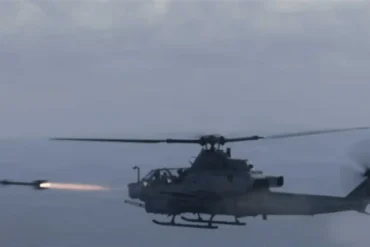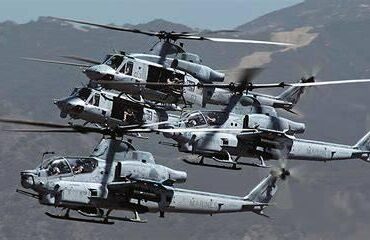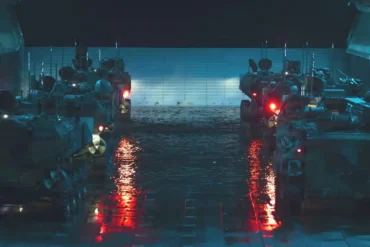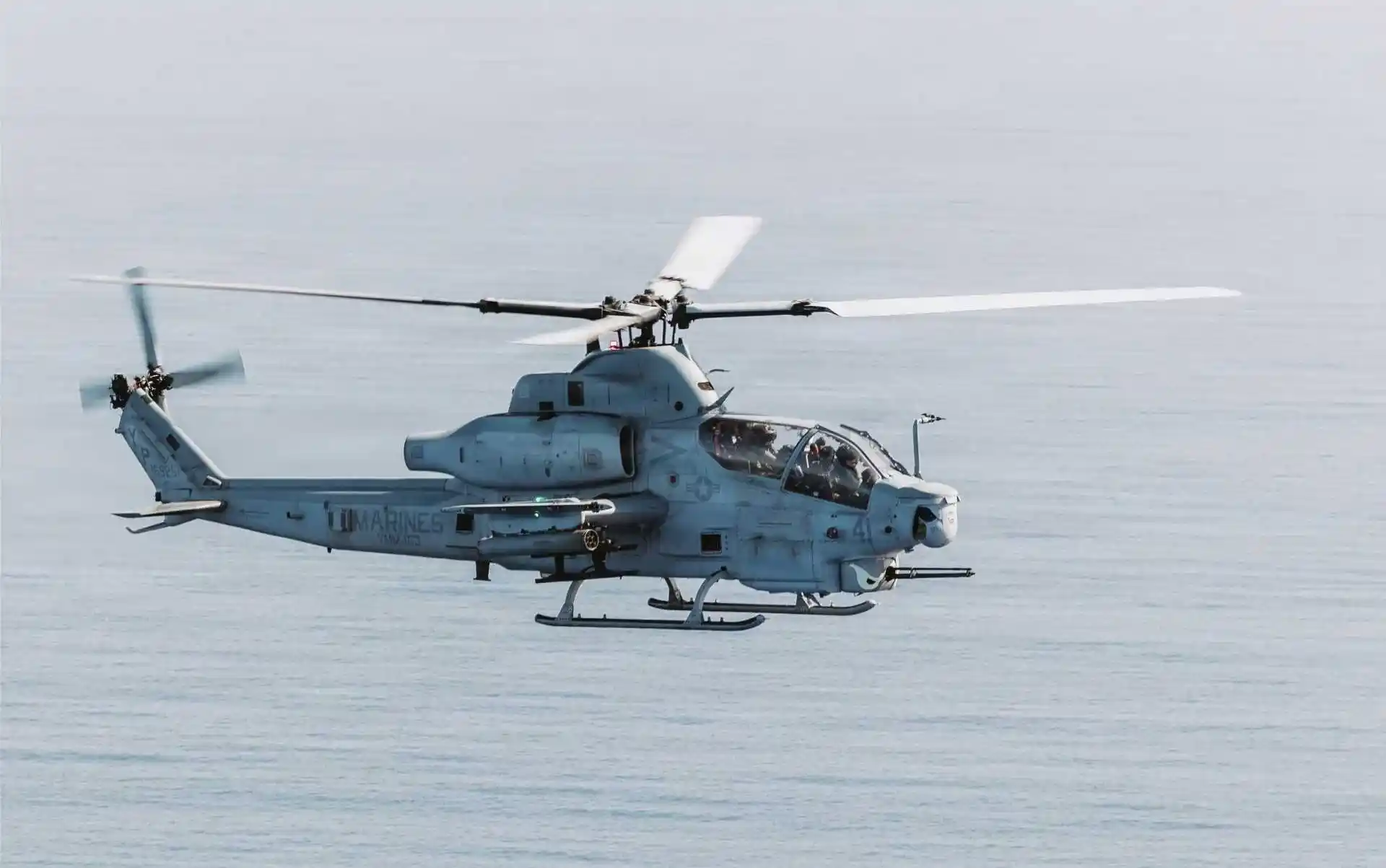
The U.S. Marine Corps has carried out high-intensity live-fire flight operations with AH-1Z Viper attack helicopters over the Pacific Ocean, reinforcing expeditionary aviation readiness in one of the world’s most strategically sensitive regions. Conducted by Marine Medium Tiltrotor Squadron 163 (Reinforced), the aviation combat element of the 11th Marine Expeditionary Unit, the operation unfolded while embarked aboard the Boxer Amphibious Ready Group, demonstrating seamless integration between Marine aviation and U.S. Navy amphibious forces.
These live-fire evolutions took place within the U.S. 3rd Fleet area of operations and reflect a deliberate focus on sustaining combat proficiency in maritime environments. The Pacific theater demands that Marine aviation units operate without reliance on fixed land bases, often launching from confined ship decks amid shifting sea states. Training under these conditions ensures aircrews can deliver precision firepower and close air support whenever and wherever required.
The 11th Marine Expeditionary Unit represents one of the Marine Corps’ most versatile forward-deployed formations. Its aviation component blends MV-22B Osprey tiltrotor aircraft with AH-1Z Viper attack helicopters, a combination designed for speed, reach, and lethality. During the live-fire flights, Vipers executed profiles that mirrored real-world combat scenarios, sharpening skills in target acquisition, weapons employment, and coordination with maritime command elements.
Operating from the Boxer Amphibious Ready Group allows the MEU to project combat power deep into contested spaces. Amphibious assault ships serve as mobile sea bases, enabling sustained aviation operations even when access to regional airfields is denied. This operational flexibility is central to U.S. force posture in the Indo-Pacific, where rapid response and persistent presence form the backbone of deterrence strategy.
Live-Fire Training Strengthens Expeditionary Combat Readiness
Live-fire flight operations remain a cornerstone of Marine Corps aviation training. Unlike simulator or dry-fire exercises, firing live munitions from airborne platforms imposes real constraints and consequences, demanding disciplined execution and precise coordination. For AH-1Z crews, these drills validate not only individual pilot and gunner proficiency but also the broader command-and-control architecture linking aircraft, ships, and ground elements.
During the Pacific operations, Viper crews practiced delivering accurate fires while operating at sea, adapting to deck motion, limited launch windows, and rapidly evolving mission tasking. Such realism ensures that expeditionary units remain combat-ready across the full spectrum of conflict, from high-end warfare to crisis response missions.
AH-1Z Viper A Cornerstone of Marine Aviation Modernization
The AH-1Z Viper stands as the most advanced attack helicopter in the Marine Corps inventory. Designed specifically for expeditionary warfare, it features a four-bladed composite rotor system, uprated transmission, and extended range compared to legacy platforms. These improvements translate into greater endurance and survivability during overwater and littoral operations.
Its digital cockpit integrates advanced avionics with helmet-mounted displays, allowing aircrews to fuse sensor data, navigation cues, and targeting information in real time. This capability is essential when operating in complex maritime environments where threats can emerge with little warning.
Armed with a formidable mix of weapons, the Viper delivers versatile firepower. The 20mm M197 three-barrel cannon provides responsive close-in support, while AGM-114 Hellfire missiles and Advanced Precision Kill Weapon System rockets enable precision strikes against armored and surface targets. The platform’s ability to employ AIM-9 Sidewinder missiles further enhances self-defense and aerial engagement options.
Naval Integration Enables Power Projection at Sea
The close integration between Marine aviation units and Navy amphibious forces was a defining feature of the exercise. Operating from amphibious assault ships demands constant coordination, from deck handling and launch sequencing to airspace management and recovery procedures. These routines are essential to sustaining high-tempo operations during extended deployments.
Training alongside the Boxer Amphibious Ready Group validated the MEU’s ability to generate combat sorties directly from the sea. This model supports U.S. strategy in the Indo-Pacific, where forward-deployed naval forces provide immediate options to commanders while reassuring allies through visible presence.
Strategic Signal in the Indo-Pacific Theater
Beyond tactical proficiency, the live-fire operations carried strategic weight. The visible employment of advanced attack helicopters at sea sends a clear message of readiness and resolve. In a region marked by growing competition and contested maritime spaces, the ability to deploy credible combat power without reliance on shore infrastructure enhances deterrence and stability.
As the Boxer Amphibious Ready Group continues its deployment, exercises like these highlight how modern platforms and integrated training sustain the Marine Corps’ role as a rapidly deployable, crisis-responsive force. The AH-1Z Viper, operating from the open ocean, remains a decisive instrument of American expeditionary power.