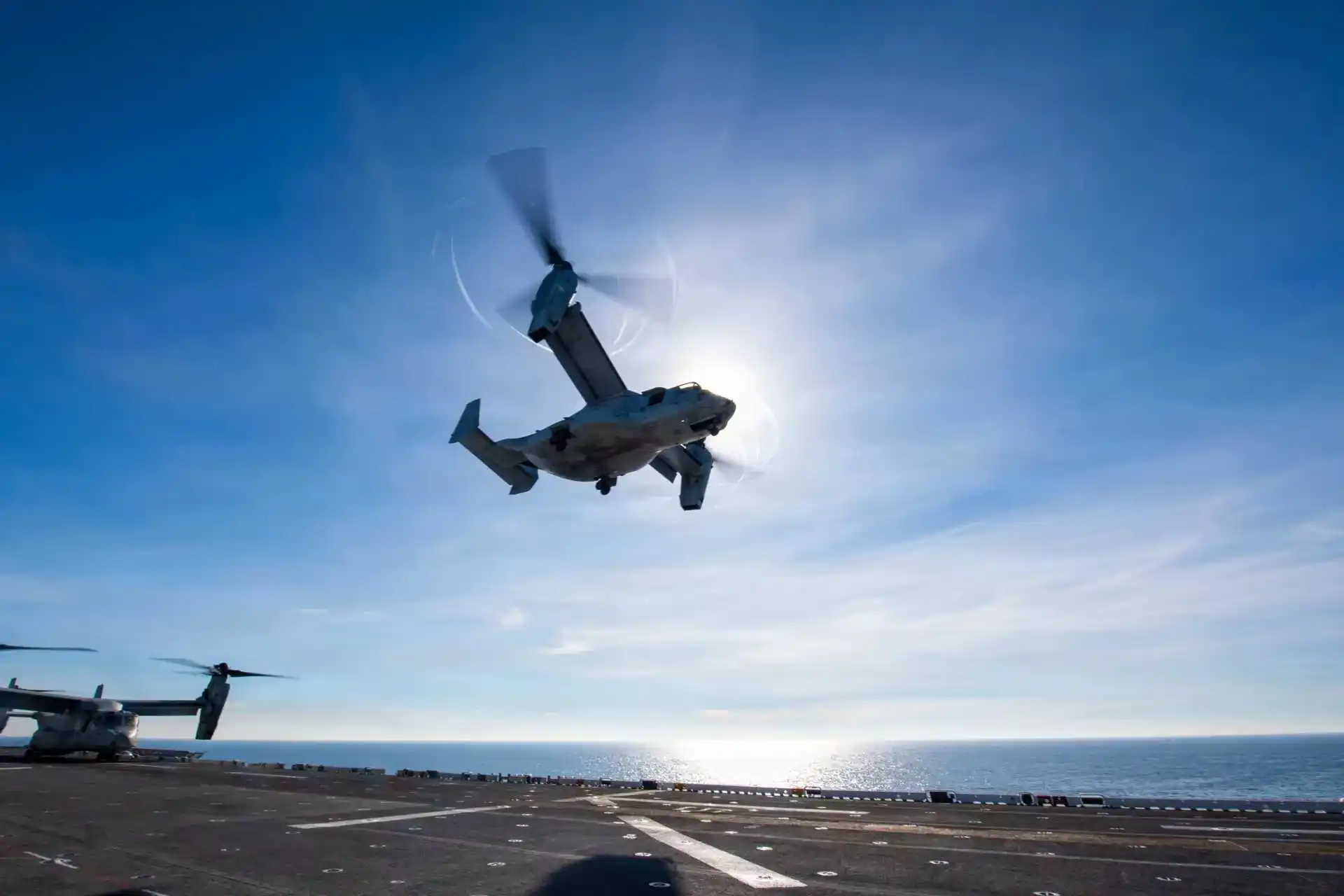
The U.S. Marine Corps has reinforced its long-range assault and crisis-response posture in the Indo-Pacific through sustained MV-22B Osprey flight operations from the amphibious assault ship USS Boxer. Conducted by Marine Medium Tiltrotor Squadron VMM-163 as part of the 11th Marine Expeditionary Unit (MEU), these at-sea operations sharpen the Amphibious Ready Group–Marine Expeditionary Unit (ARG-MEU) team’s ability to project combat power across vast maritime distances where speed, range, and unpredictability define strategic advantage.
Operating within the Boxer Amphibious Ready Group, the Osprey’s deployment signals more than routine flight deck activity. It reflects a deliberate focus on distributed maneuver, over-the-horizon insertion, and sea-based power projection in a theater where geography itself is both obstacle and opportunity. The Indo-Pacific’s immense ocean spaces and dispersed island chains demand aviation platforms capable of bridging hundreds of nautical miles without reliance on fixed infrastructure. The MV-22B is built precisely for that operational equation.
Sustained sortie generation from USS Boxer validates the full spectrum of expeditionary aviation at sea—maintenance cycles, aircraft spotting plans, refueling throughput, command-and-control integration, and aviation-ground coordination. Such repetition under operational conditions transforms capability from theory into readiness. In a contested environment defined by long-range missile threats and persistent surveillance, survivability depends on mobility. The ARG-MEU team is designed to maneuver at sea, reposition rapidly, and strike with concentrated force at a time and place of its choosing.
MV-22B Osprey: Extending the Marine Corps’ Operational Horizon
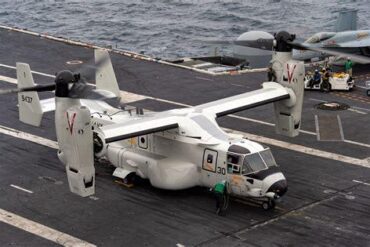
The MV-22B Osprey remains central to the Marine Corps’ expeditionary doctrine because it collapses distance in ways conventional helicopters cannot. Combining vertical lift with turboprop speed, the tiltrotor cruises at approximately 280 knots (518 km/h) and operates with a combat radius exceeding 450 nautical miles (833 km) without aerial refueling. It carries up to 24 combat-equipped Marines and can lift external loads approaching 20,000 pounds (9,072 kg).
This blend of speed and payload transforms how amphibious forces operate. Legacy medium-lift helicopters, though versatile, are limited by slower cruise speeds and shorter ranges. The Osprey’s performance enables Marines to launch from ships positioned well over the horizon—beyond immediate coastal detection—and insert forces deep inland or across dispersed island chains. In the Indo-Pacific, where operational distances are measured in hundreds of miles rather than dozens, that additional reach reduces exposure to shore-based missile systems and minimizes dependence on vulnerable forward airfields.
The tiltrotor’s design, with rotating nacelles that shift from vertical to forward flight, allows it to function both as helicopter and turboprop aircraft. This hybrid capability is not a novelty; it is a strategic multiplier. Forces can deploy vertically onto austere terrain and then reposition at fixed-wing speeds, compressing response timelines and complicating adversary targeting cycles.
USS Boxer and the ARG-MEU: A Sea-Based Assault Architecture
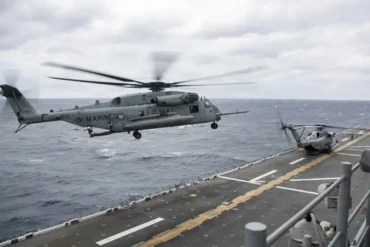
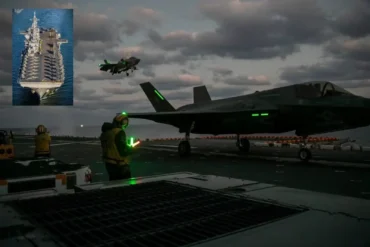
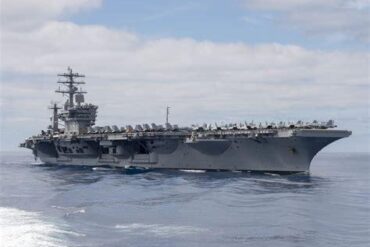
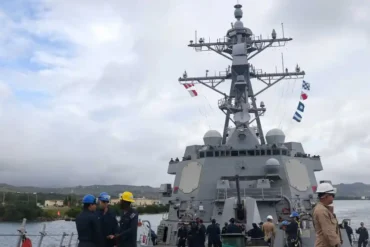
USS Boxer, a Wasp-class amphibious assault ship displacing roughly 40,500 tons, serves as a floating aviation base and command hub. Within the ARG-MEU formation, Boxer embarks a tailored mix of aviation assets, including MV-22B tiltrotors, CH-53E heavy-lift helicopters, AH-1Z attack helicopters, UH-1Y utility helicopters, and F-35B short takeoff and vertical landing fighters. This aviation combat element integrates with ground, logistics, and command components to form a self-contained, rapidly deployable force.
Sustained Osprey operations from Boxer validate deck cycle efficiency and amphibious sequencing essential for high-tempo missions. Aircraft must be launched, recovered, refueled, and repositioned with precision. The choreography on the flight deck—where rotor wash, jet exhaust, and tight spatial margins coexist—directly influences sortie rates and combat tempo. Efficiency here determines how quickly Marines can be inserted, reinforced, or extracted.
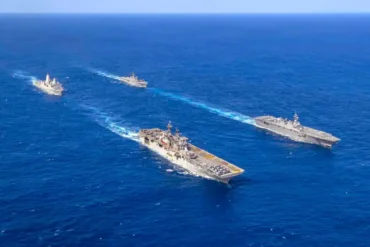
The ARG-MEU construct provides strategic flexibility. Amphibious transport docks and dock landing ships accompanying Boxer expand lift capacity and sustainment depth. Together, the group can conduct humanitarian assistance, evacuation operations, limited strikes, or full amphibious assaults. In an era of gray-zone competition and rapid crisis escalation, this scalable posture offers policymakers credible response options short of large-scale force deployment.
Expeditionary Advanced Base Operations and Distributed Maneuver
The deployment directly supports the Marine Corps’ Expeditionary Advanced Base Operations (EABO) concept. EABO envisions small, mobile units establishing temporary forward positions on key maritime terrain, contributing to sea control and denial while remaining difficult to target. The emphasis is on dispersion, rapid relocation, and integration with naval and joint fires.
The MV-22B is instrumental to that concept. Its speed advantage allows Marines to insert onto remote islands, establish sensor nodes or anti-ship capabilities, and reposition before adversary surveillance cycles converge. Casualty evacuation, aerial resupply, and reinforcement occur at a tempo that strains opposing anti-access and area-denial strategies.
In a Western Pacific contingency—where chokepoints, straits, and island arcs dominate operational planning—the ability to maneuver across hundreds of nautical miles without fixed bases becomes decisive. Sea-based aviation reduces predictability. Ships move. Flight paths vary. Launch points shift. That mobility complicates enemy targeting models built around static assumptions.
Strategic Signaling in a Contested Maritime Theater
The timing of the operations underscores broader regional dynamics. As competitors expand long-range missile inventories and maritime surveillance networks, forward-deployed forces must operate with heightened survivability. The ARG-MEU’s presence in the Indo-Pacific demonstrates that U.S. naval expeditionary forces can remain forward without relying on established airfields or permanent infrastructure.
Strategic deterrence rests not only on firepower but on credible maneuver. A sea-based force that can concentrate combat power rapidly—then disperse before counterstrikes materialize—presents a resilient posture. The Osprey’s sustained flight operations from USS Boxer highlight that mobility advantage.
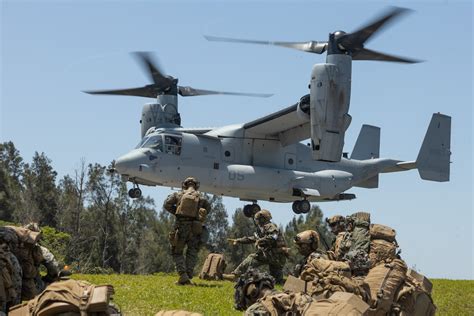
Operational readiness also hinges on repetition under realistic conditions. Training at sea tests maintenance endurance, sortie sustainability, and coordination between aviation and ground units. Each cycle refines procedural discipline and identifies friction points before real-world contingencies demand flawless execution.
Tiltrotor Aviation and Force Modernization
Despite past scrutiny over sustainment and safety challenges, the MV-22B continues to anchor Marine Corps medium-lift capability. Its performance envelope remains unmatched in its category. No conventional helicopter combines comparable cruise speed, combat radius, and heavy external lift. As force design evolves toward lighter, more distributed formations, aviation platforms that bridge distance efficiently become indispensable.
Integration with amphibious assault ships ensures that tiltrotor capability remains embedded within sea-based operations rather than dependent on shore facilities. This alignment between platform performance and operational doctrine strengthens the Marine Corps’ role as a maritime expeditionary force.
The sustained deployment of VMM-163’s MV-22B Ospreys from USS Boxer therefore represents more than an aviation milestone. It is a visible expression of how the United States intends to operate across the Indo-Pacific: mobile, distributed, sea-based, and prepared to project force across immense maritime spaces. In a region where geography shapes strategy, extending assault reach is not optional—it is foundational to maintaining credible deterrence and rapid response capability.