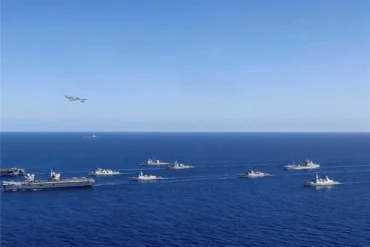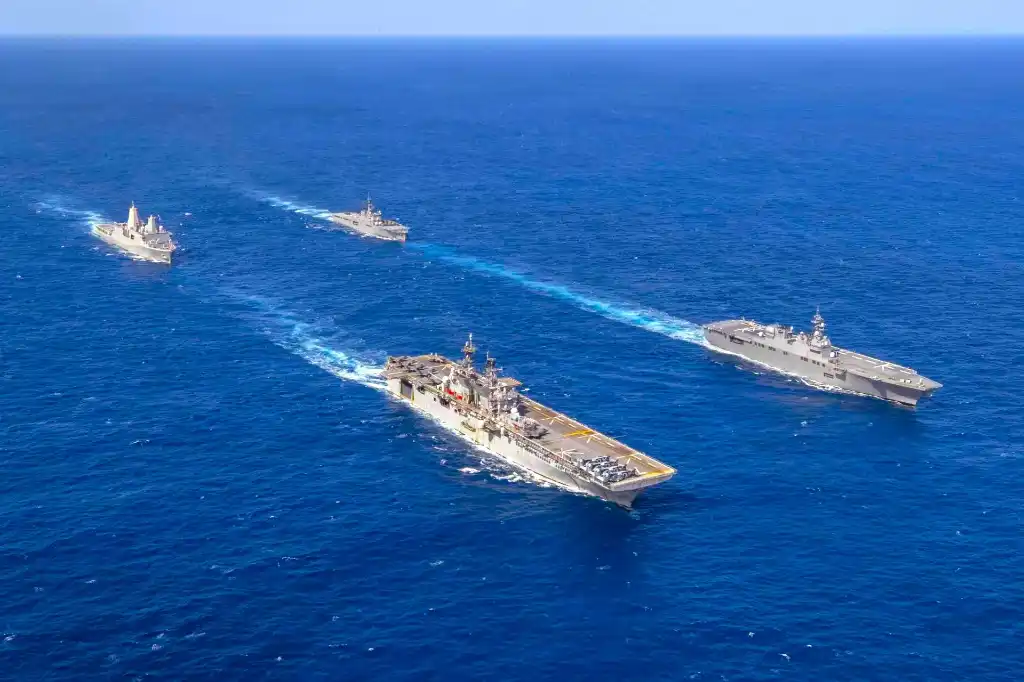
The Indo-Pacific has become the world’s most strategically scrutinized maritime theater, where naval presence is not merely symbolic but a direct demonstration of readiness, partnership, and operational coordination. Against this backdrop, the U.S. Navy’s amphibious assault ship USS Tripoli (LHA-7) sailed at the center of a multinational formation during Exercise Iron Fist 2026, operating alongside American and Japanese warships in the U.S. 7th Fleet area of responsibility.
The formation, which included USS New Orleans (LPD-18), the Japan Maritime Self-Defense Force tank landing ship JS Ōsumi (LST-4001), and the Hyūga-class helicopter destroyer JS Ise (DDH-182), represented far more than a routine naval maneuver. It served as a practical display of how U.S. and Japanese amphibious forces are refining their ability to operate together in complex expeditionary scenarios, particularly in a region defined by long maritime distances and dispersed island chains.
Through coordinated sailing operations, aviation integration, and amphibious mission rehearsals, Iron Fist continues to evolve as one of the most important bilateral exercises designed to sharpen the interoperability of allied naval and marine forces across the Pacific.
USS Tripoli at the Center of Allied Amphibious Power
At the heart of the formation stood USS Tripoli, an America-class amphibious assault ship specifically designed to function as a large-deck sea base for expeditionary warfare. Unlike traditional amphibious ships that balance aviation with large well decks for landing craft, Tripoli’s configuration emphasizes aviation operations, command functions, and rapid force projection from the sea.
This design philosophy gives the vessel a distinct role in exercises like Iron Fist. The ship acts as a floating aviation hub capable of coordinating aircraft operations, managing maritime command networks, and sustaining airborne elements of amphibious assaults. In the operational choreography of modern naval warfare, this capability allows a single ship to link air, sea, and land maneuver into a unified mission structure.
During the March 1 formation sail highlighted by U.S. Indo-Pacific Command, Tripoli’s position symbolized its role as the central aviation and command node within the combined task group. The ship’s expansive flight deck and integrated command facilities allow it to orchestrate distributed missions involving helicopters, vertical-lift aircraft, and amphibious forces operating across wide maritime areas.
Iron Fist 2026: A Comprehensive Amphibious Warfare Exercise
While the visual spectacle of warships sailing in formation captured attention, Exercise Iron Fist 2026 extends far beyond ceremonial maneuvers. The exercise brings together elements of the Tripoli Amphibious Ready Group (ARG) and the 31st Marine Expeditionary Unit (MEU) in a multi-phase training program designed to simulate real operational conditions.
Activities conducted during the exercise include:
- Electronic warfare operations designed to test communications resilience and sensor integration
- Air assault missions conducted from sea-based platforms to simulated landing zones
- Reconnaissance and surveillance drills in contested littoral environments
- Launch and recovery of amphibious craft transporting troops and equipment
- A culminating amphibious assault scenario in Okinawa
Each of these training elements contributes to a broader objective: ensuring that U.S. and Japanese forces can coordinate complex expeditionary operations with minimal friction, even under demanding battlefield conditions.
The Aviation Power of the America-Class Assault Ship
One reason USS Tripoli plays such a prominent role in Indo-Pacific exercises lies in the extraordinary aviation capabilities built into the America-class design. The ship is engineered to support a wide range of aircraft essential to Marine expeditionary operations and maritime strike missions.
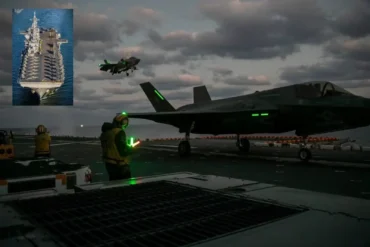
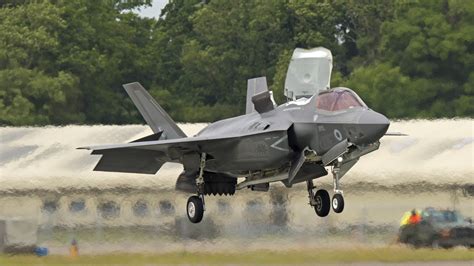
Among the aircraft regularly operating from Tripoli’s flight deck are the F-35B Lightning II, the short takeoff and vertical landing variant of the fifth-generation stealth fighter. This aircraft dramatically expands the tactical reach of amphibious assault ships by providing advanced sensors, stealth strike capabilities, and networked battlefield awareness directly from sea-based platforms.
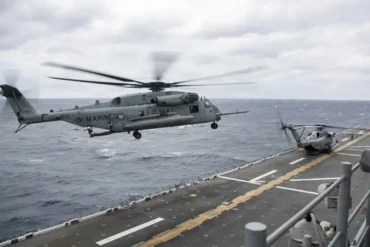
Tripoli’s flight deck has also hosted a diverse collection of rotary-wing aircraft, demonstrating its versatility in joint and coalition operations. These aircraft include:
- AH-64 Apache attack helicopters
- UH-60M Black Hawk utility helicopters
- HH-60 Pave Hawk combat rescue helicopters
- MH-60S Sea Hawk naval support helicopters
Such aviation flexibility enables the ship to support a wide range of operational tasks, including vertical assault operations, reconnaissance flights, casualty evacuation missions, logistics transport, and maritime strike coordination.
Supporting the Expeditionary Backbone: USS New Orleans
While Tripoli provides the aviation and command center for the exercise formation, USS New Orleans (LPD-18) delivers the logistical and transport muscle necessary to sustain amphibious operations.
As a San Antonio-class amphibious transport dock, New Orleans is designed to move Marines, armored vehicles, equipment, and landing craft from sea to shore. Its well deck allows the launch of amphibious vehicles and landing craft that carry troops directly into contested coastal areas.
This combination of aviation dominance from Tripoli and transport and deployment capabilities from New Orleans forms a classic amphibious task group structure. Together, the ships provide a balanced operational package capable of projecting power from the sea, reinforcing forces ashore, and maintaining sustained expeditionary operations far from established bases.
Japan’s Maritime Self-Defense Force Contributions
The Japanese vessels participating in the formation—JS Ōsumi and JS Ise—highlight the growing integration between American and Japanese maritime forces.
The Ōsumi-class tank landing ship JS Ōsumi (LST-4001) specializes in transporting vehicles, troops, and landing craft for amphibious missions. Its presence in Iron Fist reflects Japan’s increasing emphasis on island defense and rapid maritime mobility, capabilities that align closely with U.S. Marine Corps expeditionary doctrine.
Meanwhile, JS Ise (DDH-182) represents another crucial element of the task group. As a Hyūga-class helicopter destroyer, Ise functions as a command and aviation platform capable of operating multiple helicopters simultaneously. These aircraft can perform anti-submarine warfare, search-and-rescue missions, and airborne troop transport.
Together, the two Japanese ships complement the U.S. vessels by providing additional aviation support, amphibious lift capacity, and maritime coordination capabilities.
Indo-Pacific Strategy and the Importance of Amphibious Readiness
The operational setting of Exercise Iron Fist carries strategic significance. The Indo-Pacific region is defined by vast ocean expanses, contested sea lanes, and archipelagic geography where control of islands and littoral zones can shape broader maritime security outcomes.
In such an environment, amphibious forces become a crucial tool for rapid response and force mobility. Ships like USS Tripoli offer the ability to deploy aviation and ground forces without relying entirely on fixed bases, providing a flexible forward presence capable of responding quickly to regional contingencies.
This capacity becomes particularly valuable in scenarios involving humanitarian assistance, disaster relief, evacuation operations, or high-intensity conflict. By training together in realistic conditions, the United States and Japan demonstrate the ability to coordinate maritime maneuver and amphibious landings across national forces, a capability that strengthens deterrence simply by existing.
Demonstrating Allied Interoperability at Sea
Perhaps the most important outcome of the March 1 formation sail was not the visual alignment of warships but the operational synchronization behind it. Naval exercises such as Iron Fist are designed to eliminate friction between allied forces long before real crises arise.
Sailors, aviators, and Marines from both countries practice shared communication procedures, flight deck coordination, amphibious landing protocols, and command integration. Over time, this repeated cooperation transforms multinational forces into a cohesive expeditionary team capable of acting rapidly in unpredictable scenarios.
The formation of USS Tripoli, USS New Orleans, JS Ōsumi, and JS Ise illustrated that principle in practice. Each ship brought distinct capabilities—aviation command, troop transport, helicopter operations, and amphibious landing support—but together they formed a single operational structure.
In the strategic waters of the Indo-Pacific, that kind of coordination sends a clear signal. Allied naval forces are not simply present in the region; they are actively preparing to operate together across the full spectrum of maritime and amphibious warfare, with ships like USS Tripoli serving as the centerpiece of modern expeditionary power at sea.