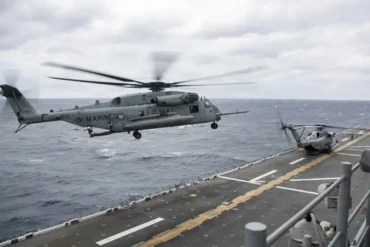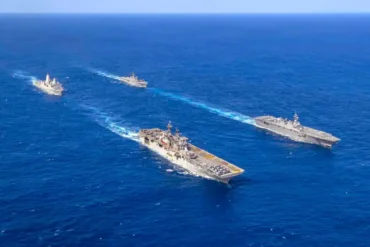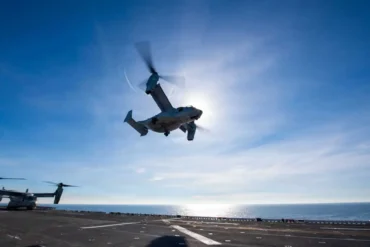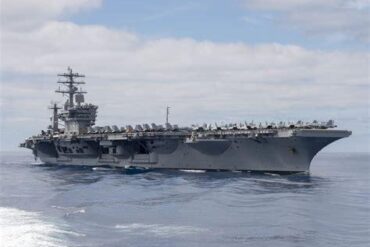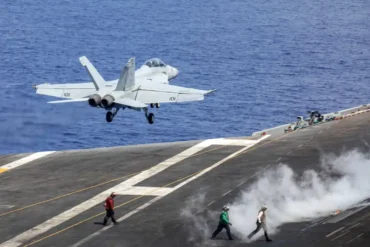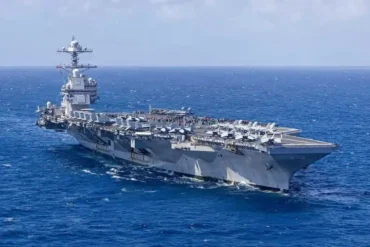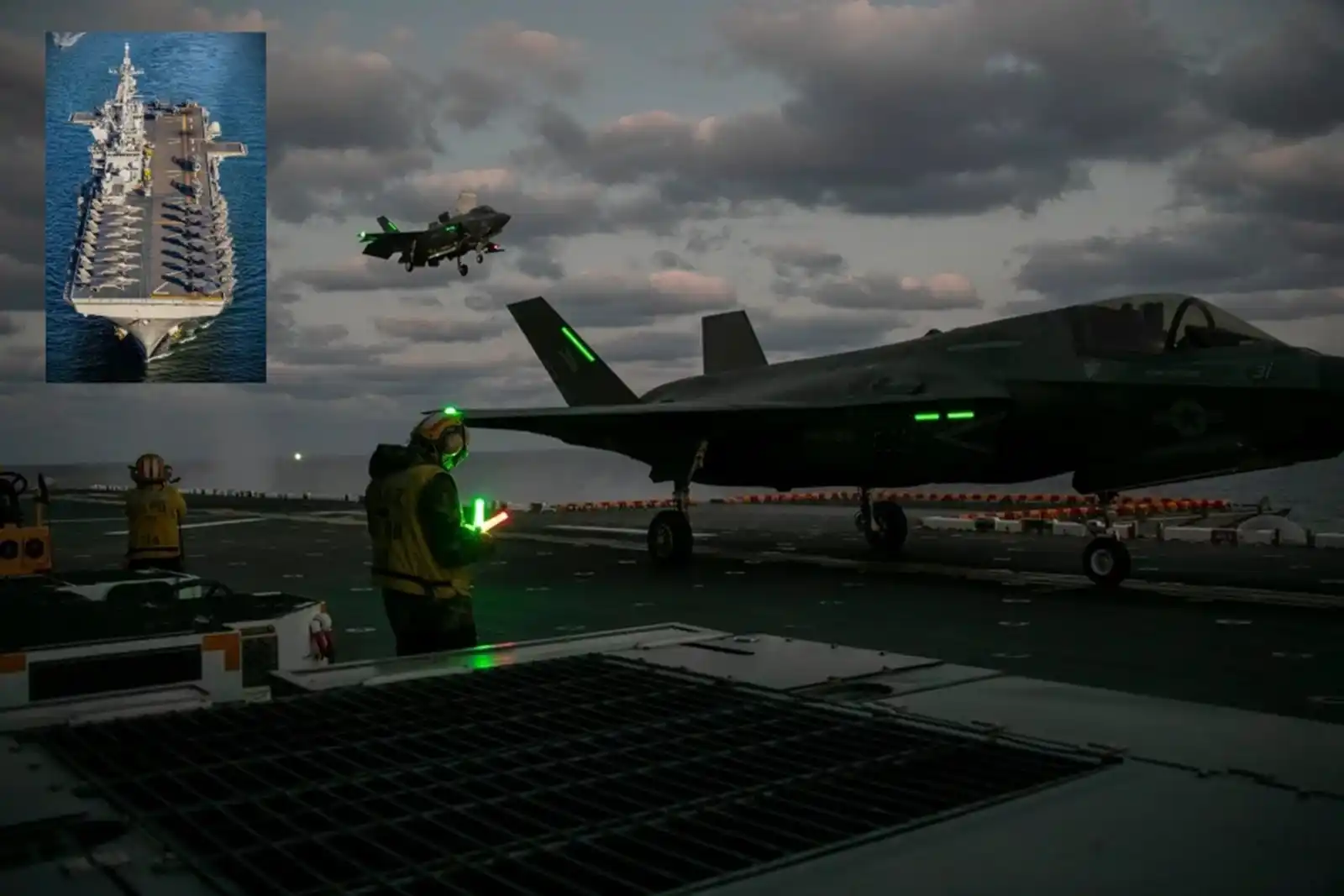
The USS Tripoli (LHA 7) has shifted decisively into its new identity as an aviation-first amphibious assault ship, proving its expanded combat utility through night F-35B Lightning II operations in the U.S. 7th Fleet on November 29, 2025. These night sorties, conducted as Tripoli settles into its Japan-based forward-deployed posture, serve as a powerful demonstration that this America-class assault ship is now functioning as a fully operational lightning carrier, capable of launching fifth-generation stealth fighters in the most demanding conditions.
This transformation has not happened overnight. The shift began years ago when the Navy removed the traditional well deck from Tripoli’s design, reallocating massive internal volume for aircraft maintenance bays, fuel storage, weapons handling facilities, and hangar space tailored to the unique needs of the F-35B’s short takeoff and vertical landing (STOVL) profile. The result is a ship built less around landing Marines ashore and more around delivering sustained, high-tempo air operations deep inside the world’s most contested theater.
The Navy brought that design philosophy to life during the late-November night evolutions, where Aviation Boatswain’s Mate 2nd Class Arnitt Jones was seen guiding a VMFA-242 ‘Bats’ F-35B under the deck’s night-lighting system. The scene is a snapshot of a broader doctrinal shift: the United States is actively spreading its airpower capability across multiple hulls, not just relying on supercarriers, to complicate adversary targeting and increase survivable strike capacity across the Indo-Pacific. Every nighttime launch from Tripoli reinforces that strategy.
Tripoli’s 2025 forward deployment to Sasebo, Japan, represents a major milestone for the America-class ship design. Commissioned in 2020, Tripoli validated the lightning-carrier concept during extensive 2022 trials in which it embarked around twenty F-35Bs. These tests confirmed that the ship’s enlarged flight deck, heat-resistant coating, and aviation-centric internal architecture could sustain aircraft generation rates approaching those of small carriers.
This is no longer a theoretical capability. VMFA-242 achieved full operational capability with the F-35B in 2022, bringing a powerful blend of radar-evading strike capacity, advanced sensor fusion, and networked combat capability directly to Tripoli’s deck. Their night operations now demonstrate seamless integration between a squadron trained for all-weather deployments and a ship built to sustain fifth-generation aviation at scale.
Fifth-Generation Airpower in the 7th Fleet: A Direct Answer to China’s A2/AD Strategy
This pairing of ship and aircraft is a deliberate response to China’s rapidly expanding anti-access/area-denial arsenal, including the DF-21D and DF-26 anti-ship ballistic missiles designed to threaten U.S. surface forces. Traditional carriers remain immensely powerful, but distributing airpower across multiple platforms—each capable of moving unpredictably through the region—creates a far more complex targeting picture for any potential adversary.
Night operations amplify that difficulty. Launching and recovering stealth aircraft under low visibility increases survivability for both pilots and ship, shrouding sortie cycles in uncertainty. The F-35B’s onboard sensors act as a force multiplier, feeding targeting data into the wider joint “kill web,” linking aircraft, destroyers, submarines, and land-based fires in real time.
A Tactical Shift With Strategic Implications Across the First Island Chain
From a tactical perspective, the Tripoli-F-35B combination allows U.S. forces to disperse high-value air assets across the maritime battlespace, decreasing the vulnerability inherent in concentrating aircraft on a single carrier. Tripoli can operate in confined waters where a full-sized carrier might hesitate, sustaining rapid-cycle STOVL operations from a compact deck even under threat.
Strategically, basing Tripoli in Japan places a fifth-generation-capable flight deck much closer to the region’s most sensitive flashpoints, including the Taiwan Strait and South China Sea. It expands the number of platforms capable of delivering precision strike, maritime interdiction, close air support, and airborne early warning—without requiring the immediate deployment of a supercarrier.
This distributed maritime posture reassures allies such as Japan and underscores to regional observers that U.S. forces are not simply present—they are evolving and modernizing in ways that increase resilience, lethality, and strategic unpredictability.
Night Deck Operations Signal a Mature Lightning Carrier Era
On the surface, the image of a sailor guiding a stealth fighter under dimmed deck lights may look like routine naval aviation, but it represents a much larger shift in Indo-Pacific military dynamics. The United States is broadening the number of decks from which fifth-generation fighters can operate, and it is proving these capabilities in the dark, under operationally realistic conditions.
For the Indo-Pacific, this means more launch points, more axes of approach, and a more complex deterrence architecture. For the Navy and Marine Corps, it marks the moment the lightning-carrier concept fully stepped into operational maturity.
The USS Tripoli’s night operations show that the future of U.S. airpower in the region is not just bigger—it is more distributed, more flexible, and far more difficult for any adversary to predict or counter.