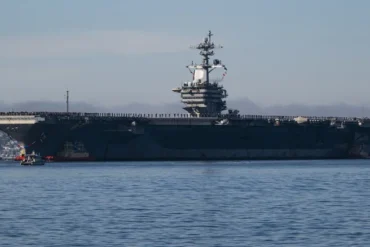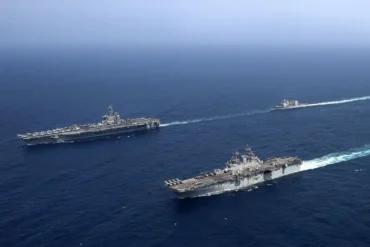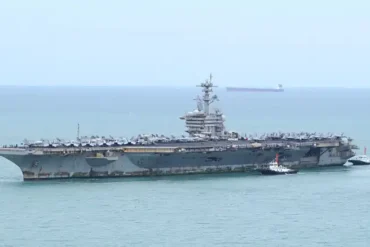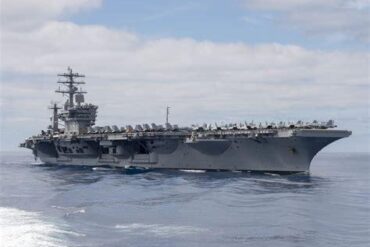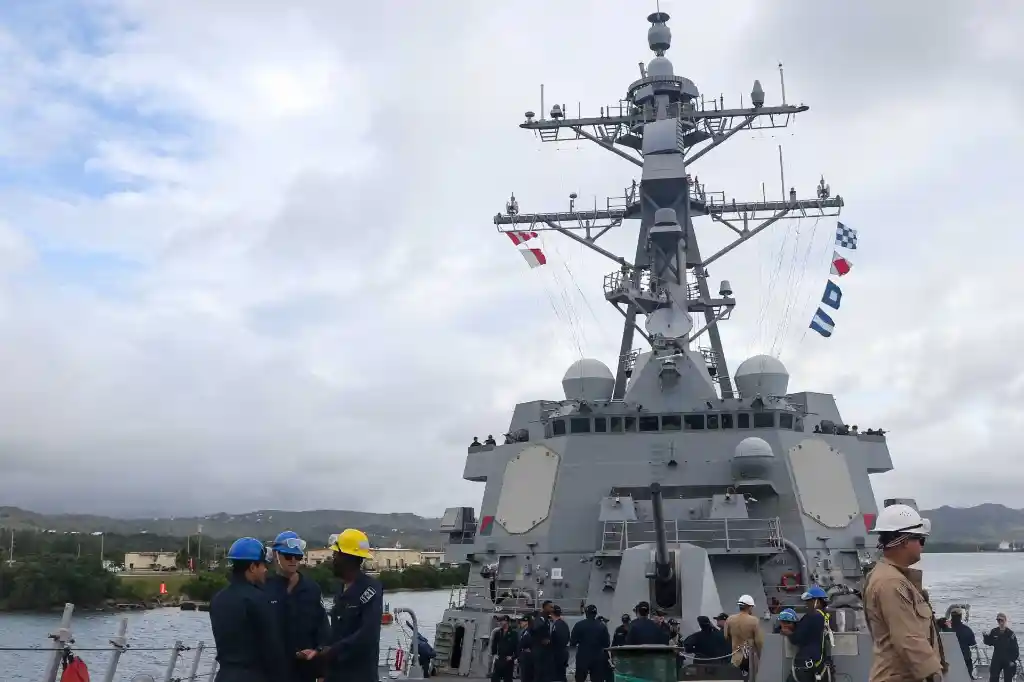
The USS Frank E. Petersen Jr. (DDG 121), a cutting-edge Arleigh Burke-class guided-missile destroyer, has departed Naval Base Guam to join the Abraham Lincoln Carrier Strike Group (CSG) operating under the U.S. 7th Fleet. This strategic maneuver comes amid rising regional tensions and evolving military dynamics across the Indo-Pacific.
Strategic Redeployment Reflects Expanding U.S. Naval Presence
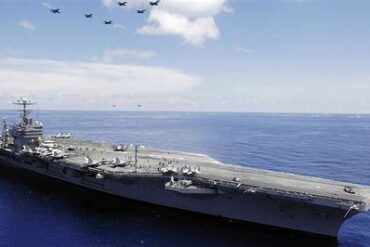
The destroyer’s departure on December 20, 2025, marks a critical enhancement of the United States Navy’s layered defense posture. With the Abraham Lincoln CSG already operating in theater following its arrival in Guam on December 11, the USS Frank E. Petersen Jr. adds a potent element of anti-air, missile, and surface warfare capabilities to a formation designed for deterrence, power projection, and regional stability.
Equipped with the Aegis Combat System, SPY-1D(V) radar, and Mk 41 Vertical Launch System, the destroyer reinforces the carrier group’s ability to defend against aerial and missile threats while also providing a credible long-range strike option using Tomahawk cruise missiles. This dual-purpose design enhances both defensive and offensive reach, allowing the strike group to operate confidently in high-threat environments.
Aegis Warship Vital to Carrier Group’s Survivability
The USS Frank E. Petersen Jr. serves a pivotal defensive role, creating a mobile protective shield around the carrier and its air wing. As peer adversaries expand their deployment of advanced anti-ship ballistic missiles, hypersonic glide vehicles, and drone swarms, the destroyer’s presence is vital for ensuring carrier mobility, survivability, and mission effectiveness.
In particular, the vessel’s Standard Missile (SM) interceptors, such as the SM-2 and SM-6, give it the ability to engage incoming threats at extended ranges, intercepting them well before they pose a danger to the core of the strike group. When layered with carrier-based aircraft and electronic warfare platforms, this configuration forms a robust and adaptable defensive web.
Responding to a More Contested Indo-Pacific Theater
The Indo-Pacific maritime domain has become increasingly complex and contested. Nations across the region—particularly China, North Korea, and Russia—are fielding more sophisticated anti-access/area denial (A2/AD) systems. These include long-range missiles, electromagnetic spectrum disruptors, and undersea warfare platforms, all aimed at limiting U.S. and allied freedom of maneuver.
By reinforcing forward-deployed CSGs with destroyers like the USS Frank E. Petersen Jr., the U.S. Navy sends a clear signal of strategic resolve. These deployments demonstrate that the U.S. retains operational endurance and force adaptability, and is prepared to contest any attempt to rewrite the rules of the maritime domain.
Guam: A Critical Launchpad for Forward Naval Operations
The destroyer’s deployment also underscores the importance of Guam as a strategic logistics and naval hub. Positioned at the western edge of U.S. sovereign territory in the Pacific, Guam offers rapid access to hotspots such as the South China Sea, East China Sea, and Philippine Sea.
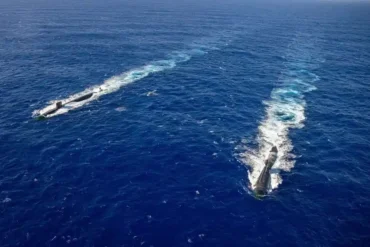
Naval Base Guam’s ability to host large-scale combatants such as nuclear-powered aircraft carriers, destroyers, and submarines, coupled with prepositioned supplies, gives the U.S. an unmatched advantage in response time and logistical reach. By operating from Guam, the USS Frank E. Petersen Jr. benefits from a shorter operational tail, improving sustainment cycles and mission tempo.
Strengthening Regional Alliances and Maritime Security
The deployment isn’t just about deterrence. It also forms part of a broader strategy to deepen interoperability with regional allies including Japan, South Korea, Australia, and the Philippines. Regular joint exercises, real-time data-sharing, and coordinated patrols enhance both warfighting effectiveness and maritime domain awareness.
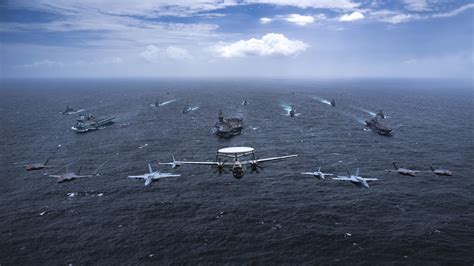
Destroyers like USS Frank E. Petersen Jr. frequently participate in multinational operations such as RIMPAC, Talisman Sabre, and Malabar, where cross-deck operations, anti-submarine warfare, and live-fire missile intercepts are rehearsed in real-world conditions. These efforts build a coalition-centered maritime defense network, able to respond to crises collaboratively and efficiently.
Ship Capabilities: A Force Multiplier at Sea
Launched in 2020 and commissioned in 2022, USS Frank E. Petersen Jr. represents the Flight IIA subclass of the Arleigh Burke lineage. The ship honors the legacy of Lt. Gen. Frank E. Petersen Jr., the first African American Marine Corps aviator and general officer—a legacy embedded in its combat ethos and operational excellence.
Notable capabilities include:
- 90-cell Mk 41 VLS supporting Tomahawk, SM-2, SM-6, and ASROC
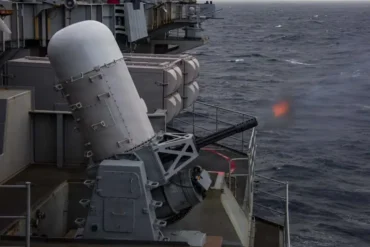
- Phalanx CIWS for close-in defense
- 2 SH-60 Sea Hawk helicopters for ASW and SAR operations
- Advanced electronic warfare suite for threat detection and disruption
These assets ensure that DDG 121 is not merely an escort but a multi-mission combat platform, capable of executing independent tasking as required.
Strategic Signaling in an Era of Great Power Competition
The timing of USS Frank E. Petersen Jr.’s deployment aligns with a heightened period of maritime tension across the Western Pacific. Frequent Chinese naval transits through the Taiwan Strait, Russian bomber flights near Japanese airspace, and North Korean missile launches have accelerated calls for greater U.S. and allied naval readiness.
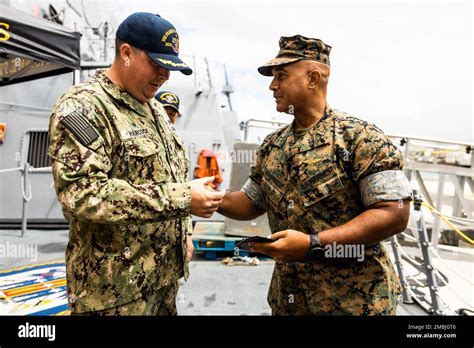
This deployment, while routine in designation, functions as a strategic signal to both allies and potential adversaries: the U.S. Navy is here to stay, fully capable of protecting international waters, enforcing maritime norms, and responding to flashpoints with speed and precision.
Future Outlook: Sustained Presence, Integrated Defense
The U.S. Navy’s ongoing operational expansion in the Indo-Pacific is not a temporary surge but a structural shift. Future deployments will likely incorporate unmanned surface vessels (USVs), artificial intelligence-driven threat recognition systems, and distributed maritime operations doctrine, where smaller, networked units like the USS Frank E. Petersen Jr. play central roles.
This model emphasizes flexibility over brute force, prioritizing resilience, adaptability, and joint connectivity. By forward-deploying destroyers alongside carrier groups and leveraging key logistical nodes like Guam, the U.S. Navy is posturing for a decades-long strategic contest in one of the world’s most consequential regions.
As the USS Frank E. Petersen Jr. sails into contested waters, it embodies more than just military might. It represents a firm commitment to allied cooperation, freedom of navigation, and a vision of regional order anchored in rules—not coercion.