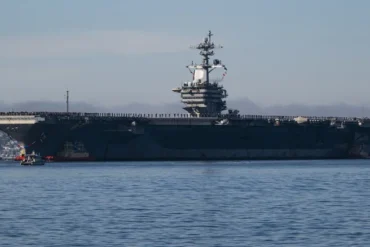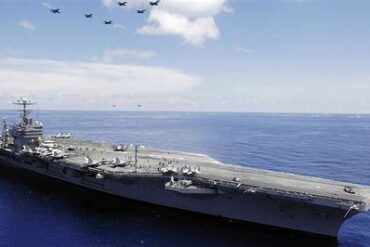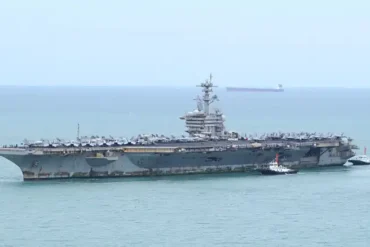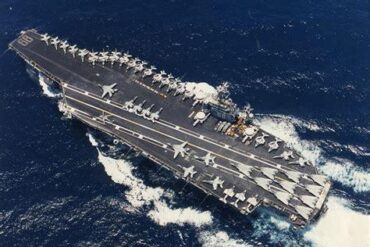
The modern aircraft carrier is no longer defined only by its air wing or its ability to project power across oceans. In an era shaped by cheap drones, explosive-laden swarm boats, and dense electronic battlefields, survival itself has become a strategic mission. The U.S. Navy’s Nimitz-class aircraft carrier USS Abraham Lincoln (CVN-72) embodies this shift, carrying an intricate web of close-range defensive systems designed to keep the world’s most valuable warship afloat when threats slip past outer defenses.
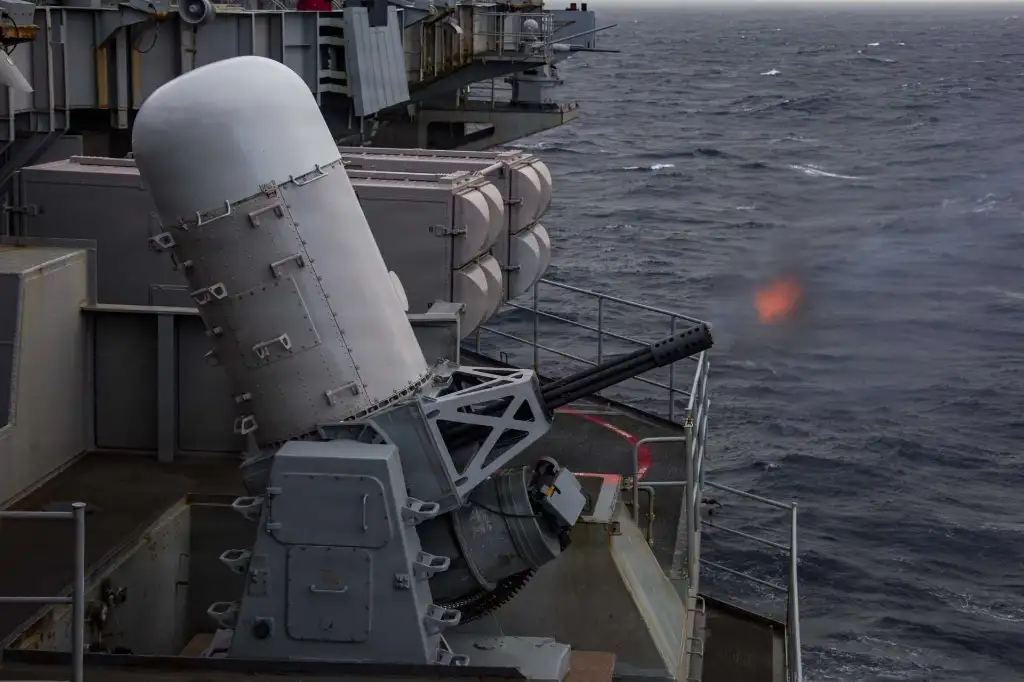
On 8 January 2026, USS Abraham Lincoln conducted a live-fire Close-In Weapon System exercise while deployed in the South China Sea, validating its ability to respond instantly to fast-moving aerial and surface threats. The drill was not symbolic. It was a blunt reminder that future naval combat will be fast, crowded, and unforgiving, especially in contested littoral regions where reaction time is measured in seconds rather than minutes.
Aircraft carriers are prime targets precisely because they are irreplaceable at sea. A single carrier strike group represents not just firepower but political influence, alliance assurance, and deterrence. For that reason, USS Abraham Lincoln’s defensive architecture is built around layered, redundant, and highly automated systems that can operate even when communications are disrupted and human decision-making time is compressed to the edge.
The Nimitz-Class Philosophy of Layered Survival
USS Abraham Lincoln’s defensive design reflects decades of operational lessons absorbed by the U.S. Navy. Rather than relying on one perfect shield, the carrier uses overlapping rings of protection, each tailored to defeat a specific class of threat. Long-range air defense belongs to escorting cruisers and destroyers. Medium-range interception is shared between the strike group and the carrier itself. At the final layer, fully autonomous systems take over.
This philosophy matters most when facing drone swarms and fast attack craft, which often aim to overwhelm defenses through numbers rather than sophistication. By forcing attackers to penetrate multiple engagement zones, the carrier increases the likelihood that threats are destroyed early, thinned out mid-range, or eliminated at point-blank distance before they can cause catastrophic damage.
The live-fire exercise aboard USS Abraham Lincoln demonstrated that these systems are not theoretical. They are maintained, crewed, and practiced under real operational conditions, including flight deck activity and regional tension.
Phalanx CIWS: The Last Line That Never Blinks
At the heart of the carrier’s close-range defense sits the Phalanx Close-In Weapon System, a weapon that has earned near-mythical status among naval crews. USS Abraham Lincoln is typically fitted with four Phalanx mounts, positioned on elevated sponsons around the hull and near the island superstructure to ensure near-total coverage.
Each Phalanx unit integrates its own search radar, tracking radar, electro-optical sensors, fire-control computer, and a six-barrel 20 mm M61A1 Gatling gun. Once activated, it can autonomously detect, track, and engage incoming threats without relying on shipwide sensors, a critical feature when electronic warfare clouds the battlespace.
Firing at over 4,500 rounds per minute, Phalanx creates a dense wall of tungsten projectiles capable of shredding sea-skimming missiles, low-flying aircraft, and small unmanned aerial vehicles within a range of roughly two kilometers. Against drones, its speed and accuracy make it brutally effective, especially when attackers attempt last-second dives toward the flight deck or island.
Countering Swarm Boats at Knife-Fight Range
Phalanx is equally feared by operators of fast inshore attack craft and unmanned surface vessels. These threats rely on speed, low profiles, and surprise, often operating in cluttered coastal waters where radar detection is difficult. CIWS excels here, able to track and engage targets skimming across the waves with minimal warning.
Rather than simply sinking a boat, the system can disable engines, detonate onboard explosives, or destroy guidance equipment, neutralizing the threat before it reaches lethal distance. In swarm scenarios, Phalanx’s autonomous targeting allows rapid engagement of multiple boats in succession, buying precious seconds for additional defenses to respond.
This capability is especially relevant in regions where asymmetric naval tactics are favored, and where explosive boats are viewed as a cost-effective way to challenge superior fleets.
Sea Sparrow: Buying Time Before Chaos
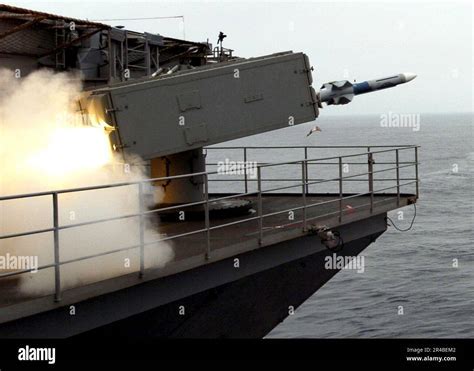
While Phalanx guards the final meters, USS Abraham Lincoln’s Mk 57 Mod 3 NATO Sea Sparrow launchers provide a vital buffer zone beyond gun range. Mounted amidships on port and starboard sponsons, these launchers fire the RIM-7 Sea Sparrow missile, a radar-guided interceptor designed to stop threats before they reach terminal velocity.
With an effective range of up to 20 kilometers, Sea Sparrow targets hostile aircraft, helicopters, and incoming anti-ship missiles flying at low to medium altitude. Against larger drones and loitering munitions with sufficient radar signatures, the missile offers a decisive early kill option, reducing pressure on close-in systems.
Sea Sparrow’s value lies in time management. Every threat destroyed at this range extends reaction windows, preserves ammunition, and reduces the risk of saturation at the innermost defensive ring.
Rolling Airframe Missile: Agility for the Modern Fight
Bridging the gap between missiles and guns is the RIM-116 Rolling Airframe Missile (RAM) system. Typically installed in two launchers aboard Nimitz-class carriers, RAM is optimized for the chaotic reality of modern naval combat, where threats maneuver aggressively and attack from multiple directions.
RAM uses passive radio-frequency and infrared guidance, homing in on a target’s emissions or heat signature without broadcasting radar energy. This makes it especially valuable in electronically contested environments, where active sensors can be jammed or targeted.
With a range of roughly 9 to 10 kilometers, RAM excels against maneuvering anti-ship missiles, helicopters, and low-altitude UAVs. Its fire-and-forget design allows rapid sequential launches, enabling the carrier to respond to multi-axis drone attacks without overwhelming crew workload.
An Integrated Web, Not Isolated Weapons
What makes USS Abraham Lincoln’s defenses formidable is not any single system, but their integration. CIWS, Sea Sparrow, and RAM are linked through combat management networks that prioritize threats, assign weapons, and prevent duplication of fire. This coordination ensures ammunition is used efficiently and that no single layer is overloaded prematurely.
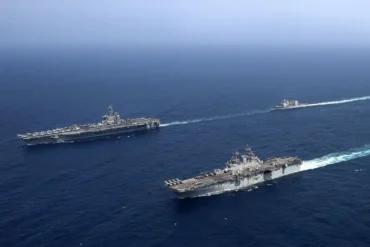
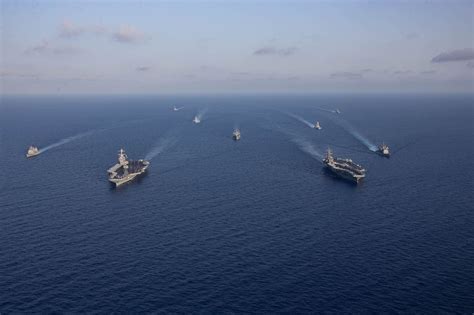
Beyond the ship itself, the carrier operates within a carrier strike group, benefiting from Aegis-equipped escorts capable of intercepting ballistic and cruise missiles hundreds of kilometers away. Carrier-based aircraft, helicopters, and unmanned platforms extend surveillance and strike capabilities, pushing danger outward from the hull.
Still, history has shown that no outer shield is impenetrable. The inner defenses aboard USS Abraham Lincoln exist for the moment when everything else fails.
Training Under Real Conditions
Live-fire drills are more than technical checks. They are psychological conditioning for crews who must trust automated systems with split-second decisions. Conducting such exercises during deployment, rather than in isolated test ranges, forces sailors to manage real-world constraints like flight operations, sea state, and regional traffic.
The January 2026 exercise confirmed not only mechanical readiness but crew proficiency, sensor alignment, and command coordination. In a real engagement, hesitation kills. Training removes hesitation.
Strategic Meaning in a Drone Age
The defensive posture of USS Abraham Lincoln reflects a broader transformation in naval warfare. The rise of inexpensive drones and unmanned boats has blurred the line between state and non-state threats, forcing even supercarriers to prepare for persistent, low-cost harassment as well as high-end missile attacks.
By investing in layered, autonomous close-in defenses, the U.S. Navy signals that its carriers will remain viable even as the battlespace grows more crowded and unpredictable. Deterrence now depends as much on resilience as on firepower.
USS Abraham Lincoln’s demonstrated ability to counter drones and swarm boats reinforces the carrier’s role as a survivable centerpiece of U.S. naval strategy, capable of operating in contested waters without surrendering initiative. In an age where the smallest platforms can deliver outsized threats, that resilience may be the carrier’s most important weapon.