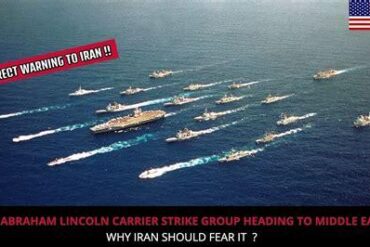
The United States has sharply escalated its military posture in the Middle East after President Donald Trump ordered a major U.S. Navy carrier strike group to reposition toward Iran, a move framed by Washington as a decisive warning amid renewed nuclear tensions and regional instability. The deployment underscores a strategy built on visible power projection, rapid-response capability, and strategic ambiguity, designed to deter Tehran while preserving the option of swift military action.
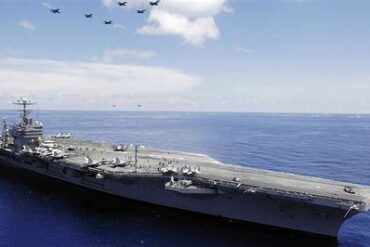
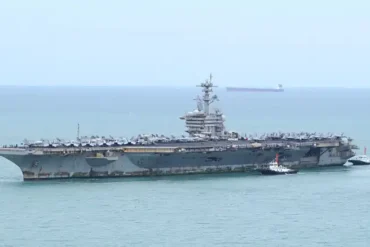
Announced on January 23, 2026, the order directs the USS Abraham Lincoln (CVN-72) and its accompanying strike group into the U.S. Central Command area of responsibility. The president described the force as an “armada,” signaling both political intent and military readiness at a moment when Iran’s nuclear activities, indirect confrontations with Israel, and internal unrest have converged into a volatile security equation.
Unlike large-scale ground deployments of previous decades, the current posture emphasizes mobile, high-end naval power that can operate independently of host-nation politics. Aircraft carriers remain the most flexible instruments in the U.S. arsenal, capable of sustained air operations, precision strikes, and command-and-control functions without reliance on regional bases that may be vulnerable or politically constrained.
The Abraham Lincoln strike group represents a significant redeployment of assets from other theaters, including the Indo-Pacific, reflecting Washington’s assessment that the Middle East has again become a priority flashpoint. This shift also signals to allies and adversaries alike that the United States is prepared to rebalance forces rapidly when strategic thresholds are approached.
A Carrier Strike Group Built for Deterrence and Escalation Control
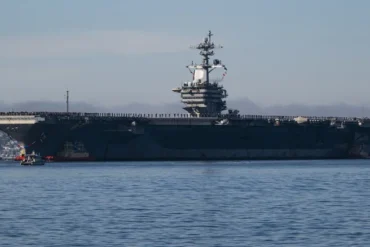
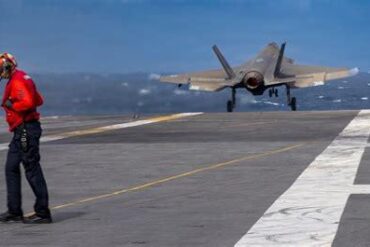
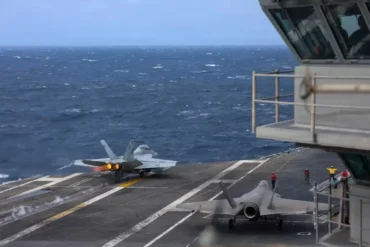
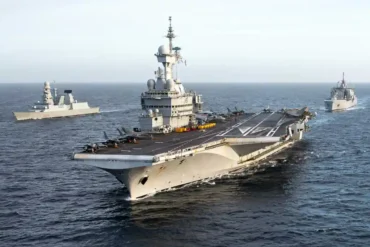
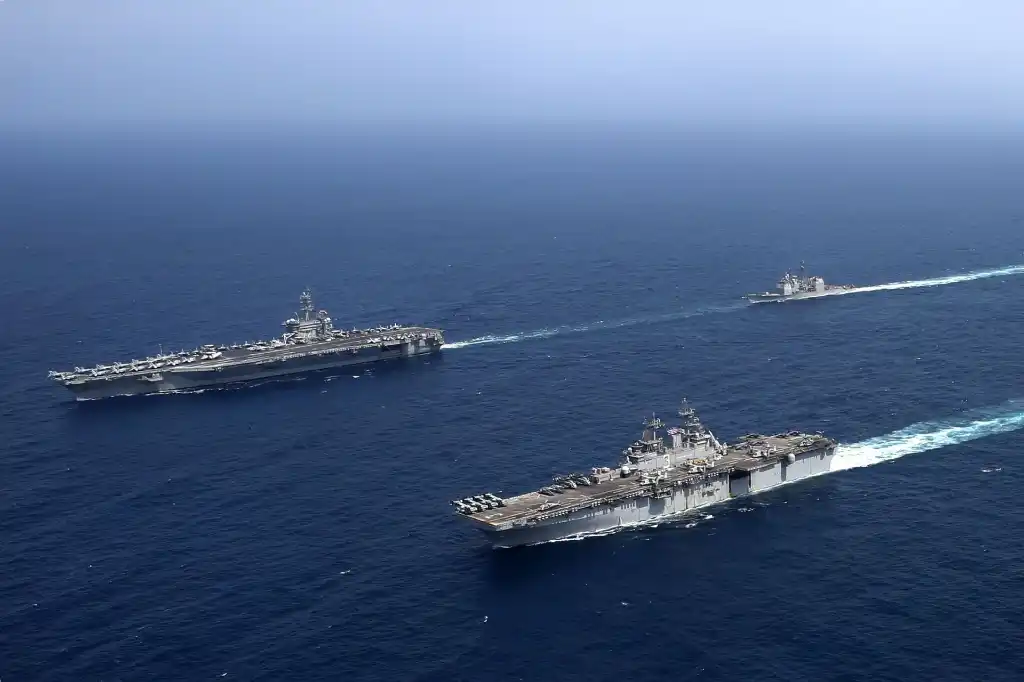
At the heart of the deployment is the nuclear-powered aircraft carrier USS Abraham Lincoln, a floating airbase capable of generating dozens of sorties per day across strike, air superiority, electronic warfare, and reconnaissance missions. Its embarked air wing gives U.S. commanders an immediate and scalable response option, ranging from visible patrols to deep precision strikes.
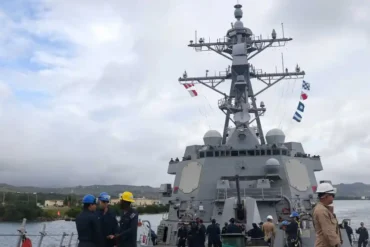
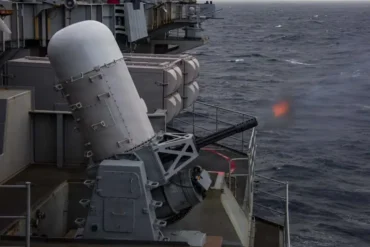
Escorting the carrier are multiple Arleigh Burke–class guided missile destroyers, including USS Mitscher, USS McFaul, USS Oscar Austin, USS Roosevelt, USS Bulkeley, and USS Paul Ignatius. These vessels form a layered defensive shield around the carrier while also providing formidable offensive reach. Their Aegis Combat Systems, centered on the SPY-1D radar, are optimized to counter aircraft, cruise missiles, and ballistic missile threats, a critical capability given Iran’s expanding missile arsenal.
Each destroyer’s vertical launch system can carry Standard Missile interceptors for air and missile defense alongside Tomahawk Land Attack Missiles. With strike ranges exceeding 1,500 kilometers, Tomahawks allow U.S. forces to engage strategic targets deep inside Iranian territory without entering contested airspace, reinforcing deterrence through credible stand-off capability.
Subsurface Power and the Silent Dimension of the Deployment
Beneath the surface, the deployment gains additional weight from the inclusion of Virginia-class attack submarines and an Ohio-class guided missile submarine. The USS South Dakota (SSN-790) contributes intelligence collection, surveillance, and precision strike potential while remaining difficult to detect, complicating Iranian defensive planning.
Even more significant is the presence of USS Georgia (SSGN-729), an Ohio-class submarine converted to carry a massive payload of Tomahawk missiles. Its ability to launch large salvos from concealed positions introduces a saturation-strike option that can overwhelm air defenses and cripple critical infrastructure in the opening phase of any conflict. The mere possibility of such an asset operating undetected exerts psychological pressure well beyond its physical footprint.
Integration With an Already Dense Regional Force Posture
The carrier strike group does not arrive in a vacuum. U.S. forces in the Middle East already include a substantial mix of naval, air, and support assets designed to monitor Iranian activity and secure key maritime routes. The USS Mount Whitney (LCC-20) provides joint command-and-control capabilities, enabling coordinated operations across services and allied forces.
Logistics and support vessels such as USNS Lewis B. Puller, USNS Carl Brashear, and USNS Henry J. Kaiser ensure sustained operations, while Littoral Combat Ships like USS Tulsa, USS Canberra, and USS Santa Barbara focus on countering asymmetric threats, including fast-attack craft and maritime drones in confined waters.
In the air domain, U.S. Central Command already fields F-35A Lightning II, F-15E Strike Eagle, F-16 Fighting Falcon, and A-10 Thunderbolt II aircraft. These platforms conduct deterrence patrols, precision strike missions, and close air support, backed by an extensive intelligence and surveillance network. Assets such as RC-135 Rivet Joint, P-8A Poseidon, and MQ-9 Reaper systems provide persistent situational awareness, while KC-135 and KC-46A tankers extend operational reach across the region.
Strategic Meaning Behind the Movement Toward Iran
The arrival of the Abraham Lincoln fundamentally alters the operational balance. A carrier-based air wing offers autonomous airspace control that does not depend on regional basing agreements and is less vulnerable to retaliatory strikes. It allows Washington to apply pressure while maintaining freedom of maneuver, a critical advantage in a region where escalation dynamics can shift rapidly.
This deployment also fits within a broader continuum of U.S. policy. In June 2025, coordinated U.S. and Israeli strikes targeted Iranian nuclear facilities linked to enrichment and sensitive infrastructure. Those actions marked a clear threshold, demonstrating that Washington was willing to engage directly to prevent advances it deemed unacceptable. The current naval movement can be read as a preparatory posture, signaling readiness to repeat or expand such operations if diplomatic and deterrent measures fail.
A Calculated Signal in a Region on Edge
By emphasizing naval and air power over ground forces, the United States is attempting to balance resolve with restraint. The strategy communicates that escalation will be met decisively, yet it avoids steps that would lock Washington into prolonged occupation or nation-building scenarios. For Iran, the message is unambiguous: continued nuclear escalation carries immediate and credible military risks.
At the same time, the deployment reassures regional partners unsettled by Iran’s posture and ongoing instability. It reinforces the perception of U.S. commitment to freedom of navigation, allied defense, and nonproliferation, even as global attention is divided across multiple theaters.
As the Abraham Lincoln strike group steams toward the Middle East, it embodies a familiar but potent formula of American power—mobile, layered, and deliberately visible. In a standoff defined by signals as much as weapons, the movement of a carrier can speak louder than words, reshaping calculations on all sides of an increasingly fragile strategic landscape.