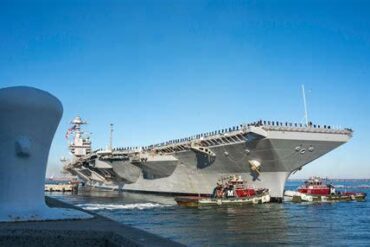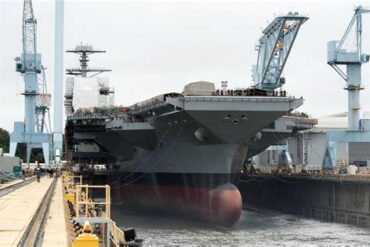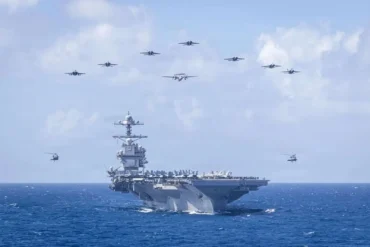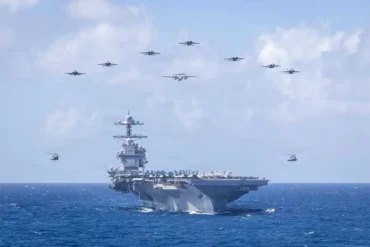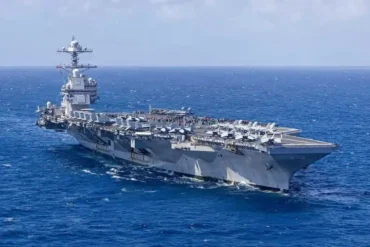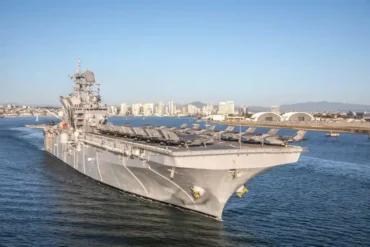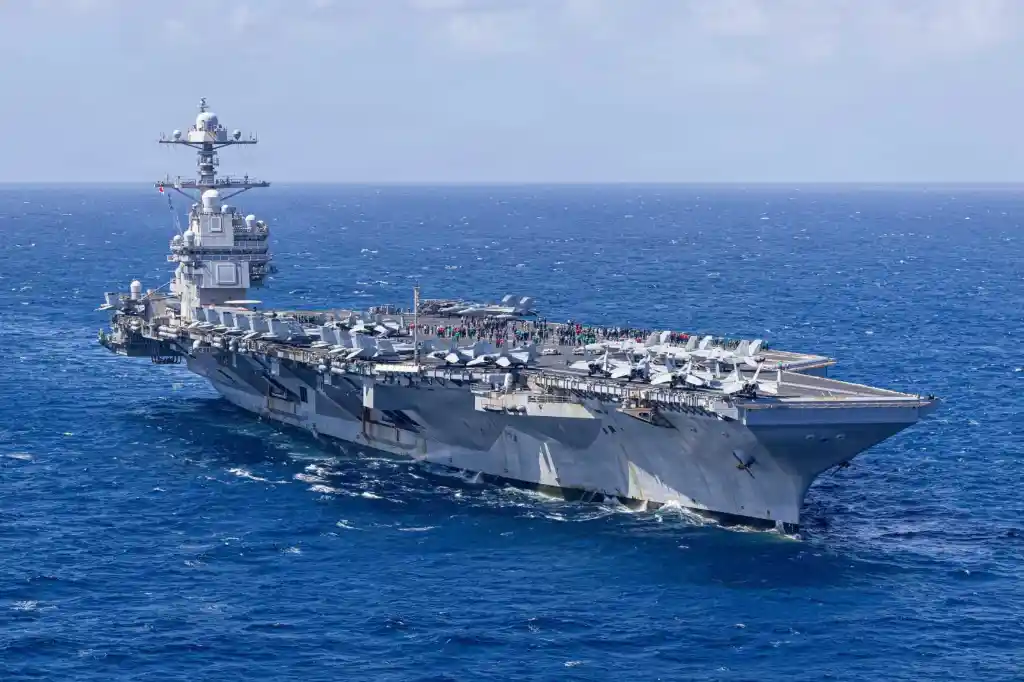
In a significant move amid escalating tensions between the United States and Iran, the U.S. Navy has deployed its advanced nuclear-powered aircraft carrier, the USS Gerald R. Ford (CVN-78), to the Mediterranean, signaling an increased military presence in the Middle East. This deployment comes at a time when diplomatic efforts between the two nations are at a crossroads, especially with Iran’s nuclear ambitions and aggressive posturing in the region.
On February 20, 2026, the USS Gerald R. Ford was observed transiting east through the Strait of Gibraltar, a critical maritime chokepoint that connects the Atlantic Ocean to the Mediterranean Sea. This action follows a pattern of strategic maneuvers by the U.S. Navy to reinforce its presence in the region, particularly in light of recent remarks by U.S. President Donald Trump, who has indicated that all options remain on the table if Iran’s nuclear program is not curtailed through diplomacy.
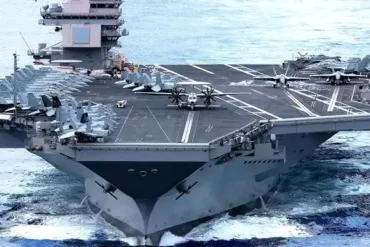
The USS Gerald R. Ford, a Ford-class supercarrier, is the most advanced warship in the U.S. Navy’s fleet, offering unparalleled operational capabilities. Displacing over 100,000 tons, the ship is powered by two next-generation A1B nuclear reactors and features cutting-edge technologies such as an Electromagnetic Aircraft Launch System (EMALS) and advanced radar systems. These innovations allow the Ford to operate a wide array of aircraft, including the F-35C Lightning II, the F/A-18E/F Super Hornet, and the EA-18G Growler, making it a formidable force projection tool for the U.S. Navy.
During its transit from the Atlantic towards the Middle East, the USS Gerald R. Ford was accompanied by the USS Mahan, an Arleigh Burke-class guided missile destroyer. This formation highlights the strategic nature of the deployment, which is not a lone movement of a single vessel but rather part of a larger operational force, the Gerald R. Ford Carrier Strike Group. This enhanced naval presence underscores the U.S. Navy’s capability to deploy a comprehensive defense and offense strategy in the region.
The strategic implications of this deployment become clearer when considering the presence of the USS Abraham Lincoln, another U.S. aircraft carrier already stationed in the Middle East. With two aircraft carriers positioned in the region, the U.S. Navy can field a highly potent force, increasing the number of available combat air sorties and expanding the missile defense coverage for U.S. allies in the region. The operational proximity of both carriers near key strategic locations such as the Strait of Hormuz, a major chokepoint for global energy shipments, could serve as a significant deterrent against any Iranian provocations.
The dual-carrier presence offers the U.S. military increased flexibility and options. While the USS Gerald R. Ford could remain in the Eastern Mediterranean to project air power across the Levant, it also has the option to transit the Suez Canal and move into the Red Sea and Arabian Sea. This ability to reposition and respond quickly is a key feature of the carrier’s operational strategy, allowing U.S. commanders to adapt their posture based on real-time intelligence and evolving political circumstances.
The tactical advantage of such a deployment cannot be overstated. According to experts, including Alain Servaes, Chief Editor of Army Recognition, the dual-carrier presence aims to maximize deterrence while maintaining control over any potential escalation. The strength of these naval assets offers Washington a full spectrum of military options, from precision strikes on key Iranian nuclear or missile infrastructure to more expansive operations targeting Iran’s air defense systems or command networks if hostilities intensify.
The importance of missile defense integration is especially critical, given Iran’s substantial missile arsenal and its reliance on fast-attack naval forces. The USS Mahan, with its Aegis Combat System and vertical launch system capable of deploying Tomahawk cruise missiles, SM-2 and SM-6 air defense interceptors, and anti-submarine warfare munitions, provides an essential layer of protection for the strike group. This makes the deployment of the USS Gerald R. Ford and its accompanying assets even more valuable in deterring potential Iranian threats in a region that sees frequent missile and naval challenges.
The strategic calculation is further influenced by Iran’s own military posture. Tehran has bolstered its defenses, reinforcing key installations and emphasizing its readiness to retaliate against any U.S. strikes. The presence of U.S. carriers in close proximity to the Strait of Hormuz increases the likelihood of a tense standoff, as this waterway remains crucial for the global oil supply. Any military conflict in this region could have significant economic and geopolitical ramifications.
The diplomatic context is equally important. President Trump has publicly stated that while diplomatic negotiations with Iran are still possible, the U.S. is prepared to act decisively should Iran continue to develop its nuclear weapons program. The deployment of such a powerful military force in the region sends a clear message to Tehran: while diplomacy remains the preferred option, military action remains a viable response if Iran does not alter its course.
As the USS Gerald R. Ford continues its journey through the Mediterranean, the international community watches closely. This move highlights not only the ongoing tensions with Iran but also the U.S. Navy’s ability to project power and influence far beyond its shores. The scale and complexity of the deployment reflect Washington’s determination to deter Iran from any further escalation, while also preparing for any potential conflict.
The exact trajectory and ultimate purpose of the USS Gerald R. Ford’s deployment will be shaped by future diplomatic efforts, intelligence assessments, and military considerations. However, the current military buildup serves as both a deterrent and a reminder of the formidable power the U.S. Navy can bring to bear in the event of a confrontation with Iran. Whether this will result in a change of course for Tehran or an intensification of tensions remains to be seen.
In the coming days, as the situation develops, the strategic positioning of U.S. naval forces will likely play a key role in shaping the outcome of this high-stakes standoff.