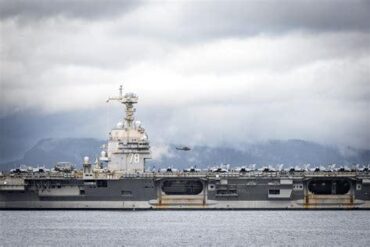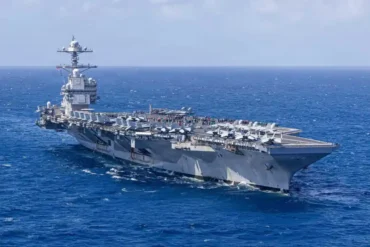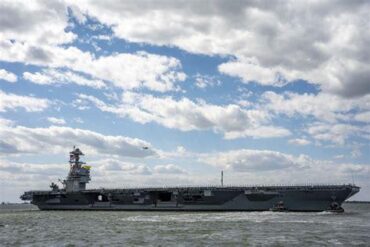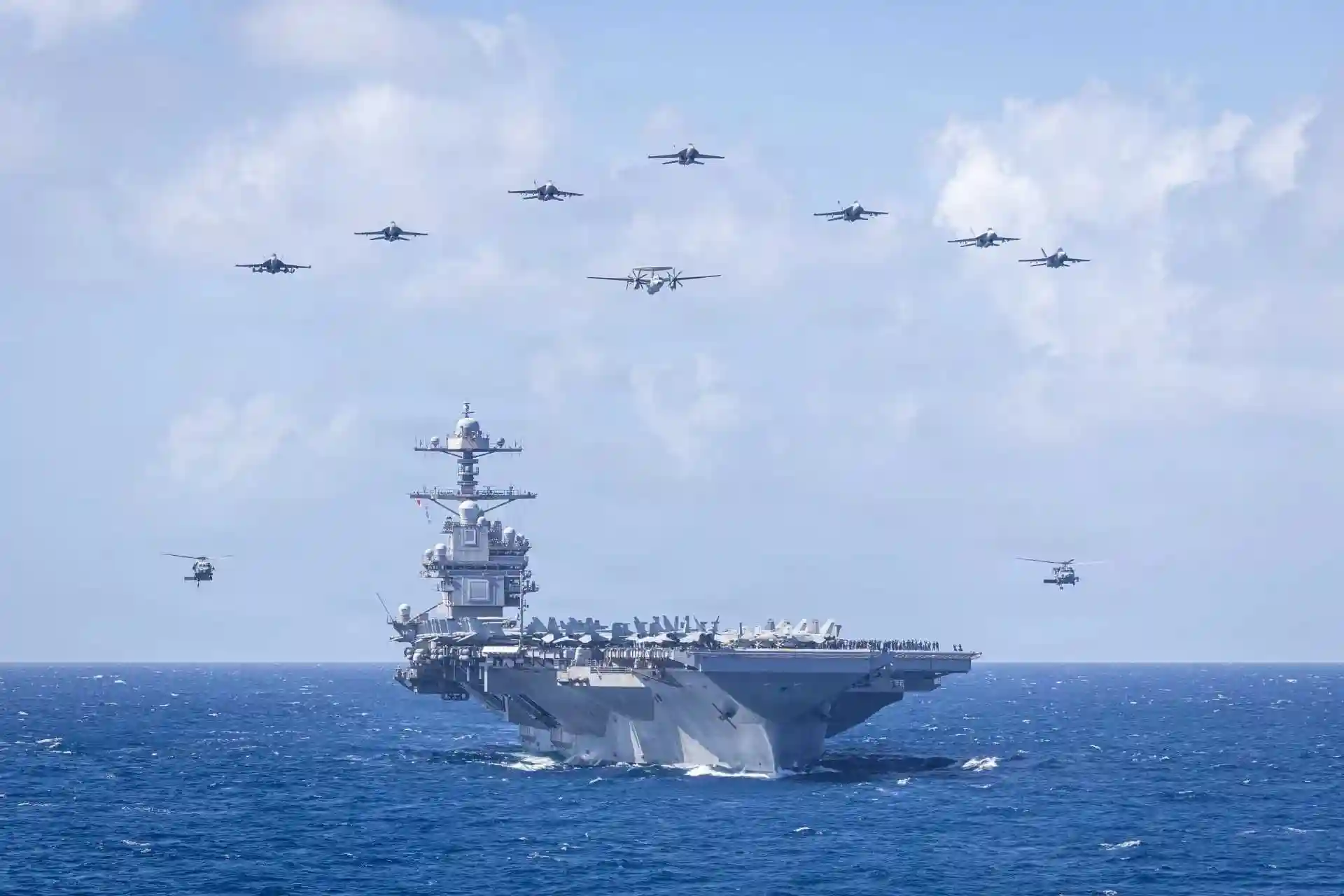
The strategic landscape of the Middle East shifted noticeably in early March 2026 when the United States Navy’s most advanced aircraft carrier, USS Gerald R. Ford (CVN-78), entered the Red Sea for the first time in its operational history. The deployment follows the carrier’s transit through the Suez Canal on March 5, placing the world’s largest warship directly inside the operational theater of U.S. Central Command during a period of escalating confrontation with Iran.
The arrival of the Ford-class carrier dramatically expands American naval aviation capability in the region as part of Operation Epic Fury, a campaign aimed at countering Iranian military activity and protecting maritime corridors threatened by missile and drone attacks. Positioned between the Mediterranean and the approaches to the Persian Gulf, the Red Sea provides an ideal launch platform for sustained air operations while maintaining proximity to critical shipping lanes connecting Europe, Africa, and Asia.
The move also represents the first Middle East deployment for USS Gerald R. Ford, the lead ship of a new generation of American supercarriers designed to increase combat sortie rates while reducing crew size and operational costs compared with the earlier Nimitz-class vessels.
Strategic Entry Into a Volatile Maritime Corridor
The Ford’s entry into the Red Sea occurred against the backdrop of intensifying regional tension following coordinated U.S. and Israeli strikes on Iranian military infrastructure. In response, Iran and affiliated groups launched waves of missiles and drones toward allied targets and maritime assets. While many of these attacks were intercepted by layered air defense systems, the incidents reinforced concerns about the vulnerability of commercial shipping and naval forces operating in the region.
By relocating from the eastern Mediterranean to the Red Sea, the carrier strike group now sits closer to both Iranian military facilities and the contested maritime corridors that have experienced repeated attacks. The move allows American naval aviation to respond more quickly to emerging threats while strengthening defensive patrols over vital shipping routes.
The Red Sea has increasingly become a geopolitical pressure point due to its connection to the Bab el-Mandeb Strait, one of the world’s most important chokepoints for energy shipments and global trade. Missile and drone attacks launched by Iranian-aligned groups in recent years have raised fears that disruption to this corridor could affect global supply chains.
Deploying the most powerful aircraft carrier ever built into this environment signals Washington’s intent to maintain maritime security and ensure that international shipping lanes remain open.
The World’s Largest Warship at the Center of Operations
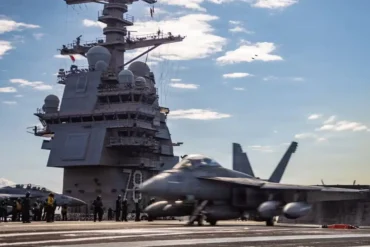
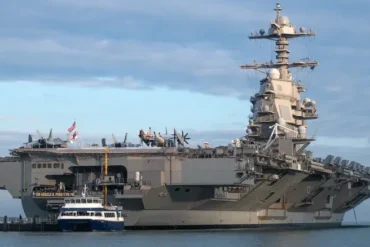
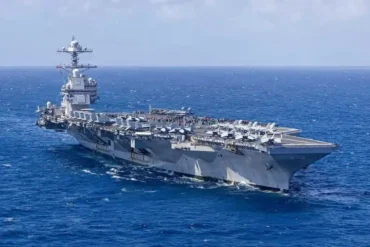
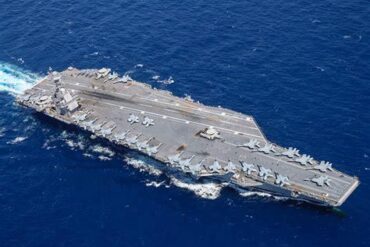
USS Gerald R. Ford stands as a technological milestone in naval engineering. Displacing roughly 100,000 tons at full load, the vessel stretches 1,106 feet in length and carries a flight deck spanning more than 256 feet in width. With a height approaching 250 feet from keel to mast, the ship resembles a floating city capable of sustaining thousands of personnel and dozens of aircraft.
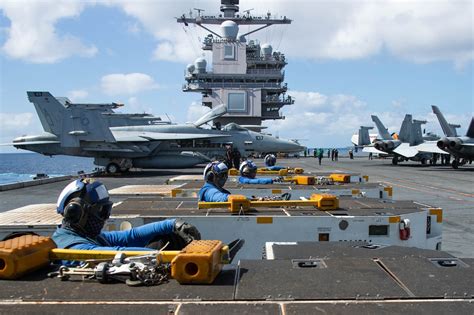
The carrier houses 25 decks and accommodates approximately 4,500 sailors and air wing personnel, forming a self-contained combat ecosystem capable of projecting power across vast distances. Its aviation facilities allow the ship to operate more than 75 aircraft, ranging from strike fighters to surveillance platforms and electronic warfare aircraft.
Propulsion is provided by two Bechtel A1B nuclear reactors, a next-generation design that generates significantly more electrical power than previous carrier reactors. This enormous energy supply enables high-speed operations exceeding 30 knots while supporting advanced onboard systems and future technologies such as directed-energy weapons.
Perhaps most remarkable is the carrier’s endurance. The nuclear reactors can operate for around 25 years without refueling, allowing the ship to remain deployed for extended periods limited primarily by crew rotation and logistical support rather than fuel availability.
Revolutionary Technology Redefining Carrier Aviation
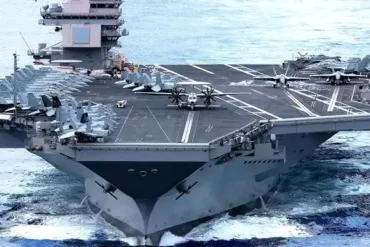
The Ford class introduced several groundbreaking innovations intended to transform aircraft carrier operations. The most visible of these is the Electromagnetic Aircraft Launch System (EMALS), which replaces the steam catapults used on earlier carriers.
Traditional steam catapults required large quantities of pressurized steam drawn from the ship’s reactors. EMALS instead uses powerful electromagnetic motors to accelerate aircraft along the flight deck. This method allows for smoother launches, improved energy efficiency, and the ability to launch a wider range of aircraft weights.
Another major innovation is the Advanced Arresting Gear (AAG) system used to recover aircraft during landing. Unlike older hydraulic systems, AAG relies on energy-absorbing mechanisms that adjust automatically based on aircraft weight, reducing mechanical stress and improving reliability.
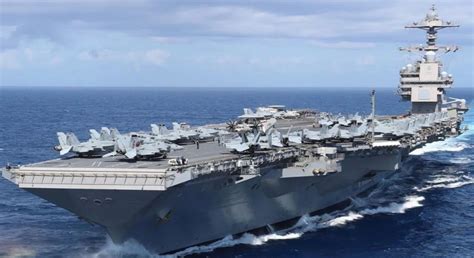
The carrier’s internal layout was also redesigned to streamline weapons handling. New high-speed elevators move munitions from storage magazines directly to the flight deck, significantly accelerating the preparation of aircraft for combat missions. These improvements are expected to increase sortie generation rates by up to 25 percent while reducing crew requirements by roughly the same margin.
The ship’s island superstructure, which houses radar and command facilities, was repositioned about 140 feet farther aft compared with earlier carrier designs. This change expands usable flight deck space and improves the flow of aircraft during launch and recovery cycles.
Together, these technological advances transform the Ford-class carrier into a highly efficient platform capable of sustaining intense air operations during prolonged conflicts.
Air Wing Power During Operation Epic Fury
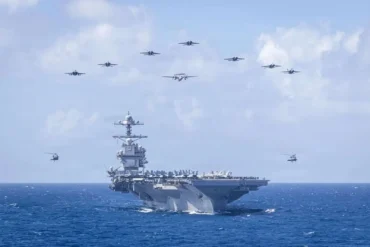
During the ongoing Operation Epic Fury, aircraft launched from USS Gerald R. Ford are playing a central role in strike missions, surveillance, and electronic warfare across the region.
The carrier’s air wing includes several key platforms:
- F/A-18E and F/A-18F Super Hornet multirole fighters conducting precision strikes against military infrastructure and mobile targets.
- EA-18G Growler electronic warfare aircraft designed to jam and suppress enemy air defense networks.
- E-2D Advanced Hawkeye airborne early warning aircraft providing battle management, surveillance, and command coordination.
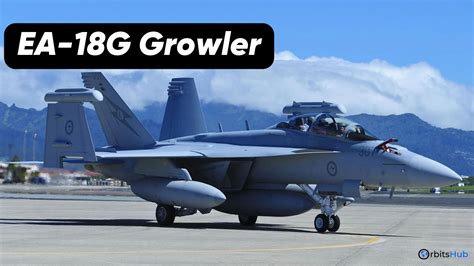
Together these aircraft create a layered operational capability that combines offensive strikes with defensive counter-air patrols. Hawkeye aircraft detect threats at long distances, Growlers disrupt radar and missile systems, and Super Hornets deliver precision munitions against strategic targets.
This networked airpower allows the carrier strike group to respond quickly to missile launches, drone swarms, or hostile aircraft operating within the theater.
Expanding the Role of Unmanned Strike Systems
One of the more experimental aspects of Operation Epic Fury has been the introduction of LUCAS low-cost one-way attack drones, deployed by a specialized formation known as Task Force Scorpion Strike.
These unmanned systems are designed to complement traditional carrier aviation by adding a distributed strike capability. Instead of relying solely on expensive fighter jets, commanders can launch swarms of inexpensive attack drones capable of overwhelming enemy defenses or targeting high-value infrastructure.
The integration of unmanned systems with carrier operations hints at the evolving future of naval warfare. In many scenarios, drones may perform reconnaissance or initial strike missions while manned aircraft provide command oversight and precision targeting.
This blend of human pilots and autonomous systems represents a significant shift in military doctrine, reflecting broader technological changes reshaping modern battlefields.
Dual Carrier Presence Strengthens U.S. Naval Aviation
The Ford’s arrival in the Red Sea also coincides with the continued deployment of the Nimitz-class carrier USS Abraham Lincoln, currently operating in the Arabian Sea.
The simultaneous presence of two American carrier strike groups creates a formidable concentration of naval aviation power across the region. With two flight decks available, operations can be divided between offensive strike missions and defensive patrols, enabling continuous air coverage over multiple maritime zones.
Carrier escorts equipped with the Aegis combat system further enhance the task force’s defensive capabilities. Guided-missile destroyers and cruisers can intercept ballistic missiles using Standard Missile interceptors while also launching Tomahawk cruise missiles for long-range precision strikes.
This layered approach forms one of the most sophisticated maritime defense networks ever assembled in the region.
A Deployment Approaching Historic Duration
USS Gerald R. Ford departed Naval Station Norfolk on June 24, 2025, beginning a mission that has already stretched beyond 255 days at sea by early March 2026. If the deployment continues as planned, the carrier could remain operational in the region until May 2026, pushing the mission close to the 11-month mark.
Such a timeline would rival some of the longest American carrier deployments since the Vietnam War. In recent decades, the longest post-Vietnam carrier deployment occurred between 2019 and 2020, when USS Abraham Lincoln spent 294 days away from home port.
While nuclear propulsion allows the Ford to operate for decades without refueling, long deployments still require complex logistical support. Supply ships deliver food, aviation fuel, spare parts, and munitions, while aircraft occasionally transport urgent equipment or personnel to the carrier at sea.
Extended missions also place pressure on crews and equipment. Aircraft require continuous maintenance, and mechanical systems aboard the ship must operate under demanding conditions for months at a time.
Preparing for Possible Three-Carrier Operations
Even as Ford and Abraham Lincoln conduct operations across the Middle East, preparations are underway for a potential third carrier deployment. The USS George H.W. Bush recently completed an intensive training cycle along the U.S. East Coast, during which its air wing flew 1,586 sorties and conducted more than 1,300 arrested landings.
If deployed, the Bush strike group would bring three American carriers within operational reach of Iran, dramatically expanding the United States’ ability to sustain continuous air operations across multiple theaters.
Such a concentration of naval aviation would enable simultaneous missions spanning the Mediterranean Sea, Red Sea, and Persian Gulf, while reinforcing maritime security operations along some of the world’s most critical shipping routes.
The arrival of USS Gerald R. Ford in the Red Sea therefore marks more than a simple repositioning of naval assets. It represents a clear demonstration of modern carrier power at a moment when the geopolitical balance of the Middle East remains volatile, and when control of the sea lanes continues to shape global stability.