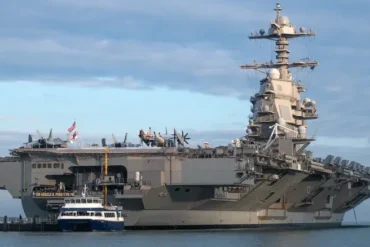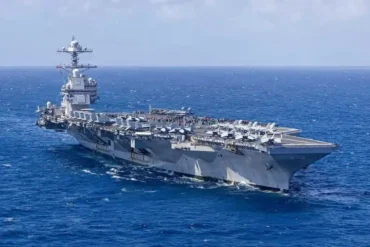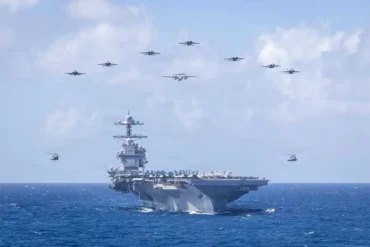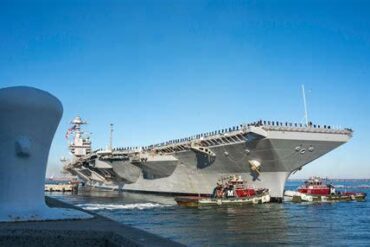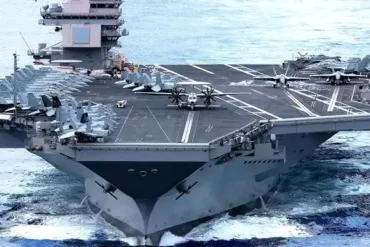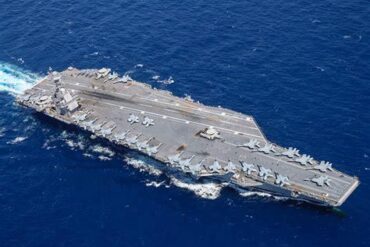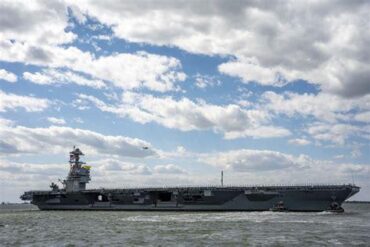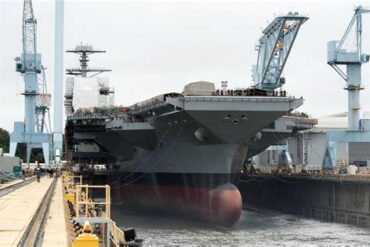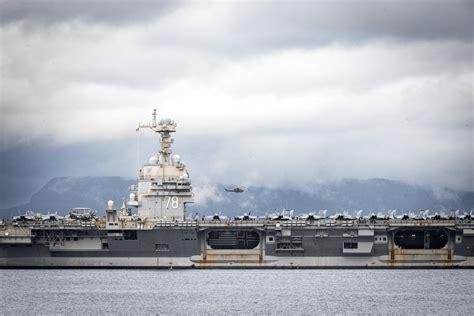
The USS Gerald R. Ford, the United States Navy’s most advanced and expensive aircraft carrier, has rewritten modern naval history with a staggering 297-day deployment, surpassing the USS Abraham Lincoln’s 294-day record set during the global turmoil of 2020. What appears on the surface as a triumph of endurance and operational capability reveals a far more complicated story beneath the steel decks—one marked by combat intensity, mechanical strain, crew fatigue, and unexpected onboard crises.
This unprecedented deployment was never meant to stretch into nearly ten months at sea. Originally scheduled as a standard European rotation, the mission evolved into a multi-theatre operation spanning the Mediterranean, Caribbean, Arctic, and Middle East. Each redirection extended not just the carrier’s reach, but also the limits of its crew and systems, turning a routine deployment into a defining test of modern naval warfare resilience.
By the time the carrier crossed its ninth month at sea, it had not only broken records but also exposed the fragility of even the most advanced warships when pushed beyond designed operational cycles. The Ford’s journey became a floating case study in how strategic demands can collide with human endurance and mechanical reality.
From Routine Deployment to Global Flashpoint Operations
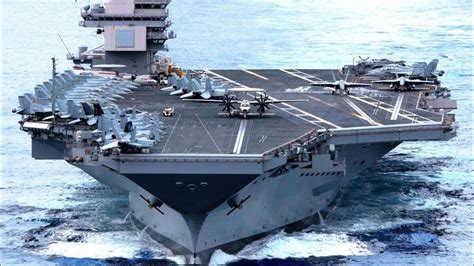
When the USS Gerald R. Ford departed Naval Station Norfolk on June 24, 2025, its mission profile was clear: support NATO allies, participate in joint exercises, and maintain a visible deterrent presence in European waters. Early operations unfolded as planned, with participation in Exercise Neptune Strike and maneuvers across the Adriatic Sea, central Mediterranean, and North Sea, eventually extending into Arctic operations.
Yet global tensions have a way of rewriting carefully laid plans. By October 2025, rising instability in Venezuela prompted the Pentagon to redirect the carrier strike group to the Caribbean under U.S. Southern Command (USSOUTHCOM). The Ford’s mission shifted dramatically—from alliance reassurance to counter-narcotics operations and geopolitical intervention support.
The stakes escalated further in early 2026 when the carrier became entangled in a sensitive operation involving Venezuelan President Nicolás Maduro’s extraction. What should have been the final chapter of the deployment instead became a prelude to yet another reassignment.
Rather than returning home, the Ford was ordered east once more—this time into the volatile CENTCOM theater, where tensions with Iran were rapidly approaching open conflict.
Operation Epic Fury and High-Intensity Combat at Sea
By late February 2026, the USS Gerald R. Ford had transitioned from strategic deterrence to active combat operations. The launch of Operation Epic Fury marked the beginning of a five-week regional war, placing the carrier at the center of sustained air campaigns against Iranian military infrastructure.
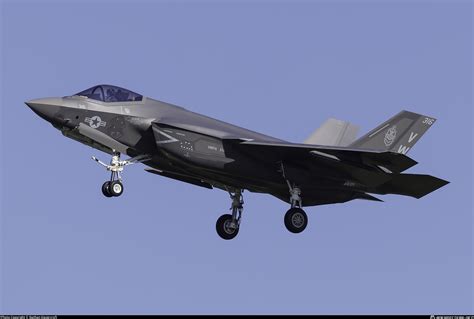
The Ford’s Carrier Air Wing, featuring F/A-18 Super Hornets and F-35C Lightning II fighters, executed relentless sortie cycles. Aircraft launched and recovered around the clock, striking missile installations, air defense networks, naval assets, and logistical hubs. The objective was clear: establish and maintain air superiority in the earliest phase of the conflict.
Such operational intensity came at a cost. Continuous flight operations placed enormous strain on the carrier’s catapults, arresting gear, and flight deck surfaces, while maintenance crews worked under extreme pressure to keep aircraft mission-ready. The tempo blurred the line between day and night, turning time itself into an abstraction for those onboard.
Crisis Within: Fire, System Failures, and Living Conditions
Even as the Ford projected power outward, it faced a series of crises within its own hull. One of the most disruptive incidents involved a catastrophic breakdown of the ship’s sewage system, leaving the majority of its roughly 650 toilets inoperable. Sailors reportedly endured 45-minute queues for basic sanitation—a stark reminder that even advanced warships rely on mundane systems to sustain daily life.
The situation worsened on March 12, 2026, when a major fire erupted in the carrier’s laundry and berthing compartments while operating in the Red Sea. The blaze raged for more than 30 hours, injuring crew members and destroying critical living spaces. For sailors already stretched thin, the fire compounded exhaustion with displacement, as many lost their sleeping quarters entirely.
Speculation surrounding the cause of the fire added another layer of tension. While no conclusions have been confirmed, investigators examined the possibility of deliberate sabotage, fueled by extreme fatigue and frustration among the crew. Whether accidental or intentional, the incident underscored how prolonged deployments can erode not only equipment but also morale.
The Psychological Toll of Endless Deployment
Extended deployments test more than machinery—they test human limits. Life aboard an aircraft carrier follows a relentless rhythm defined by the watch system, where sailors rotate through duties that often stretch across long, irregular hours. In combat zones, this tempo intensifies, leaving little room for rest or recovery.
Over nearly ten months at sea, the Ford’s crew experienced cumulative fatigue, isolation from family, and sustained operational stress. These factors combine into what experts describe as a “psychological time bomb,” where even minor issues can escalate under prolonged pressure.
Reports of deteriorating morale were not limited to anecdotal accounts. Concerns raised by policymakers highlighted the broader implications of such deployments, emphasizing that crew well-being is inseparable from operational effectiveness. Fatigue affects decision-making, reaction time, and coordination—critical elements in both flight operations and combat scenarios.
Mechanical Wear and the Hidden Cost of Endurance
While the Ford’s deployment demonstrated remarkable staying power, it also accelerated wear across nearly every system onboard. Aircraft carriers are engineered for endurance, but not without limits. Prolonged operations intensify degradation in key areas:
- Flight deck surfaces, where non-skid coatings erode under constant aircraft movement
- Launch and recovery systems, which endure repeated high-stress cycles
- Elevators and propulsion systems, strained by continuous operations
- Plumbing and electrical networks, vulnerable to delayed maintenance
Each additional week at sea compounds these stresses, increasing the likelihood of failures like the sewage system breakdown. Maintenance that would normally occur during scheduled port visits or dry dock periods is deferred, often leading to larger and more complex repair requirements later.
The Ford itself was expected to undergo months of shipyard maintenance before its deployment was extended. Delaying these repairs not only raises long-term costs but also risks reducing the carrier’s readiness in future operations.
Logistics, Supply Strain, and Life at Sea
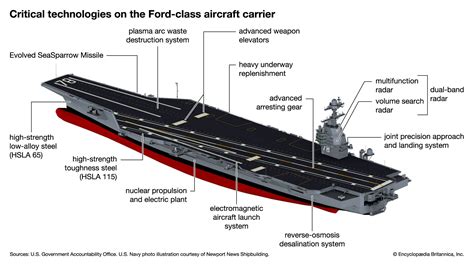
Sustaining a floating city of over 4,500 personnel requires a constant flow of supplies. During extended deployments—especially in combat zones—traditional port visits become limited, forcing reliance on underway replenishment operations. These complex maneuvers transfer fuel, food, and equipment between ships while at sea, often under challenging conditions.
Even with such systems in place, prolonged deployments can strain supply chains. Reports from similar naval operations have pointed to reduced food quality and rationing, highlighting how logistical challenges ripple through daily life onboard.
For sailors, these conditions reinforce the sense of isolation. Meals, rest, and personal time—already scarce—become further constrained, amplifying fatigue and affecting morale in subtle but significant ways.
Strategic Implications of Record-Breaking Deployments
The USS Gerald R. Ford’s 297-day deployment sends a powerful message about U.S. naval reach and flexibility, demonstrating the ability to project force across multiple theaters without interruption. Yet it also raises difficult questions about sustainability.
Modern naval strategy increasingly relies on a smaller number of highly capable platforms. When one of these platforms is extended beyond its planned cycle, the consequences ripple across the entire force structure. Maintenance delays, crew burnout, and increased costs are not isolated issues—they shape long-term readiness.
Extended deployments can also impact reenlistment rates, as sailors weigh the demands of service against personal and family considerations. Retaining experienced personnel becomes more challenging when deployments grow longer and more unpredictable.
A Record That Redefines Limits
The USS Gerald R. Ford’s historic deployment is both an achievement and a warning. It showcases the extraordinary capabilities of modern naval engineering and the dedication of the sailors who operate it. At the same time, it reveals the hidden costs of sustained global presence, where success is measured not just in missions completed, but in the resilience of the people and systems involved.
As the carrier continues operations in the Eastern Mediterranean, its legacy is already secured—not just as a record-breaker, but as a case study in the evolving realities of naval warfare. The lesson is clear: endurance has limits, and pushing beyond them comes with consequences that no amount of advanced technology can fully eliminate.