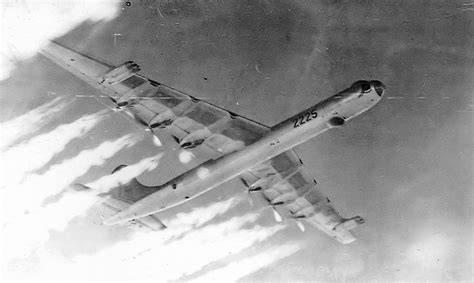
The Convair B-36 Peacemaker was an aircraft built around an extraordinary idea: create a bomber capable of leaving North America, reaching targets thousands of miles away, delivering enormous weapons, and returning without depending on overseas bases. It was conceived when the United States feared that Europe might become inaccessible during World War II, yet it eventually entered service in a completely transformed strategic environment. By then, the bomber was no longer preparing for the Second World War. It was becoming the centerpiece of America’s early nuclear deterrent.
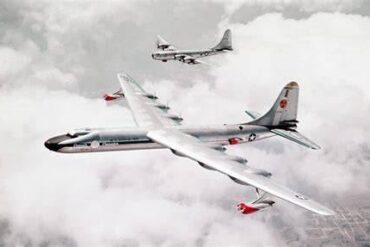
At its peak, the B-36 represented an extraordinary combination of size, range, payload, and altitude. It was the largest piston-engined combat aircraft ever placed into operational service, with a wingspan of 230 feet and a maximum bomb load approaching 86,000 pounds. Its six enormous Pratt & Whitney R-4360 Wasp Major radial engines gave it the distinctive appearance of a giant flying machine from another technological era.
Yet the B-36 faced an unavoidable problem. Aviation was changing faster than the bomber could evolve. The piston engine was giving way to the turbojet, fighter aircraft were becoming dramatically faster, radar-directed defenses were improving, and the Soviet Union was developing weapons designed specifically to defeat high-flying bombers. The Air Force responded with a remarkable solution: it bolted four General Electric J47 turbojets onto the B-36.
The modification produced one of the most recognizable aircraft configurations of the early Cold War. A B-36 could now be described by the famous phrase “six turning and four burning.” But the extra engines were ultimately a bridge between two technological eras, not a permanent solution. The B-36 remained immensely capable, but its basic design was already becoming obsolete.
The B-36 Peacemaker Was Born From a World War II Nightmare
The origins of the B-36 Peacemaker stretch back to 1941, before the United States entered World War II. American military planners were concerned that Britain might be defeated by Germany. If that happened, American bombers could lose the forward bases needed to attack targets in continental Europe.
The solution was radical. The United States wanted a bomber capable of flying from North America to Europe and back without relying on intermediate bases. That requirement demanded enormous range, substantial fuel capacity, a huge airframe, and an unprecedented payload capability.
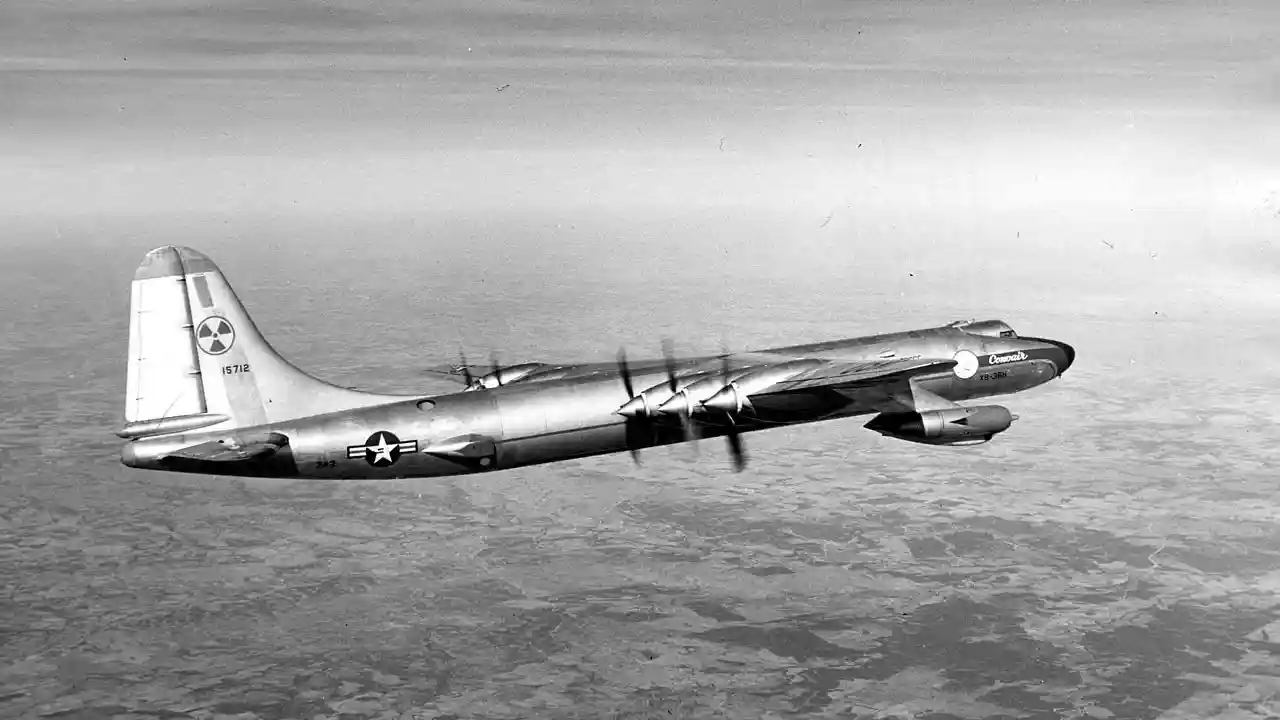
Consolidated Vultee, which later became part of Convair, developed the aircraft around those requirements. The resulting design was enormous even by modern standards. Its massive wings were optimized for efficient high-altitude flight, while the six R-4360 engines were installed in a pusher configuration, placing the propellers behind the wings rather than ahead of them.
The B-36 made its first flight in August 1946. By June 1948, the Strategic Air Command had received its first operational aircraft. The timing was remarkable. The war that had created the original requirement had already ended, but the strategic purpose of the aircraft had changed rather than disappeared.
The arrival of nuclear weapons gave the Peacemaker a new mission. Instead of being simply an intercontinental conventional bomber, it became the United States’ first purpose-built intercontinental nuclear bomber.
A Bomber Designed for Weapons That Other Aircraft Could Not Carry
The B-36’s greatest advantage was not speed. It was size and payload capacity.
The aircraft could carry approximately 86,000 pounds of bombs, a figure that dwarfed the payload capacity of earlier strategic bombers. Its enormous internal bomb bays were designed to accommodate weapons that were too large and heavy for most existing aircraft.
This became particularly important as nuclear weapons evolved. Early atomic bombs were already large, but the first thermonuclear weapons presented an even greater challenge. Some experimental hydrogen bombs weighed tens of thousands of pounds, forcing designers to think about bombers as enormous weapons-delivery platforms rather than simply long-range aircraft.
The B-36 was exceptionally well suited to that role. Its huge fuselage and extensive bomb bays provided the capacity needed for the first generation of very large nuclear weapons.
The geopolitical environment also made the aircraft relevant. When the Soviet Union successfully tested its first atomic bomb in 1949, the United States could no longer assume a permanent nuclear monopoly. The B-36 therefore became an important part of America’s ability to threaten targets deep inside Soviet territory.
For several years, its combination of range, altitude, and payload made it extremely difficult to replace.
Why the B-36 Was Initially So Difficult to Intercept
During the late 1940s, the B-36 possessed a major defensive advantage that had little to do with guns.
It could operate at altitudes around 40,000 feet, with later versions reaching approximately 45,000 feet. At that time, many Soviet fighters lacked the performance necessary to reliably intercept such a high-flying target.
The B-36’s range also complicated defensive planning. It could approach Soviet targets from different directions, forcing defenders to protect a vast area rather than concentrating their resources along a single predictable route.
This was the strategic environment in which the Peacemaker initially made sense. Its slow cruising speed was less problematic when potential interceptors could not easily reach it.
But aviation technology did not stand still.
The emergence of increasingly capable Soviet jet fighters fundamentally changed the equation. Aircraft such as the MiG-17 and MiG-19 offered far greater speed and climb performance than the fighters of the late 1940s. At the same time, radar-guided air-defense systems and surface-to-air missiles began creating another layer of danger.
The B-36 was no longer merely facing fighters. It was facing an increasingly sophisticated integrated air-defense system.
The Four J47 Turbojets Created “Six Turning and Four Burning”
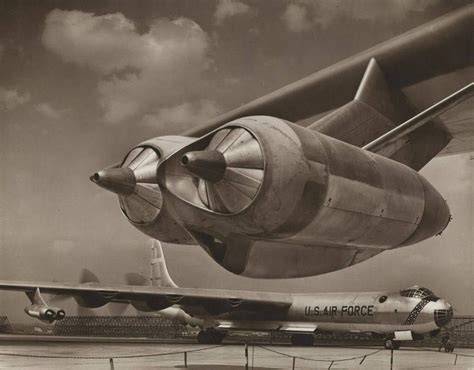
The Air Force understood that the B-36 needed more performance. The most visually dramatic answer was the installation of four General Electric J47 turbojet engines.
These engines were mounted in two twin-engine pods beneath the outer wings. Their addition transformed the aircraft’s appearance and gave the Peacemaker a substantial temporary performance boost.
The piston engines remained the primary propulsion system. The turbojets were supplementary powerplants rather than replacements. They were particularly valuable during heavy-weight takeoffs, when the enormous aircraft needed every available pound of thrust.
The jets also helped the B-36 climb more rapidly and provided additional speed when operating in potentially hostile airspace. In an emergency or during a high-speed dash, the aircraft could ignite its four turbojets and dramatically increase its performance.
This produced the famous description “six turning and four burning.”
The arrangement was clever, but it came with a significant drawback: turbojets of the period consumed enormous quantities of fuel. Keeping all four J47s running continuously would have been economically and operationally inefficient.
The engines were therefore used selectively. They supplied extra thrust when it mattered most rather than becoming the aircraft’s normal source of propulsion.
Why Four Jet Engines Could Not Save the B-36
The turbojet modification improved the B-36, but it could not change its fundamental identity.
The aircraft was still overwhelmingly a piston-powered bomber. Its normal cruise performance remained dramatically below that of the new generation of all-jet strategic aircraft.
A B-36J cruised at approximately 230 mph, or around 200 knots, while its four J47s could raise maximum speed to roughly 435 mph. That was an impressive improvement, but it remained a temporary burst of performance rather than a transformation into a true jet bomber.
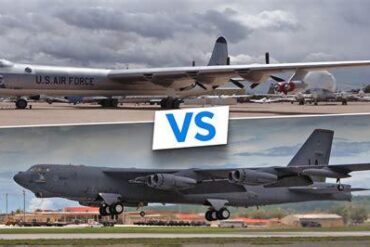
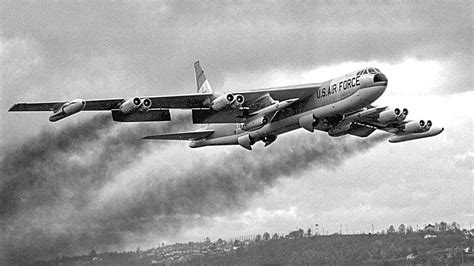
The difference became obvious when the B-36 was placed beside aircraft such as the Boeing B-47 Stratojet and Boeing B-52 Stratofortress.
The B-47 could cruise at roughly 434 knots, while the B-52 could reach approximately 456 knots. These aircraft were not simply faster versions of the same concept. They represented a fundamentally different approach to strategic bombing.
The B-36’s piston engines were powerful and efficient for their era, but they were mechanically complicated. Each R-4360 contained 28 cylinders, and the aircraft’s six engines demanded extraordinary maintenance.
The pusher arrangement introduced additional complications. The engines were prone to overheating and fires, while maintenance crews faced an enormous workload. Servicing the aircraft could involve changing a staggering 336 spark plugs.
The B-36 was therefore becoming expensive to keep operational at exactly the moment when its strategic advantages were being eroded.
Featherweight Modifications Could Only Go So Far
The Air Force tried more than turbojets to extend the bomber’s useful life.
The Featherweight programs removed equipment that was no longer considered essential, including defensive armament, ammunition, armor, and other weight. The objective was straightforward: reduce the aircraft’s mass and improve altitude, range, and speed.
The approach made sense. A lighter aircraft could climb higher, fly farther, and perform better without requiring a completely new propulsion system.
Electronics were also upgraded, while specialized reconnaissance versions such as the RB-36 expanded the aircraft’s usefulness beyond bombing.
Some B-36s even participated in highly unusual reconnaissance concepts. Modified aircraft were adapted to launch and recover specially configured RF-84 aircraft, demonstrating the remarkable flexibility engineers were attempting to extract from the enormous platform.
But these modifications were ultimately attempts to delay the inevitable.
The fundamental problem was not simply that the B-36 was heavy. It was that the jet age had changed the requirements for survivability.
The B-52 Made the B-36 Obsolete
The emergence of the Boeing B-52 Stratofortress accelerated the Peacemaker’s decline.
The B-52 offered intercontinental range while being considerably faster. Its eight jet engines provided the performance needed to operate in a strategic environment increasingly dominated by fast interceptors and sophisticated air defenses.
This mattered enormously. A bomber’s ability to survive depended not only on how much it could carry or how far it could fly. It also depended on how quickly it could reach its target, how long it remained exposed, and how effectively it could respond to changing threats.
The B-36’s immense size became increasingly less useful as its speed became increasingly inadequate.
By the middle of the 1950s, Soviet fighters were advancing rapidly, while surface-to-air missile systems such as the S-25 Berkut and later S-75 Dvina threatened high-altitude aircraft. The Peacemaker’s original advantage—operating too high for most fighters—was disappearing.
The four J47s could give the aircraft a short burst of additional speed, but they could not provide the sustained performance of an all-jet bomber.
The distinction was crucial. The B-36 was being optimized to survive yesterday’s threat while the B-52 was designed around tomorrow’s battlefield.
The B-36 Was Too Big, Too Complicated, and Too Late
The Peacemaker’s tragedy was not that it was a bad aircraft.
It was an extraordinary aircraft designed for a strategic problem that changed before the aircraft could fully mature.
The B-36 entered service in 1948, only a few years after World War II had ended. Yet within a decade, the technology surrounding strategic aviation had transformed dramatically.
The bomber was also expensive to operate. Six enormous radial engines, four auxiliary turbojets, extensive maintenance requirements, large crews, and a gigantic airframe created a logistical burden.
Its sheer size, once a symbol of capability, increasingly became a liability. A smaller, faster jet bomber could deliver a comparable strategic effect while offering better performance against emerging defenses.
The B-36 also suffered from timing. It never gained the combat legacy of the B-29. It arrived too late for World War II, did not participate in the Korean War, and was retired before the Vietnam War became a major American air campaign.
Consequently, its historical reputation never matched its technological significance.
Why the B-36 Peacemaker Still Matters
The final B-36 was retired in 1959, bringing the aircraft’s operational career to an end after roughly eleven years.
That relatively short career can make the Peacemaker appear unsuccessful, but that interpretation misses its importance. The B-36 was a bridge between the piston-engine bomber era and the modern jet-powered strategic age.
Its design demonstrated what was possible when range and payload were given priority above almost everything else. Its massive bomb bays helped accommodate the enormous nuclear weapons of the early Cold War. Its reconnaissance variants expanded the aircraft’s role, while its J47 turbojets demonstrated the Air Force’s determination to keep the platform relevant.
Ultimately, however, no amount of modification could reverse the technological revolution surrounding it.
The four turbojets were a remarkable engineering compromise, but they could not turn a piston bomber into a true jet bomber. The B-36 remained an enormous aircraft powered primarily by radial engines, operating in an era increasingly dominated by aircraft designed around turbojet propulsion.
Only four complete B-36 aircraft survive today in museums, and none remains airworthy. Their preservation nevertheless provides a tangible reminder of an extraordinary moment in aviation history.
The Peacemaker was enormous, ambitious, expensive, mechanically demanding, and technologically transitional. It was also one of the most important strategic aircraft ever built by the United States.
Its story illustrates a brutal truth about military aviation: sometimes an aircraft does not become obsolete because engineers stop improving it. It becomes obsolete because the world changes faster than the improvements can keep up.
For the B-36, four jet engines bought valuable time. They improved takeoff performance, climb, and high-speed capability, and they helped the aircraft remain useful during the early Cold War. But they could not solve the deeper problem.
The jet age had arrived.
And once the B-52 Stratofortress demonstrated what a true all-jet strategic bomber could accomplish, the Peacemaker’s enormous piston-powered silhouette was already becoming a relic of the past.