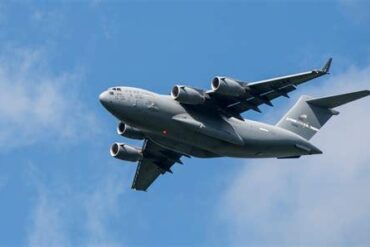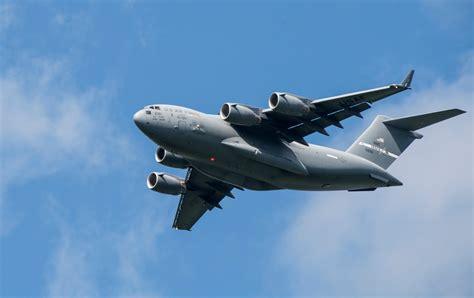
The Boeing C-17 Globemaster III occupies a rare space in modern aviation. It is at once enormous and agile, strategic and tactical, brute-force powerful yet engineered with finesse. Among military airlifters, it has earned a reputation not just as a workhorse, but as a machine that routinely bends expectations of what an aircraft its size should be able to do. At the heart of that reputation lies a simple but astonishing number: the thrust generated by its four engines.
Understanding how much thrust each engine produces—and why that figure is so critical—reveals how the C-17 manages feats that would overwhelm most large aircraft. Heavy armor, helicopters, humanitarian aid pallets, paratroopers, or medical evacuation loads are all routine. Short, unimproved runways and hot-and-high conditions are part of the job description. None of this is possible without extraordinary propulsion.
The C-17 is not simply big; it is demanding. Every design choice, from wing geometry to landing gear, assumes engines capable of delivering reliable, predictable, and immense power. Those engines do more than push the aircraft forward. They define how, where, and under what conditions the Globemaster can operate.
From Cold War Requirement to Global Backbone
The origins of the C-17 trace back to the closing decades of the Cold War, when the US Air Force faced a logistical dilemma. The aging C-141 Starlifter lacked the payload capacity and flexibility required for modern operations, while the smaller C-130 Hercules could not handle outsized cargo or long intercontinental missions. What was needed was a single aircraft that could bridge the gap—strategic reach paired with tactical access.
McDonnell Douglas, later absorbed into Boeing, proposed a design that initially seemed almost contradictory. The aircraft would be large enough to cross oceans with heavy cargo, yet capable of landing on short, damaged, or unimproved runways close to the front lines. Achieving that balance meant pushing the limits of propulsion, aerodynamics, and flight control systems.
The C-17 first flew on September 15, 1991, but its development path was anything but smooth. Early testing revealed weight growth and performance shortfalls, raising serious concerns about range and payload. Engineers refined aerodynamics, improved software-driven flight controls, and leaned heavily on engine performance to recover lost margins. When the first operational squadron stood up in January 1995, the aircraft had transformed from a risky program into a cornerstone capability.
Over time, crews gave it a fitting nickname: “the Moose.” The name does not reference size alone. During aerial refueling, air venting from the fuel system produces a deep, resonant bellow reminiscent of a moose’s call—an unmistakable sound tied directly to the aircraft’s massive fuel and power systems.
The Pratt & Whitney F117-PW-100: A Military Workhorse
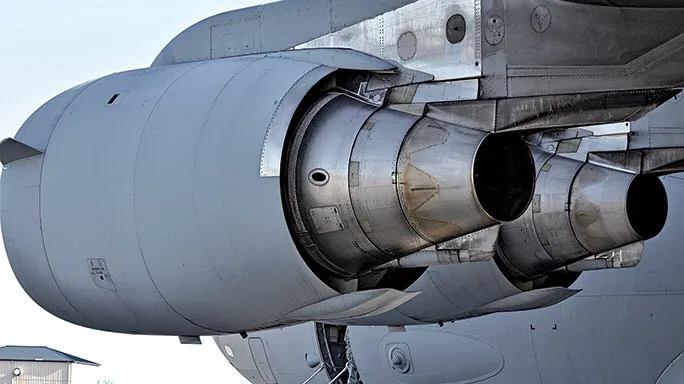
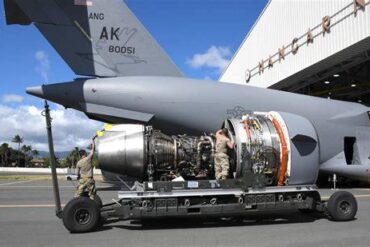
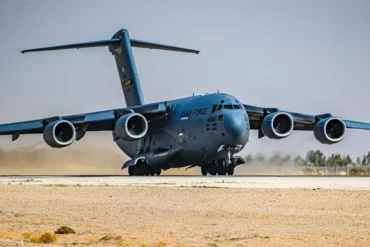
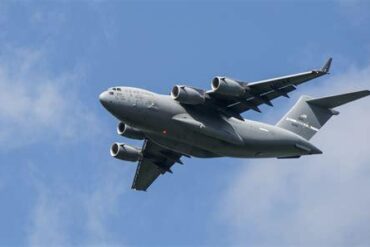
Each C-17 Globemaster III is powered by four Pratt & Whitney F117-PW-100 turbofan engines, one mounted beneath each wing. On paper, each engine is rated at 40,440 pounds of thrust. Multiply that by four, and the result is more than 160,000 pounds of total thrust available at takeoff.
The F117 is derived from the commercial PW2000 engine family, best known for powering the Boeing 757. That commercial lineage is no accident. It provides a foundation of proven reliability, efficiency, and maintainability. Yet the F117 is far from a simple civilian engine with a military label. It was extensively modified to meet the harsh realities of airlift operations.
High-bypass turbofan architecture allows the engine to move a large mass of air at relatively lower exhaust velocity, improving fuel efficiency and reducing noise. While military aircraft are not bound by civilian noise regulations, reduced acoustic footprint remains a tactical and diplomatic advantage, especially when operating near populated areas or allied bases.
Each F117 weighs roughly 7,100 pounds, measures nearly 147 inches in length, and has a maximum diameter of 84.5 inches. Internally, it boasts an overall pressure ratio of 30.8:1 and a bypass ratio of 5.9:1, figures that place it firmly in the class of modern, efficient turbofans.
What truly distinguishes the F117, however, is how it behaves under stress. It is optimized for rapid throttle response, critical during short-field takeoffs and tactical approaches. The engine is controlled by a full-authority digital engine control (FADEC) system, ensuring precise power management and reducing pilot workload during demanding phases of flight.
Why 40,440 Pounds of Thrust Per Engine Is Not Excessive
On first glance, 40,440 pounds of thrust per engine might seem extravagant. In reality, it is carefully matched to the C-17’s size, weight, and mission profile.
The aircraft measures 174 feet in length, spans 169 feet 10 inches, and stands more than 55 feet tall. Empty, it weighs approximately 282,500 pounds. At maximum takeoff weight, that figure climbs to a staggering 585,000 pounds, with a maximum payload capacity of 170,900 pounds.
This mass must be lifted not only from long, well-prepared runways, but often from short, rough, or damaged strips where acceleration distance is limited and engine reliability is non-negotiable. High thrust provides the safety margin needed to get airborne quickly, climb aggressively, and clear obstacles even when heavily loaded.
The thrust-to-weight relationship is especially critical during hot-and-high operations, where reduced air density robs engines of performance and wings of lift. In such environments, the combined output of four F117 engines allows the C-17 to operate where other large transports would be grounded or severely restricted.
Thrust as a Tactical Tool, Not Just Raw Power
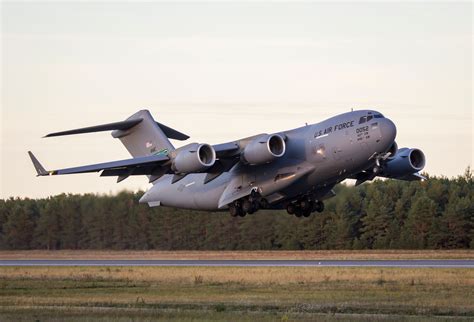
The C-17’s engines do far more than accelerate the aircraft down a runway. They are integral to its tactical capabilities. One of the most distinctive features of the F117 installation is its directed-flow thrust reverser, which can be deployed in flight.
This capability enables steep, controlled descents known as tactical descents, with vertical rates four to five times greater than those of typical commercial airliners. The aircraft can rapidly lose altitude, minimizing exposure to threats while positioning itself precisely for short-field assault landings.
Upon touchdown, full reverse thrust combined with advanced braking allows the C-17 to stop in remarkably short distances for an aircraft of its size. This is not an academic capability. It is what allows the Globemaster to deliver cargo directly into austere or contested airfields, rather than relying on secure, distant hubs.
In these scenarios, engine thrust becomes a maneuvering tool, not just a source of forward motion. Pilots actively manage power to shape approach profiles, control descent angles, and fine-tune touchdown points with an accuracy that belies the aircraft’s mass.
Engine Placement and Airframe Synergy
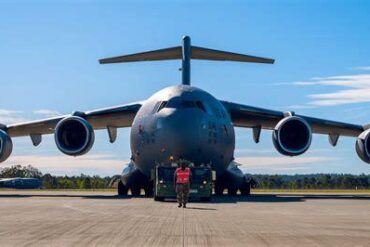
The effectiveness of the C-17’s engines is amplified by how they are integrated into the airframe. The high-wing configuration provides generous ground clearance, reducing the risk of foreign object damage when operating from dirt, gravel, or debris-strewn surfaces. This placement also improves low-speed handling, essential during heavy, slow approaches.
The T-tail design keeps the horizontal stabilizer clear of disturbed airflow from the wings and engines, preserving pitch control during high-angle-of-attack operations. This is particularly important during steep approaches and short-field landings, where precise control margins are slim.
All of these design elements assume engines capable of delivering consistent thrust across a wide operating envelope. Without the F117’s reliability and responsiveness, the airframe’s advanced features would be far less effective.
Airdrop, Aeromedical, and Heavy Equipment Missions
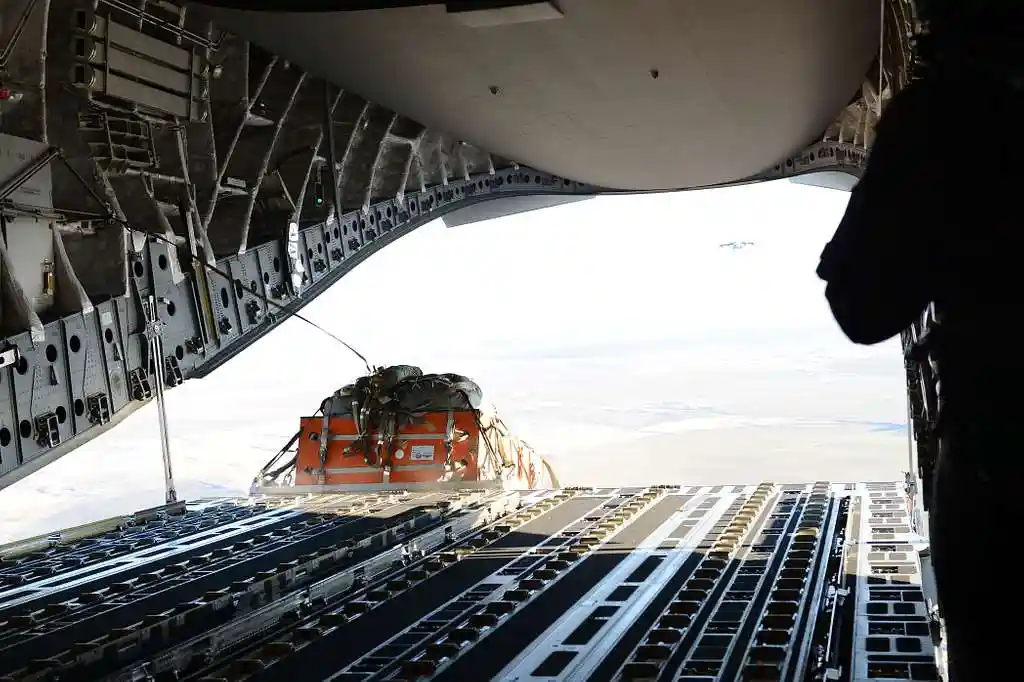
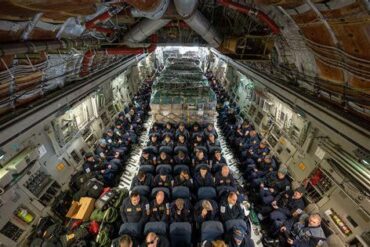
The C-17’s engine thrust underpins its versatility across vastly different mission types. During airdrop operations, precise power management ensures stable flight while cargo or paratroopers exit the rear ramp. The aircraft can carry up to 102 paratroopers, or be configured for 36 litters and 54 ambulatory patients in aeromedical evacuation roles.
For heavy equipment transport, the engines provide the muscle needed to lift armored vehicles and helicopters while maintaining acceptable climb performance. Even after an engine failure, the remaining three F117s deliver sufficient thrust to continue the mission or divert safely, a critical requirement for long-range operations over remote terrain or open ocean.
This redundancy is not theoretical. It is baked into operational planning, allowing commanders to rely on the C-17 in scenarios where failure is not an option.
Reliability Over Decades of Global Operations
The C-17 remained in production until 2015, but its operational life is far from over. Fleets around the world continue to rely on it as a primary heavy airlift platform. Over decades of service, the F117 engines have demonstrated exceptional durability, even under punishing conditions.
Their commercial heritage simplifies logistics and maintenance, while military-specific modifications ensure resilience against dust, debris, and temperature extremes. For crews, predictable engine behavior translates into confidence. For planners, it means fewer mission cancellations and greater global reach.
In many ways, the engines are the quiet enablers of the C-17’s reputation. They rarely draw attention to themselves, yet every dramatic short-field landing, every steep tactical descent, and every overloaded takeoff owes its success to those four turbofans.
Why Engine Thrust Defines the C-17’s Legacy
The question of how much thrust each C-17 engine produces is not merely a technical curiosity. It is the key to understanding why the aircraft has proven so difficult to replace. Few designs can match its blend of payload, range, and access, and fewer still can do so with the same reliability.
At 40,440 pounds of thrust per engine, the Pratt & Whitney F117-PW-100 provides exactly what the Globemaster III demands: power without drama, strength without fragility, and flexibility without compromise. Together, the four engines form the foundation upon which every C-17 mission is built.
As global airlift requirements continue to evolve, the C-17 remains a benchmark. Its engines, quietly and relentlessly delivering over 160,000 pounds of thrust, ensure that this aircraft is not just a product of its era, but a lasting pillar of modern military aviation.