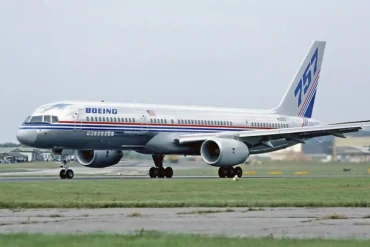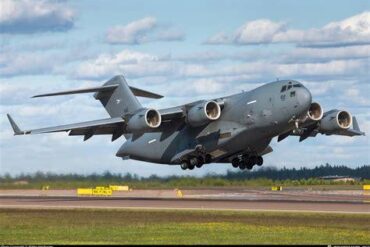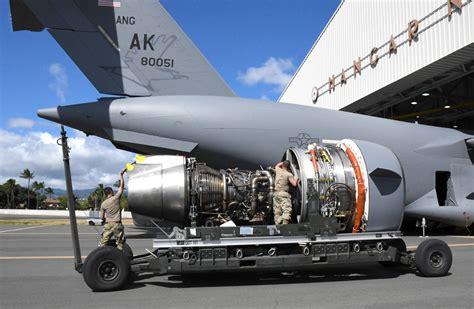
The idea that the C-17 Globemaster III is powered by “Boeing 757 engines” has spread widely across aviation forums, social media, and even some industry corners, largely because it sounds plausible and technically sophisticated. The reality is more precise, more interesting, and far more revealing about how military and commercial aviation technologies evolve. We are dealing not with identical engines, but with a shared engineering bloodline that links two very different aircraft through a common turbofan heritage. Understanding this distinction matters, because it affects how we interpret performance, maintenance, durability, and the true capabilities of one of the world’s most important military transport aircraft.
In aviation, language can be deceptively slippery. When people say “757 engines,” they often blur three separate concepts: the aircraft manufacturer, the commercial engine family, and the military derivative. The C-17 Globemaster III does not sit on the ramp with engines lifted directly from a Boeing 757. Instead, it flies with the Pratt & Whitney F117-PW-100, a military turbofan that was derived from the commercial Pratt & Whitney PW2000 series used on many Boeing 757 aircraft. This single point of origin is where the myth is born, but it is also where the technical story becomes truly fascinating.
Before diving deeper into engines, it is essential to understand the aircraft itself. The C-17 was designed at a time when the United States Air Force needed a transport aircraft that could bridge the gap between intercontinental strategic airlift and front-line tactical delivery. It had to carry oversized cargo, land on short or poorly prepared runways, reverse course quickly, and redeploy without depending on pristine infrastructure. That operational profile drove choices in aerodynamics, structure, and powerplant design that fundamentally separate the C-17 from any commercial narrowbody airliner.
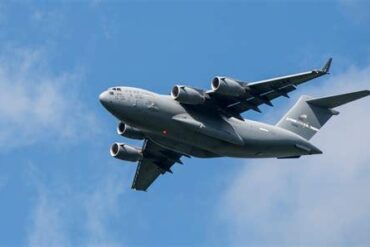
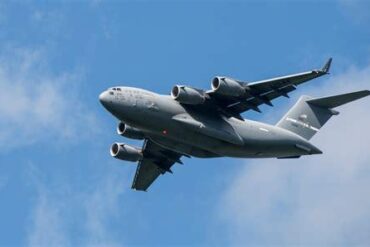
The C-17 Globemaster III features a high-mounted swept wing with advanced high-lift devices that dramatically increase lift at low speeds. Massive multi-segment flaps, leading-edge slats, and externally blown flaps work in harmony with powerful reverse thrust to allow the aircraft to arrive steeply and stop in remarkably short distances. This is not a luxury for a military aircraft; it is survival. The aircraft has proven itself in combat supply missions, humanitarian disasters, and rapid strategic deployments across the globe, consistently demonstrating the flexibility that defined its original design brief.
Where the myth begins to gain traction is at the engine level. The four engines under the C-17’s wings are Pratt & Whitney F117-PW-100 turbofans. These engines are not commercial airliner units casually repurposed, but purpose-built military powerplants that evolved from a commercial ancestor. That ancestor is the Pratt & Whitney PW2000, one of the primary engine families used to power the Boeing 757 during its long and highly respected service life. The relationship is real, but it is one of lineage, not identity.
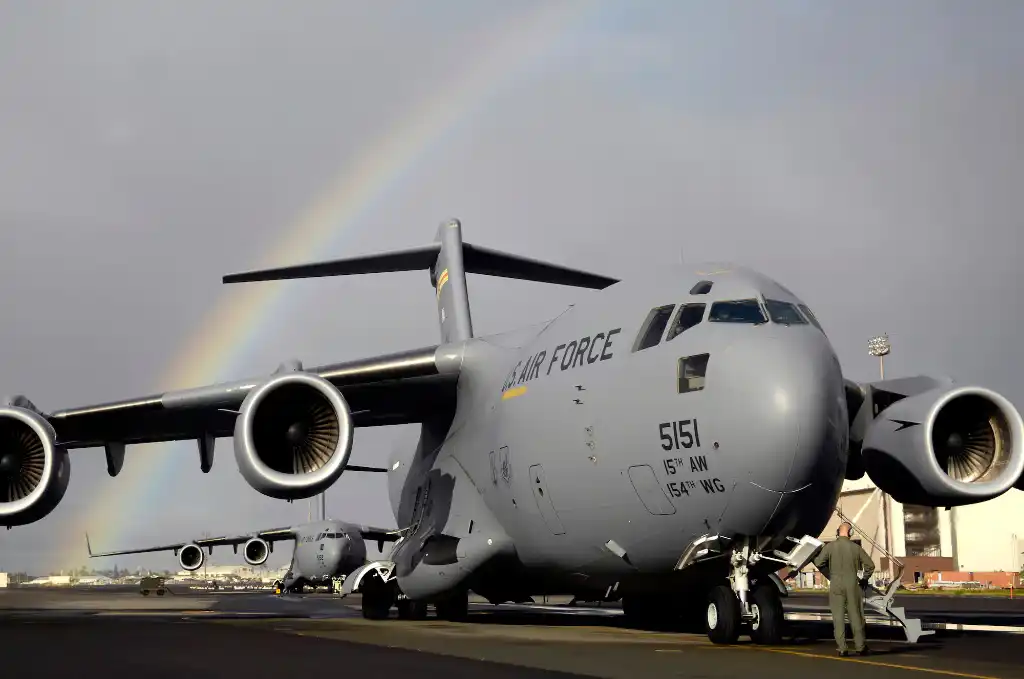
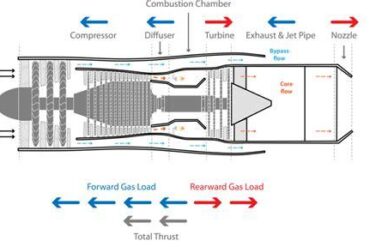
To appreciate the lineage, we must step into the engineering DNA of turbofan engines. Both the PW2000 and the F117 belong to the high-bypass, two-spool turbofan architecture. “High-bypass” means most of the air pulled in by the fan flows around the engine core rather than through it, dramatically improving fuel efficiency and reducing noise. “Two-spool” refers to the design in which the low-pressure and high-pressure sections rotate on concentric shafts, each optimized for its specific operating regime. This architecture is the skeleton shared by both commercial and military variants.
The Boeing 757 itself was conceived as a muscular and efficient narrowbody aircraft. While most people associate it with medium-haul airline routes, its real reputation was built on strong takeoff performance, excellent climb rates, and the ability to operate from hot-and-high airports where thinner air reduces engine performance. These capabilities made the aircraft unusually versatile. Airlines used it on transcontinental routes, long overwater segments with ETOPS certification, and high-density short-haul routes where reliability and power mattered more than raw passenger capacity.
The engines that powered the 757 were either Rolls-Royce RB211-535 variants or Pratt & Whitney PW2000 family engines. The PW2000 was a technological milestone. It was Pratt & Whitney’s first commercial engine to introduce full-authority digital engine control, commonly known as FADEC. This system replaced many mechanical and hydromechanical controls with a digital brain that precisely meters fuel, adjusts variable geometry, and protects the engine from exceeding safe operating limits. This innovation is central to the shared DNA between the C-17 and the 757.
The F117-PW-100 that powers the C-17 is, in essence, a militarized evolution of the PW2000 core. The word “militarized” here is doing heavy lifting. A military engine must tolerate dust ingestion, brutal temperature swings, frequent takeoff and landing cycles, high thrust reverser usage, and long periods of idle punctuated by sudden demands for maximum power. Airlines optimize for smooth cycles and predictable maintenance intervals. Military airlifters demand engines that behave like reliable workhorses in environments that would rapidly wear down commercial equipment.
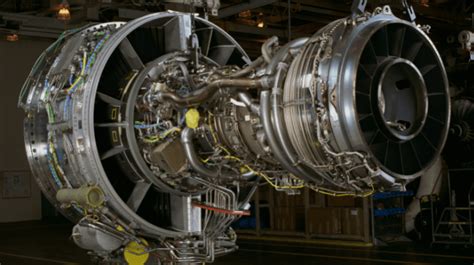
One of the biggest physical and functional differences appears in the thrust reverser system. On the F117, the thrust reverser is designed to be deployable in flight, a feature that assists in steep tactical descents and short-field landings. This is not a feature found on commercial 757 engines. The F117 also incorporates reinforced structures, specialized coatings, and military-specific accessory gearboxes to support additional systems such as more robust generators and battlefield-specific avionics loads.
From the flight deck, the similarities still reveal themselves in subtle ways. Both engines rely on FADEC logic that manages spool speeds, temperature limits, and fuel flow. Pilots would recognize the philosophy of protection logic, even though the actual interfaces and operational procedures differ. For maintainers, the modular construction is another shared philosophy. Major subassemblies, or modules, can be swapped without tearing down the entire engine, significantly reducing downtime. This approach was perfected in the commercial world and then adapted to the military mission profile.
The thrust class further illustrates both similarity and divergence. The F117 delivers approximately 40,000 pounds of thrust, firmly within the high-output range that the PW2000 family was designed to inhabit. This gives the C-17 an extraordinary blend of acceleration, climb performance, and cruise efficiency for such a large aircraft. When fully loaded with armored vehicles, helicopters, or humanitarian pallets, the aircraft still achieves strong runway performance, something that smaller commercial airliners in similar thrust classes could not achieve due to structural and aerodynamic differences.
The misconception that the C-17 uses “Boeing 757 engines” also fails to account for integration. An engine does not exist in isolation. The nacelle design, pylon structure, bleed-air systems, environmental control interfaces, and flight control software are all custom-tailored for the aircraft. Even if two engines share a common ancestor, the way they interact with the airframe is uniquely engineered. The C-17’s entire propulsion system is optimized for reliability under combat-like conditions, rapid turnaround times, and self-sufficiency in remote locations.
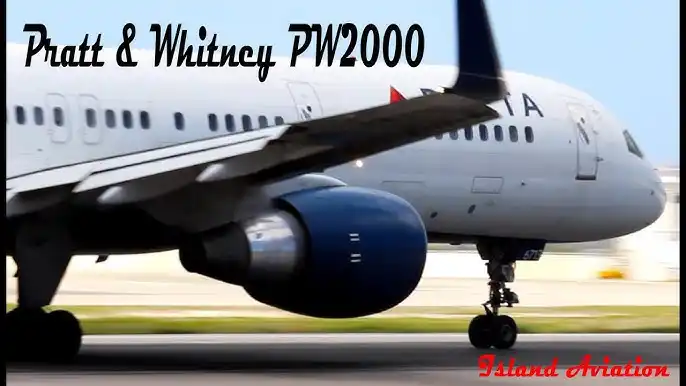
Historically, the decision to base the F117 on the PW2000 made perfect strategic sense. It leveraged an existing, proven commercial engine platform with millions of flight hours and an established global supply chain. This reduced development risk, accelerated testing timelines, and ensured that spare parts and technical expertise would be widely available. However, the Air Force did not want a commercial engine; it wanted a battlefield-ready machine. The result was an engine that feels familiar in its bones but behaves very differently in its daily life.
Real-world operations highlight these differences sharply. Airline 757 engines typically follow predictable maintenance schedules based on flight cycles and hours in relatively clean atmospheric conditions. C-17 engines must tolerate dust storms, sand ingestion, rapid throttle movements, and frequent reverse thrust operations on unpaved or semi-prepared runways. The F117 is designed with advanced filtration, ruggedized components, and specific inspection intervals that reflect this harsher reality.
The myth persists largely because it compresses this complex story into a catchy phrase. Saying “the C-17 uses 757 engines” sounds elegant, authoritative, and easy to remember. The accurate version is longer and more nuanced: the C-17 uses Pratt & Whitney F117-PW-100 engines that are derived from the PW2000 family used on many Boeing 757 aircraft. The distinction may seem academic, but in aviation, precision is everything. Precision determines safety, performance, maintenance philosophy, and long-term operational cost.
There is also a symbolic element to this relationship. The commercial and military aviation worlds often cross-pollinate. Technologies born in airline service find new lives in military applications, and military requirements often push engineering in directions that later benefit commercial aircraft. The PW2000 to F117 evolution is a textbook example of this technological exchange, where a reliable commercial core becomes the foundation for a rugged military powerplant.
The bottom line is elegantly simple once the technical fog is cleared. The C-17 Globemaster III is not powered by Boeing 757 engines in a literal, hardware-identical sense. It is powered by Pratt & Whitney F117-PW-100 turbofans, which are military derivatives of the Pratt & Whitney PW2000 series that powered many Boeing 757 aircraft. They share architectural DNA, digital control philosophy, and core engineering concepts, but they diverge significantly in structure, durability, mission systems, and integration with their respective airframes.
We can say with confidence that the popular claim is only half true. The truth is more interesting than the myth because it reveals how aerospace engineering evolves, adapts, and repurposes proven designs for radically different missions. The C-17’s engines are not borrowed from an airliner; they are purpose-built military machines that stand on the shoulders of a legendary commercial engine family. That is not a shortcut in design. It is a sophisticated and deliberate evolution, and it is precisely why the C-17 Globemaster III remains one of the most capable airlifters ever built.