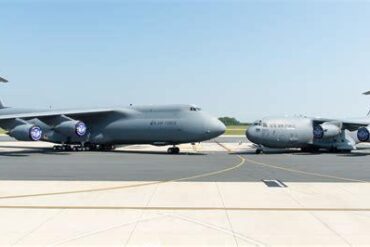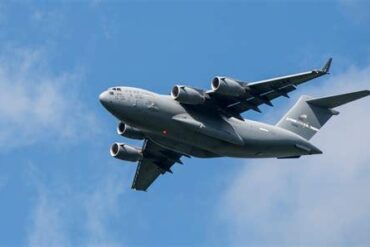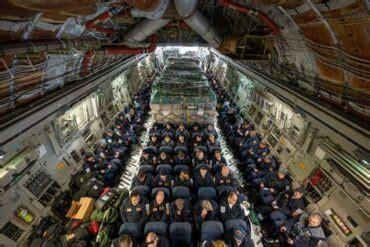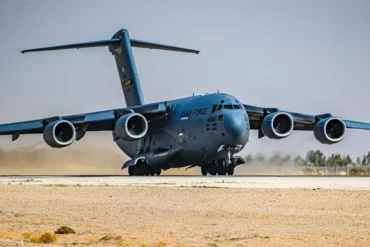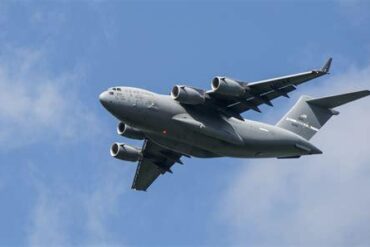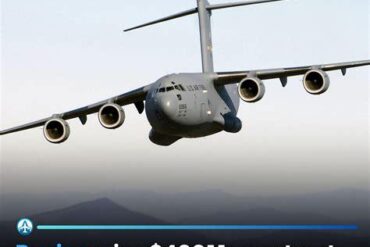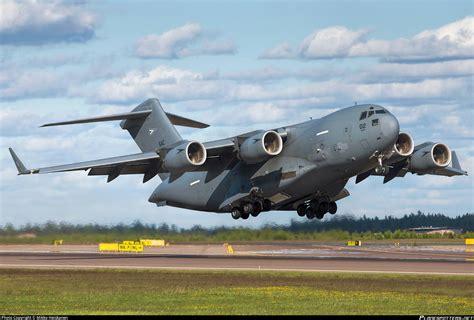
The Boeing C-17 Globemaster III stands as a testament to modern airlift engineering, delivering unmatched capabilities in both strategic and tactical operations. As a four-engine military transport aircraft conceived in the crucible of Cold War logistics and battlefield realities, the C-17 has matured into the backbone of rapid global mobility for the United States Air Force (USAF) and several allied nations. Combining range, payload, and agility, it has become indispensable in combat, humanitarian, and diplomatic missions across the world.
Developed initially by McDonnell Douglas and later absorbed into Boeing after the 1997 merger, the C-17 program drew its lineage from the YC-15 prototype, which had demonstrated promising short takeoff and landing (STOL) capabilities. The first flight occurred on September 15, 1991, and after a rigorous flight test program, the aircraft entered operational service on January 17, 1995. Despite a rocky development phase marked by political debates and budgetary restrictions, Boeing produced 279 units, concluding with the final delivery on November 29, 2015.
A Legacy Born from AMST and the C-X Initiative
The origin story of the C-17 begins with the Advanced Medium STOL Transport (AMST) program in the 1970s. From that competition, McDonnell Douglas’s YC-15 edged out Boeing’s YC-14 and Lockheed’s concepts. In 1981, the YC-15 was selected as the base for the C-X program, a new initiative by the USAF seeking a modern replacement for the aging C-141 Starlifter and a complementary lifter to the C-5 Galaxy. The new aircraft would need to operate from short, austere airfields while carrying outsized loads at intercontinental ranges.
To meet these requirements, engineers redesigned the YC-15 with swept wings, T-tail configuration, and upgraded Pratt & Whitney F117-PW-100 engines, creating what would become the C-17. However, progress was marred by challenges. Between 1992 and 1993, key wing testing failures delayed approvals, while funding setbacks in 1990 saw the initial order slashed from 210 to just 120 units. The program incurred a $1.5 billion loss, but continued advocacy and successful flight evaluations at Edwards Air Force Base laid the groundwork for recovery.
From Production Caps to Global Deployment
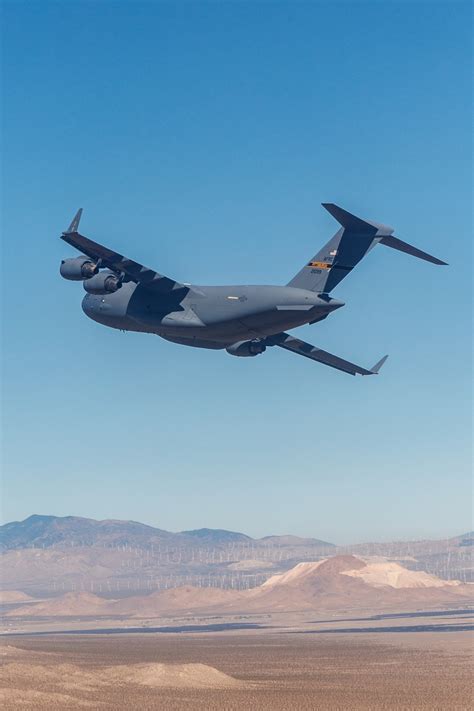
Congress initially capped production at 40 aircraft in 1993, but successive defense reviews and operational successes expanded confidence in the program. By 2009, procurement had reached 205 aircraft, and by 2013, a total of 223 C-17s had been delivered to the USAF. Boeing smartly managed production pacing to attract foreign military sales (FMS), leading to 56 additional aircraft delivered to international partners including the United Kingdom, India, Australia, and others.
Annual output once peaked at 16 aircraft, but later tapered to extend the production timeline through 2015. These strategic delays enabled Boeing to accommodate and fulfill increasing foreign interest while avoiding premature line closure.
Design and Engineering Mastery
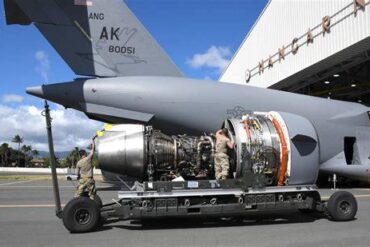
The C-17 Globemaster III measures 174 feet in length with a wingspan of 170 feet. It features a high-mounted, anhedral wing configuration and a T-tail, maximizing cargo space while retaining aerodynamic performance. The four Pratt & Whitney F117-PW-100 turbofan engines, each generating 40,400 lbf of thrust, deliver both high-altitude efficiency and ground-hugging STOL capabilities.
Its cavernous cargo hold—88 feet long, 18 feet wide, and 12 feet high—can accommodate vehicles as large as the M1 Abrams main battle tank, helicopters, or three Stryker vehicles. The maximum payload is a formidable 170,900 pounds, and it can operate from runways as short as 3,500 feet, even unpaved.
With an unrefueled range of 6,230 nautical miles when empty and 2,800 nautical miles carrying a maximum payload, the C-17 ensures uninterrupted global reach. A standard crew of three—pilot, co-pilot, and loadmaster—streamlines operations while advanced avionics reduce workload and enhance situational awareness.
Operational Impact Across Continents
United States Air Force (USAF)
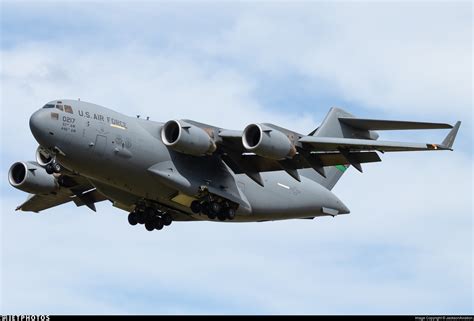
Since achieving initial operational capability in 1995, the USAF has leveraged the C-17 in virtually every major conflict and contingency operation. It set benchmarks for transporting oversized loads and earned the 1994 Collier Trophy for aeronautical achievement. The C-17 played key roles in Kosovo (1999), Afghanistan (Operation Enduring Freedom), Iraq (Operation Iraqi Freedom), and supported Antarctic resupply missions under Operation Deep Freeze.
It also served in Presidential logistics, and more recently, participated in Rapid Dragon tests—launching cruise missiles from cargo bays, showcasing its evolving utility in next-gen warfare.
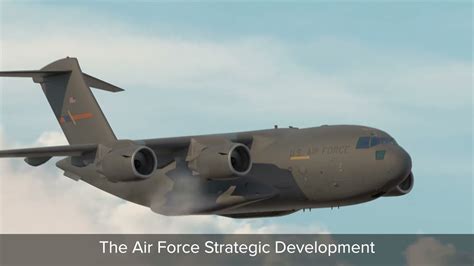
Royal Air Force (RAF)
The UK’s Royal Air Force initially leased four C-17s in 2001, later purchasing them and expanding to eight aircraft by 2012. RAF C-17s proved vital during operations in Mali (2013), the evacuation from Tunisia (2015 Sousse attack), and repatriating the late Queen Elizabeth II (2022). Their heavy lift capability provided unmatched versatility, particularly during the Afghanistan drawdown and urgent humanitarian efforts.
Royal Australian Air Force (RAAF)
Australia procured eight C-17s between 2006 and 2015. Their strategic lift capacity enabled rapid disaster response during Pacific typhoons, and operational support in Iraq, Afghanistan, and Southeast Asia. The aircraft frequently flies to remote Australian territories and partner nations, enhancing regional interoperability.
Royal Canadian Air Force (RCAF)
Canada’s fleet of five CC-177s (Canadian designation for the C-17) entered service between 2007 and 2015. They were instrumental in delivering aid to Haiti (2010 earthquake), Philippines (2013 Typhoon Haiyan), and conducting Arctic sovereignty patrols. The RCAF depends on the C-17 for heavy cargo movements between isolated forward operating bases.
NATO Strategic Airlift Capability (SAC)
A unique model of multinational ownership, the Heavy Airlift Wing (HAW) at Pápa Air Base, Hungary, operates three C-17s shared among 12 NATO and partner countries. Operational since 2009, this capability has increased shared mobility across the Atlantic alliance, emphasizing collective security.
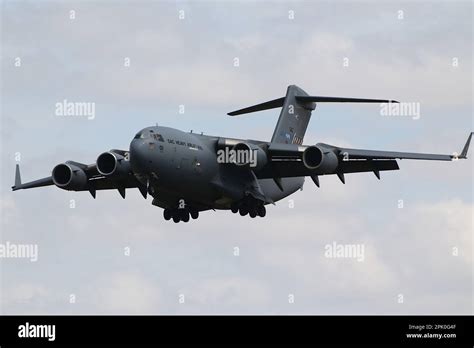
Indian Air Force (IAF)
India acquired 10 C-17s between 2010 and 2014, plus the final production aircraft in 2019. The IAF uses the Globemaster III to access high-altitude Himalayan bases, such as Leh, showcasing the aircraft’s powerful performance in thin air. C-17s carried relief during the Turkey–Syria earthquake (2023) and participated in anti-piracy operations (2024). As India’s strategic reach expands, the C-17 underpins both hard power and soft power projections.
Gulf Cooperation Council Operators
Among Gulf states, the C-17 has found a firm foothold. Qatar began acquiring them in 2009, eventually operating eight aircraft. The UAE purchased six, while Kuwait operates two. These nations deploy the Globemaster III for regional logistics, international coalition operations, and as platforms of geopolitical influence, enabling humanitarian missions in Africa and Asia.
Advanced Variants and Systems Evolution
The original C-17A was succeeded by extended-range variants featuring center-wing fuel tanks, as seen in Block 13+ configurations. Subsequent upgrades introduced in Block 16 and Block 21 included modern avionics, ADS-B transponders, OBIGGS II fire suppression, enhanced navigation systems, and IFF improvements to maintain operational relevance.
Though Boeing proposed the C-17B, a specialized variant with enhanced STOL and rugged airfield performance, the concept did not progress to production. Nonetheless, incremental modifications continue to ensure the aircraft remains responsive to evolving combat and humanitarian demands.
Conclusion: The Enduring Value of Strategic Airlift
Three decades after its first flight, the Boeing C-17 Globemaster III remains a linchpin of global airpower. Its ability to project force, sustain operations, and deliver aid across any terrain, at any time, offers an unmatched combination of speed, payload, and reliability. Whether dropping supplies in the Antarctic, rescuing hostages off pirate coasts, or transporting presidential motorcades, the C-17’s versatility is its signature. As older fleets age and new threats emerge, the legacy of the Globemaster III will endure—not just in tonnage lifted or missions flown, but in its role as an enabler of modern military and humanitarian diplomacy.