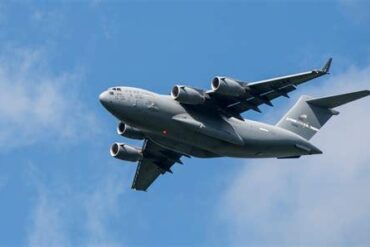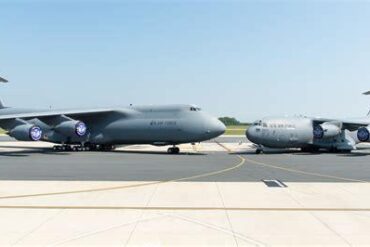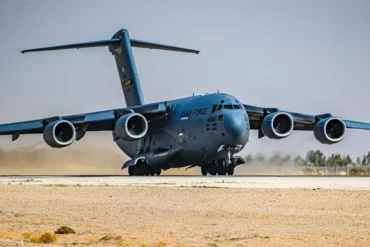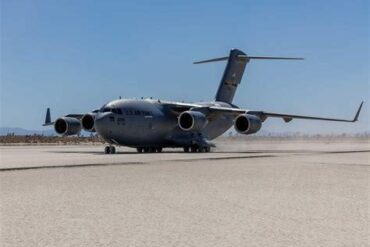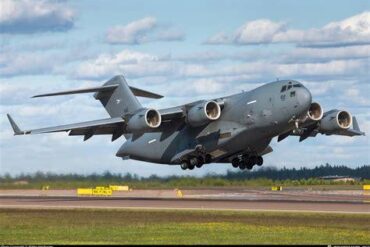
The C-17 Globemaster III occupies a rare sweet spot in military aviation: a jet-powered transport that blends strategic reach with tactical intimacy. It can cross oceans with outsized cargo, then descend onto short, unimproved runways where logistics normally arrive by truck or not at all. This dual personality is not an accident of aerodynamics or engine thrust alone. It is the direct result of a cabin engineered as a mission system rather than a static hold.
From its earliest design reviews in the late Cold War, the C-17’s interior was treated as the aircraft’s beating heart. Engineers assumed the airplane would be asked to do contradictory things—haul tanks one day, evacuate casualties the next, then pivot to disaster relief without returning to a depot. That assumption shaped everything from floor strength and restraint geometry to environmental controls and power distribution. The result is a cargo space that behaves less like a box and more like a reconfigurable platform.
The significance of that choice becomes clear when looking at how the aircraft is actually used. Armored vehicles roll straight aboard without cranes. Medical teams build airborne wards mid-flight. Scientific expeditions receive entire seasons of supplies in a single landing on ice. All of this happens inside one continuous, unobstructed volume that was designed to tolerate punishment, improvisation, and speed—often simultaneously.
A Cabin Sized for Reality, Not Theory
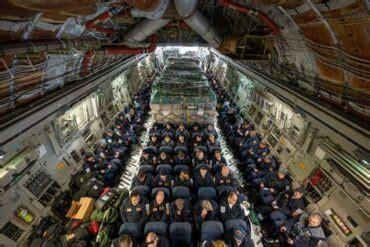
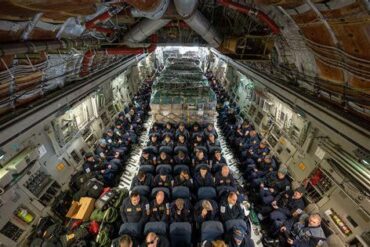
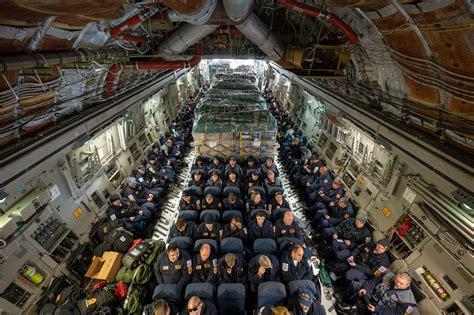
The C-17’s cargo compartment stretches roughly 88 feet in length, 18 feet in width, and more than 12 feet in height, dimensions chosen not just to impress on paper but to match the physical reality of modern military equipment. This geometry allows the aircraft to carry up to 18 standard 463L pallets, or a single outsized load that would overwhelm most tactical transports.
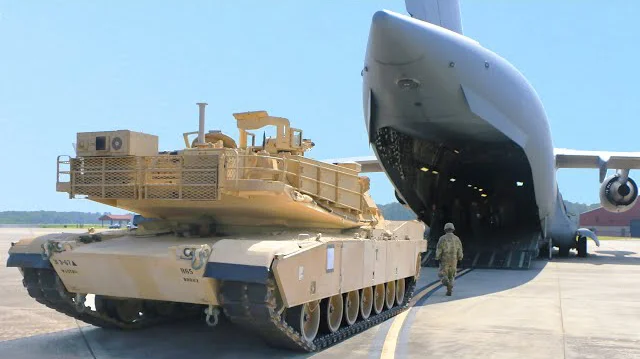
What matters more than raw size is usability. The cabin is rectangular, unobstructed, and engineered around straight-through loading. Vehicles do not need to be angled, partially disassembled, or creatively squeezed. An M1 Abrams tank, a Bradley fighting vehicle, or multiple MRAPs can be secured using built-in restraint systems rated for extreme loads, all while preserving proper center-of-gravity margins.
The floor itself is a structural statement. Reinforced to tolerate concentrated loads far beyond civilian standards, it integrates cargo rollers, tie-down fittings, and power interfaces directly into the structure. This allows loadmasters to switch configurations rapidly without installing bespoke equipment. The cabin becomes a toolkit, not a constraint.
Engineering for Speed on the Ground
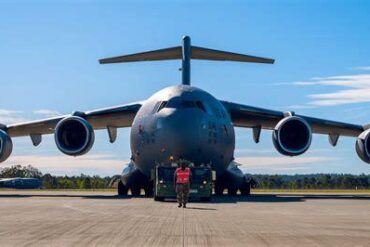
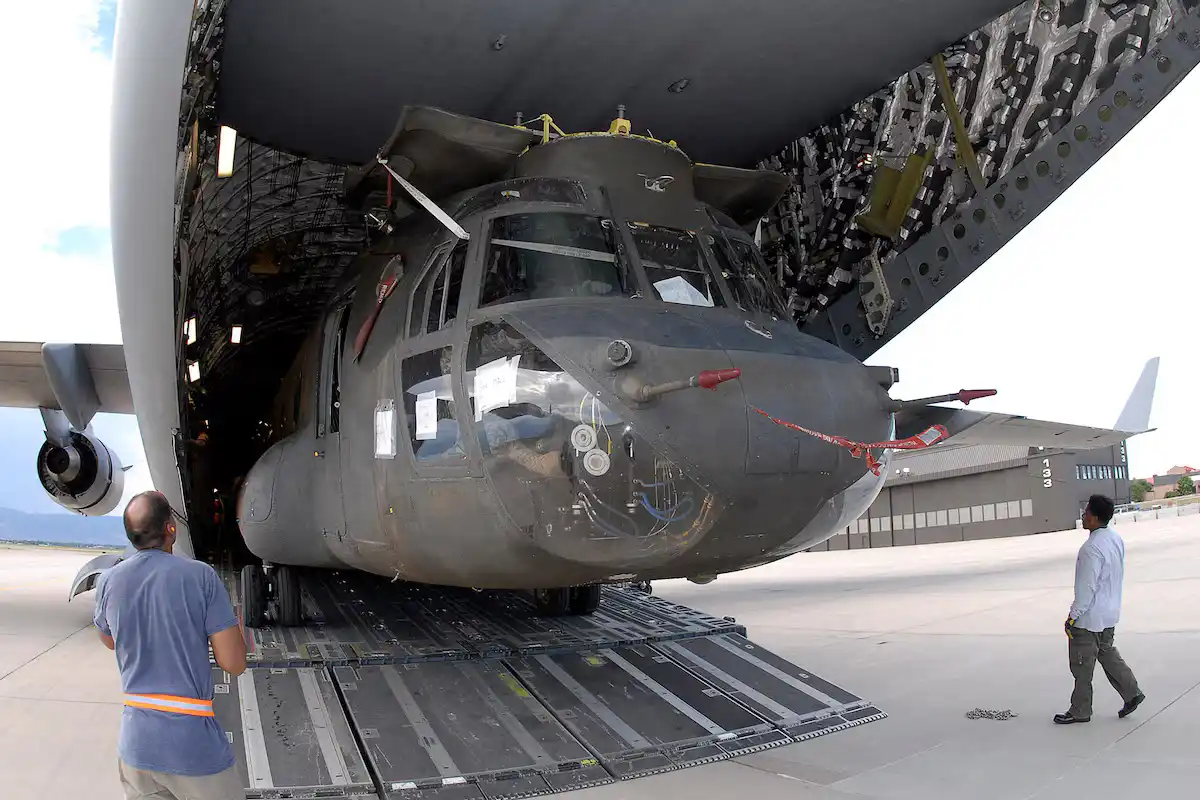
A defining feature of the C-17’s cabin is its rear ramp and door system, which transforms the aircraft into a true roll-on/roll-off transporter. Tanks, trucks, and engineering vehicles can drive directly aboard under their own power, eliminating the need for forklifts or cranes that may not exist in forward areas.
The aircraft’s low-slung landing gear plays a quiet but decisive role here. By keeping the ramp angle shallow, it reduces stress on vehicles and allows loading on rough, uneven surfaces. In practical terms, this means a C-17 can land, unload, and depart from locations where fixed infrastructure is minimal or nonexistent. The cabin is not just large; it is operationally accessible.
This design philosophy collapses timelines. In combat or humanitarian scenarios, hours matter. The ability to offload heavy cargo quickly, without waiting for specialized ground equipment, often determines whether aid arrives in time or forces reach the fight intact.
Built to Change Roles Without Changing Aircraft
Flexibility is the C-17 cabin’s defining trait. Unlike older transports that required extensive downtime to reconfigure, the Globemaster can pivot roles with remarkable speed. Pallets come out. Medical modules go in. Tie-downs are repositioned. Power outlets are reassigned. The aircraft itself barely notices.
This modularity allows the same airframe to support troop transport, cargo airlift, humanitarian relief, and aeromedical evacuation in rapid succession. The cabin’s environmental control system is sized not just for cargo, but for people—dozens of them—operating sensitive equipment at altitude for long durations.
The philosophy is brutally pragmatic. Real-world crises do not announce themselves neatly. The C-17’s cabin assumes uncertainty and treats it as a design requirement.
The Flying Hospital: Aeromedical Evacuation at Scale
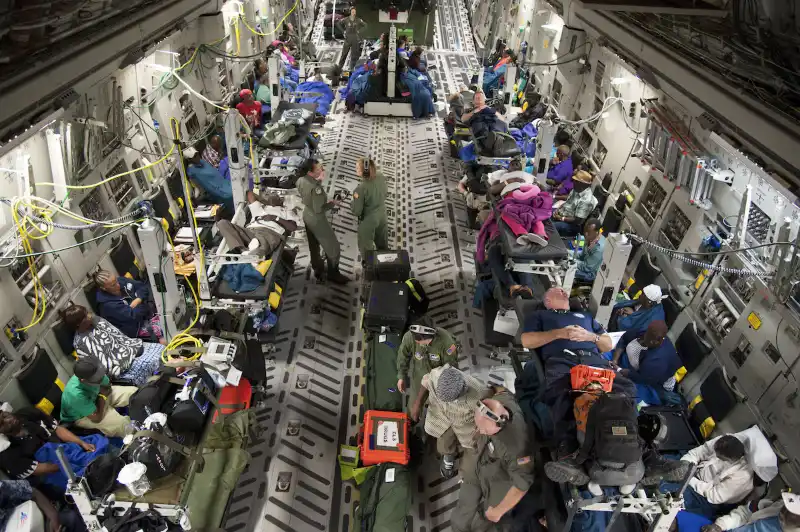
When configured for aeromedical evacuation, the C-17’s cargo bay becomes something closer to an airborne trauma center than a transport aircraft. Modular AE kits allow medical teams to install rows of litters, oxygen distribution systems, monitoring equipment, and workspaces for in-flight care.
The sheer volume of the cabin matters here. Space allows doctors and nurses to move, treat, and stabilize patients in ways impossible on smaller aircraft. According to U.S. Air Force medical planners, the C-17 can carry up to 36 litter patients and 54 ambulatory patients, alongside full medical teams, without compromising access or care quality.
Speed amplifies that advantage. Jet performance shortens transit times dramatically, reducing en-route risk and delivering patients to advanced care facilities faster than turboprop alternatives. In conflicts and disasters alike, this combination has saved lives measured not in statistics, but in minutes.
Pandemic Proof: COVID-19 and Cabin Adaptation
The COVID-19 pandemic offered a stark, modern demonstration of the C-17’s cabin design under global stress. As commercial air networks faltered, military airlift became a backbone for medical logistics. The C-17’s unobstructed interior and robust onboard power made it uniquely suited to carry field hospitals, ventilators, protective equipment, and isolation systems across continents.
In April 2020, a U.S. Air Force C-17 executed the first operational aeromedical evacuation using the Transport Isolation System, flying COVID-positive patients from Afghanistan to Germany. Sealed containment units were installed inside the cabin, allowing medical care without exposing aircrew. This mission was not a special modification program; it was an improvisation enabled by space, power, and airflow capacity already built into the aircraft.
Royal Air Force C-17s performed similar feats, delivering complete deployable hospitals to regions with collapsing healthcare infrastructure. The cabin proved capable not just of carrying supplies, but of carrying systems—entire medical ecosystems in a single sortie.
Carrying the Uncarryable: Heavy Armor and Experimental Payloads
At the upper end of its envelope, the C-17 can lift payloads approaching 170,900 pounds, a figure that places it among the most capable airlifters ever fielded. What distinguishes it is not only how much it can carry, but what shape that cargo can take.
Main battle tanks, oversized helicopters, ballistic launch vehicles, and engineering machinery all fit within the cabin’s structural and geometric limits. Advanced restraint systems allow asymmetric loads, enabling planners to mix vehicles and pallets in combinations tailored to specific missions.
The cabin has even become a laboratory. In Rapid Dragon testing, palletized cruise missiles are deployed from the cargo bay as part of stand-off strike concepts. While not a traditional combat role, this experimentation underscores how a spacious, accessible cabin can support emerging doctrines without redesigning the aircraft.
Polar Logistics: Proving Ground at the Ends of the Earth
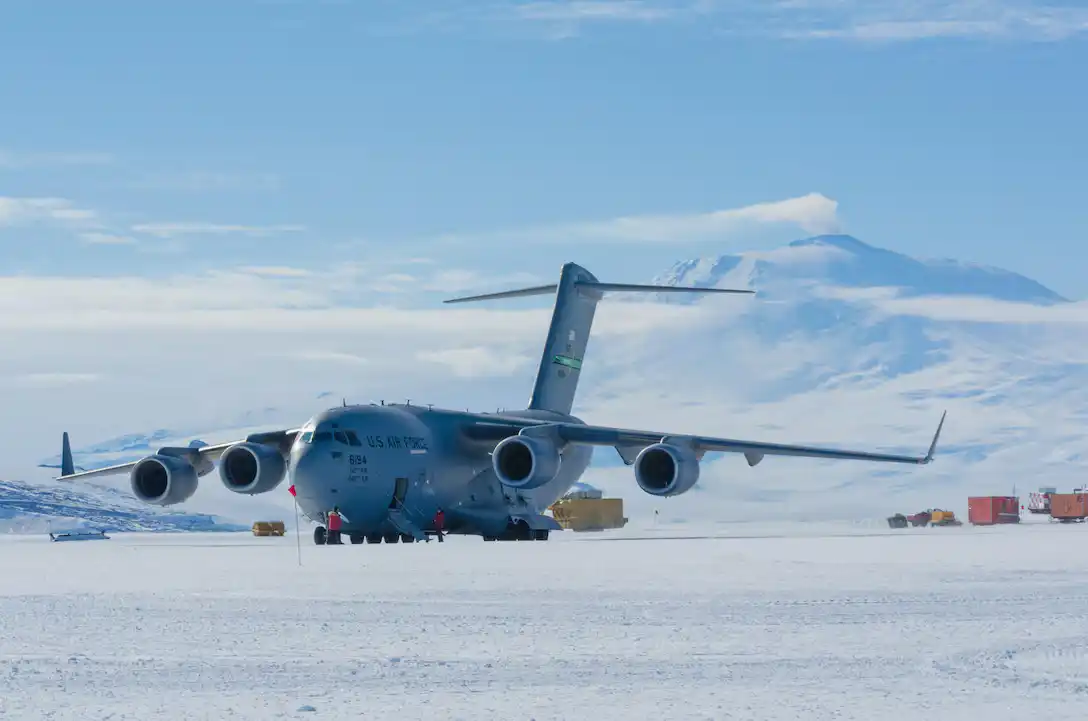
Few environments are as unforgiving as the polar regions, and few aircraft have proven as reliable there as the C-17. Since the late 1990s, Globemasters have supported Antarctic resupply missions to McMurdo Station, landing on ice runways with cargo loads that would overwhelm most aircraft capable of operating in such conditions.
The cabin’s volume allows entire seasonal supply packages—construction materials, vehicles, fuel bladders, and food—to be delivered in fewer sorties. This efficiency reduces exposure to weather risk and conserves precious flight hours in extreme cold.
In the Arctic, Canadian CC-177 Globemaster III aircraft perform biannual resupply missions to CFS Alert, the northernmost permanently inhabited outpost on Earth. Thousands of kilograms of fuel and equipment are hauled onto snow-and-gravel runways, supported by a cabin designed to tolerate temperature extremes and minimal ground support.
Diplomacy, Dignity, and Singular Moments
Not every mission is measured in tonnage. The C-17’s cabin has also played a role in moments of profound diplomatic and historical significance. Its ability to carry ceremonial payloads with precision and respect has made it the aircraft of choice for state transfers and solemn duties.
In September 2022, a Royal Air Force C-17 carried the coffin of Queen Elizabeth II from Edinburgh to London. The flight became the most tracked aircraft movement in the history of Flightradar24, a quiet testament to how deeply the aircraft has embedded itself into public consciousness. The same cabin that carries tanks and hospitals also carries history.
Why the Cabin Still Sets the Standard
As air forces look toward next-generation transport aircraft, the C-17’s cabin remains a reference point. Its success demonstrates that true airlift power is not defined solely by range or payload charts, but by how quickly and intelligently an aircraft can adapt to reality.
Reinforced floors, modular systems, generous power margins, and unobstructed geometry are not luxuries. They are enablers of decision-making at the strategic level and survival at the tactical one. The Globemaster’s cabin allows commanders to choose speed over perfection, flexibility over specialization, and action over delay.
Decades after entering service, the C-17 continues to earn its relevance not through novelty, but through design choices that assumed the world would remain unpredictable. That assumption, baked into the aircraft’s cavernous interior, is why the Globemaster III remains one of the most indispensable airlift platforms on Earth.