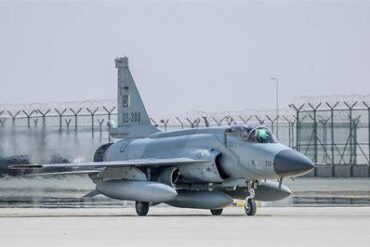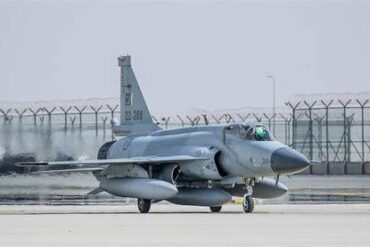
Pakistan’s aerospace ambitions reached a new milestone at RIAT 2025, where the JF‑17 Block III fighter jet made its first-ever European appearance, marking a pivotal moment in the nation’s campaign to establish itself as a competitive global defense exporter. Held at RAF Fairford in Gloucestershire, United Kingdom, the Royal International Air Tattoo (RIAT) drew international attention not only for its massive lineup of top-tier military aircraft but also for the unprecedented presence of the Pakistan Air Force’s (PAF) 8 Squadron, which brought two JF‑17C Block III fighters to the show floor.
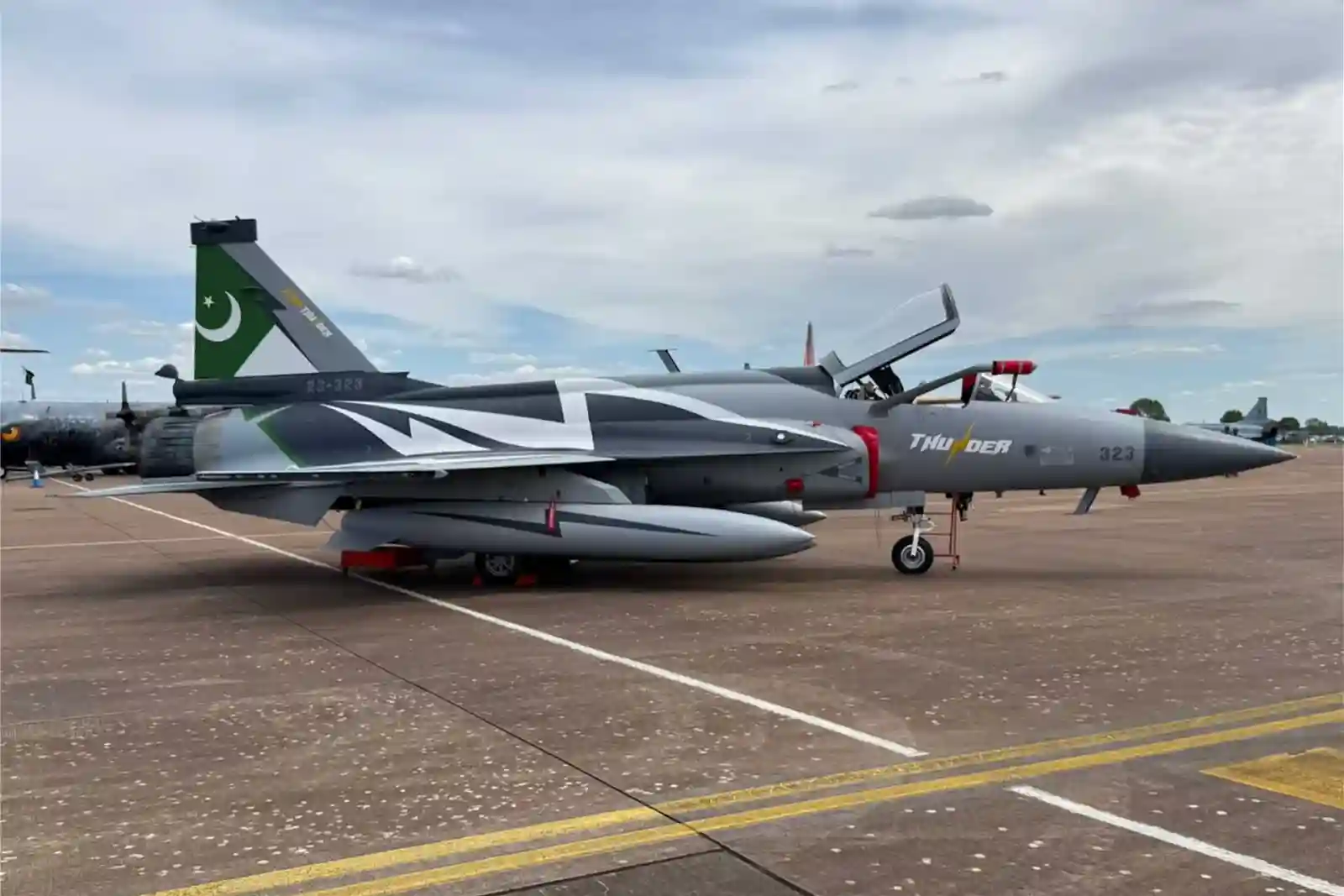
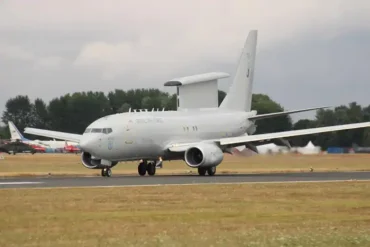
Accompanied by a C‑130E Hercules transport and an IL‑78 air-refueling aircraft, the deployment showcased Pakistan’s growing ability to project power across borders. But more importantly, it underlined a calculated strategic move: to put the most advanced version of the JF‑17 Thunder in front of Western and global defense audiences, with a clear export-driven agenda. This was not merely a demonstration of aircraft capabilities; it was a declaration of industrial maturity, regional ambition, and defense diplomacy.
JF‑17 Block III: Pakistan’s First 4.5-Generation Export Fighter
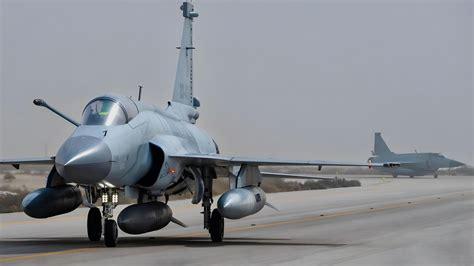
At the heart of the display was the JF‑17C Block III, the most technologically advanced variant of the JF‑17 family, a joint venture between Pakistan Aeronautical Complex (PAC) and China’s Chengdu Aircraft Corporation. Compared to earlier versions, the Block III incorporates a sweeping set of upgrades that elevate it into the 4.5-generation fighter class, positioning it as a cost-effective but modern multirole combat platform that rivals some Western fighters in terms of systems integration and avionics.
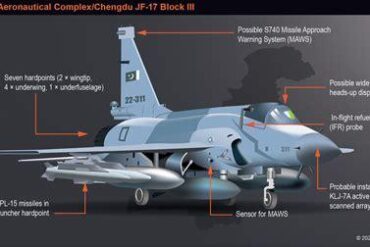
The centerpiece of the Block III’s leap in capability is the KLJ-7A Active Electronically Scanned Array (AESA) radar, a breakthrough system for Pakistan’s air force. This radar enables:
- Simultaneous tracking of multiple aerial targets
- Increased resistance to electronic jamming
- Improved reliability in beyond-visual-range (BVR) engagements
The cockpit has been fully digitized with a wide-area display, fly-by-wire controls, and a helmet-mounted display/sight (HMD/S) system that gives the pilot an edge in high-speed dogfights. Powered by the RD-93MA engine, the Block III delivers improved thrust and durability—vital for maneuver-intensive operations.
Combat-Ready: Weapons Integration and Tactical Flexibility
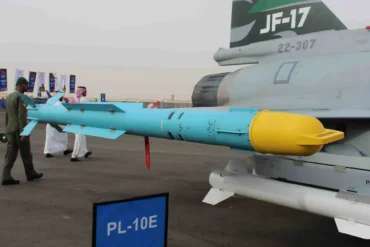
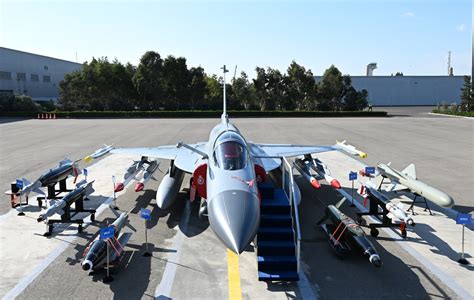
The static display at RIAT revealed the JF‑17C Block III’s fully weaponized capability, including PL-10 infrared-guided missiles on the wingtips. These high off-boresight weapons are integrated with the pilot’s helmet display system, allowing near-instantaneous target acquisition. More significantly, the aircraft was fitted with PL-15E BVR missiles, the export variant of China’s cutting-edge long-range missile, capable of rivaling or exceeding Western equivalents like the AIM-120 AMRAAM.
The PL-15E’s range and radar-guidance, paired with the AESA system, offer a compelling case for nations seeking next-gen engagement capability at an accessible price point. The Block III also features:
- Advanced Electronic Warfare (EW) suite
- Infrared Search and Track (IRST) system
- Integrated datalink for real-time battlespace networking
- Modular avionics for future adaptability
In essence, the aircraft embodies a network-enabled multirole fighter, capable of fulfilling air-to-air superiority, ground strike, and electronic suppression roles.
RIAT 2025: Strategic Display for Strategic Gains
Pakistan’s participation in RIAT 2025 was neither accidental nor merely ceremonial. It was a deliberate projection of confidence, crafted to attract attention from defense delegations, aerospace analysts, and global procurement agencies. By appearing alongside aircraft such as the Eurofighter Typhoon, F-35 Lightning II, and Dassault Rafale, the JF‑17 Block III was placed in the competitive spotlight of Europe’s largest military aviation showcase.
The timing was equally telling. As Western nations grapple with rising procurement and sustainment costs, the demand for affordable yet capable combat aircraft is growing across Africa, Latin America, and Southeast Asia. For these nations, the JF‑17 Block III offers an attractive proposition: cutting-edge technology, multirole versatility, and competitive pricing, without the political strings often attached to Western military sales.
Global Demand: Pakistan’s Breakthrough Export Campaign
Already, the aircraft is bearing fruit in the export market. The $4.6 billion deal with Azerbaijan for 40 aircraft marks Pakistan’s largest-ever defense export agreement, validating the international appeal of the Block III. Earlier customers like Myanmar, Nigeria, and Ghana have acquired the earlier Block I and II versions, but it is the Block III that is poised to redefine the global perception of Pakistani aerospace capabilities.
As per defense insiders, interest is brewing in countries such as Malaysia, Egypt, Argentina, and several Sub-Saharan nations, who view the JF‑17 as a viable alternative to F-16s or Gripens—especially those nations excluded from or limited by Western export controls. The aircraft’s Chinese lineage further increases its appeal among countries seeking to diversify their military suppliers amid shifting geopolitical alliances.
Industrial Rise: Pakistan’s Aerospace Renaissance
The JF‑17 program is more than an aircraft. It symbolizes Pakistan’s emergence as a semi-autonomous aerospace power, with PAC Kamra evolving from an assembly line into a design, integration, and manufacturing hub. The collaboration with China’s AVIC and Chengdu Aircraft Corporation has helped Pakistan leapfrog decades of R&D, bringing in localized expertise in areas such as:
- Mission computer development
- Avionics and radar integration
- Structural manufacturing of airframe components
- Testing and certification of indigenous upgrades
This transformation has enabled a new generation of Pakistani engineers and technicians to engage directly in high-end aerospace production, reducing dependency on foreign vendors and building the foundation for sustainable defense autonomy.
Message to the West: Not Just a Budget Fighter
By placing the JF‑17 Block III alongside NATO-standard jets at RIAT 2025, Pakistan was making a statement: this is not a low-tier budget platform, but a legitimate peer contender in modern warfare environments. Its performance specs, sensor fusion, modularity, and missile integration place it well within the realm of relevance for 4.5-generation aerial combat.
More importantly, it addresses a market segment that most Western manufacturers have neglected—defense forces needing affordability without sacrificing capability. As traditional fighter prices climb beyond reach for most countries, Pakistan is offering a strategic alternative.
Looking Ahead: A New Era of South-South Defense Collaboration
The debut at RIAT 2025 is unlikely to be the JF‑17 Block III’s final word. In the years ahead, it could serve as the nucleus for expanded South-South defense cooperation, joint manufacturing agreements, and regional security frameworks that bypass traditional Western hegemony. As global tensions rise and countries seek resilient, independent defense strategies, Pakistan may find itself at the center of a new multilateral defense landscape.
The RIAT showing will be remembered not merely for what was displayed on the tarmac, but for what it represented: a nation’s transition from defense recipient to defense provider, and a fighter jet that may well become the F-16 of the Global South.