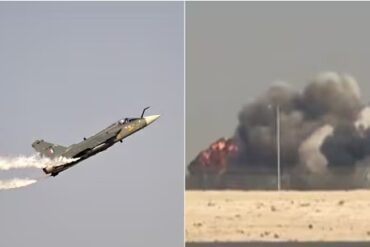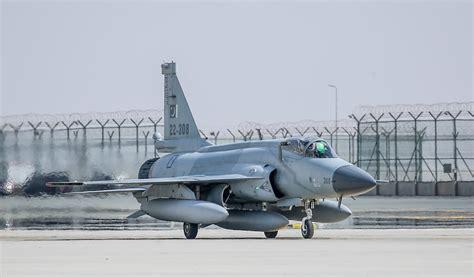
On November 20, 2025, Pakistan confirmed the signing of a new Memorandum of Understanding (MoU) with an undisclosed friendly nation for the acquisition of the JF-17 Thunder fighter jet during the prestigious Dubai Airshow 2025, held at Al Maktoum International Airport. This announcement marks a critical step forward for Pakistan’s aerospace exports, as the country continues to present the JF-17 Thunder Block III as a formidable, affordable, and adaptable multirole combat aircraft on the global stage.
The JF-17 Thunder: A Cornerstone of Pakistan’s Indigenous Air Power
The JF-17 Thunder program, co-developed by Pakistan Aeronautical Complex (PAC) and Chengdu Aircraft Corporation (CAC) of China, emerged from Pakistan’s strategic need to modernize its air force without reliance on Western suppliers vulnerable to sanctions. This aircraft was designed to replace aging fleets of A-5C bombers, F-7P/PG interceptors, and Mirage III/5 fighters, offering the Pakistan Air Force (PAF) a reliable, cost-effective solution with increasing local manufacturing capabilities.
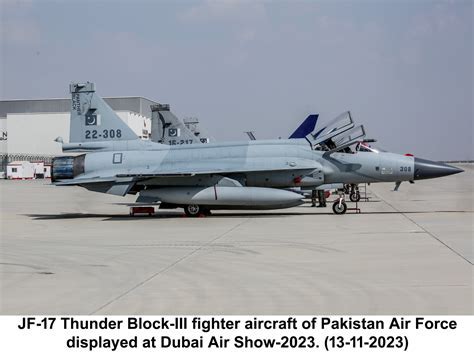
By 2025, nearly 58% of the airframe is produced domestically in Pakistan, including key structures such as the front fuselage and wings, while 42% comes from Chinese partners. Assembly takes place in Kamra, where annual output has scaled in response to export demand.
Block Evolution: From Baseline to Block III Dominance
The initial Block 1 variant served as the baseline configuration with a unit cost of around $15 million, offering basic multirole capability. In 2013, the Block 2 introduced significant advancements including:
- Air-to-air refuelling
- Composite material integration
- Upgraded data link and avionics
- Enhanced load capacity
- Strengthened electronic warfare capabilities
These improvements increased the unit cost to approximately $25 million, but significantly expanded the aircraft’s operational envelope. The JF-17B, a dual-seat combat trainer, followed in 2017, with production shared between China and Pakistan from 2018 to 2020. It features extended dorsal fuel tanks and full combat capability, allowing for advanced pilot training without compromising combat readiness.
The JF-17 Block III: A Leap in Lethality and Survivability
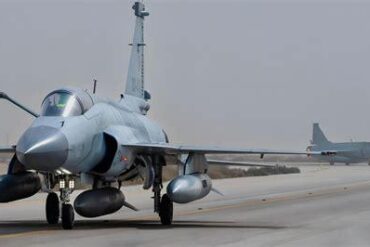
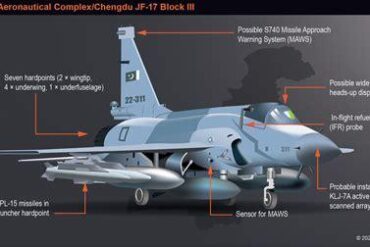
The Block III, now the flagship version of the JF-17 Thunder, represents the most advanced evolution of the platform, referred to internally as JF-17C. While the airframe maintains its 14.3-meter length and cropped delta wing layout, it incorporates more composite materials, an additional chin hardpoint, and an increased emphasis on low maintenance and high service life—rated for 4,000 hours or 25 years.
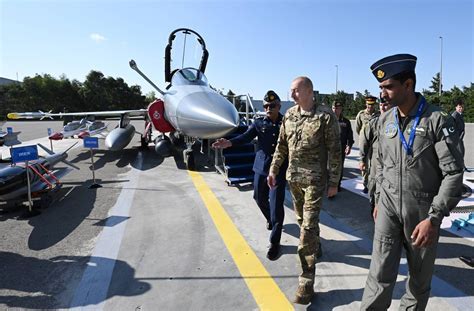
The Block III is powered by the Klimov RD-93MA engine, offering 91.2 kN of thrust and managed by a full authority digital engine control (FADEC). Key performance specs include:
- Max Speed: Mach 1.8
- Service Ceiling: 16,900 meters
- Combat Range: ~900 km (internal fuel)
- Ferry Range: >3,400 km (with drop tanks)
- Max Takeoff Weight: ~13,500 kg
- External Stores Capacity: ~3,400 kg
Avionics and Combat Systems: Digital Superiority in the Skies
The cockpit is equipped with:
- Three color MFDs in portrait orientation
- Wide-angle HUD
- HOTAS (Hands-On Throttle-And-Stick)
- Martin Baker PK16LE ejection seat
Software is based on an open C++ architecture, facilitating integration of new weapons and sensors from a wide supplier base. The most prominent electronic advancement is the KLJ-7A AESA radar, which provides tracking for up to 15 targets and simultaneous engagement of four, enhancing both air-to-air and air-to-ground capabilities.
Defensive systems include:
- Radar Warning Receiver (RWR)
- Missile Approach Warning System (MAWS)
- Chaff/flare dispensers
- Optional jamming pods
- Future integration of passive IRST and indigenous helmet-mounted displays (HMDs)
Weapons Versatility: From Air Superiority to Maritime Strike
The JF-17 Block III supports a broad inventory of munitions:
Air-to-Air:
- PL-5E, PL-9C (IR-guided)
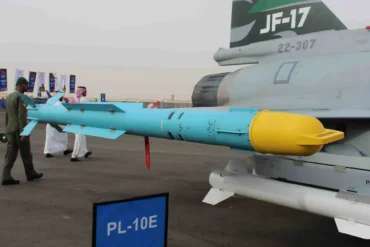
- PL-10E (high off-boresight with HMD)
- SD-10 / PL-12 (active radar homing)
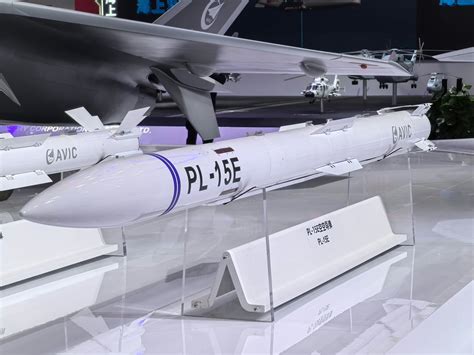
- PL-15E (BVR, ~145 km range)
Air-to-Surface:
- Laser-guided bombs
- Satellite-guided munitions
- C-802AK anti-ship missile
- MAR-1 anti-radiation missile
- CM-400AKG supersonic AShM (for high-value or naval targets)
For precision targeting, Pakistan utilizes the Aselsan ASELPOD, supported by a tactical data link allowing non-pod-equipped aircraft to receive data in real time.
Combat Record: A Tested Warrior
Since entering service, the JF-17 has accumulated a formidable combat resume:
- North Waziristan (2014–17): Used in counterterror operations
- Iran Border (2017): Downed an Iranian drone
- Operation Swift Retort (2019): Participated in retaliatory strikes against India
- Iran (2024): Targeted Baloch separatist groups in Sistan-Baluchestan
- Afghanistan (2024): Conducted operations against TTP positions
- India Conflict (May 2025): Allegedly destroyed components of India’s S-400 air defense system using CM-400AKG, though India denies the claim
These operations demonstrate the JF-17’s ability to operate effectively in high-stakes environments, blending precision with survivability.
Export Expansion: The Thunder Goes Global
The Dubai Airshow 2025 deal builds on a growing list of export successes:
- Myanmar: 16 JF-17 Block 2 units (2015)
- Nigeria: 3 JF-17A Block 2 units delivered in 2021
- Azerbaijan: 40 Block III units (~$4.6 billion in 2025)
- Iraq: 12 Block III fighters plus Mushshak trainers (~$1.8 billion)
- Bangladesh: Publicly expressed interest (2025)
Several African, Middle Eastern, and Latin American nations have also evaluated the JF-17, attracted by its price-to-performance ratio and flexible configuration.
Strategic Implications of the 2025 Dubai Deal
The MoU signed at the Dubai Airshow 2025 not only underscores growing global interest in the JF-17 Thunder Block III but also signals Pakistan’s maturity as a defense exporter. By presenting a full spectrum combat platform with advanced avionics, multirole adaptability, and sustained affordability, Pakistan aims to carve a niche in the mid-tier fighter jet market traditionally dominated by legacy platforms like the F-16 or Mirage 2000.
Moreover, the deal reflects a wider geopolitical calculus, where countries seek combat-proven, sanction-resilient alternatives amid an increasingly polarized global defense environment. Pakistan’s growing aerospace-industrial base, now capable of meeting foreign demands efficiently, positions it as a competitive exporter in Asia and beyond.
Conclusion: JF-17 Thunder Soars Beyond Borders
The unveiling of the JF-17 Block III at Dubai Airshow 2025 and the subsequent MoU are not isolated developments—they are the culmination of over two decades of determined indigenous development, international collaboration, and battlefield validation. With enhanced avionics, advanced radar, extended range munitions, and a favorable cost profile, the JF-17 Thunder Block III has emerged as a compelling alternative for nations seeking autonomy, performance, and reliability in their air forces.
As Pakistan looks ahead, the momentum from Dubai may well lead to more firm orders, making the JF-17 not just a fighter jet, but a symbol of strategic self-reliance and global relevance in modern air warfare.