The future of commercial aviation is being shaped by a new generation of giant jet engines that promise to redefine efficiency, performance, and sustainability. For decades, Boeing and General Electric have dominated the high-thrust widebody aircraft market through legendary engines such as the GE90 and the upcoming GE9X. However, a new challenger from Rolls-Royce could dramatically change the balance of power.
The Rolls-Royce UltraFan represents one of the most ambitious engine development programs in modern aviation history. Designed to deliver unprecedented fuel efficiency, lower emissions, and flexible scalability, this massive engine concept could become a key weapon for Airbus as the industry moves toward next-generation aircraft. While Boeing prepares for the delayed arrival of the 777X powered by the GE9X, Rolls-Royce is developing technology that could influence the aircraft market throughout the 2030s and beyond.
The competition is no longer simply about building the most powerful engine. The next aviation battle will be fought over efficiency, sustainability, operating costs, and the ability to power multiple aircraft platforms. In this new era, the company that creates the most adaptable engine architecture could gain a major advantage.
The Rise of Ultra-Large Jet Engines in Commercial Aviation
Modern commercial aviation has moved away from the traditional four-engine aircraft era. Aircraft such as the Boeing 747 and Airbus A380 once relied on multiple engines to achieve long-range capability and heavy payload performance. However, rising fuel prices, stricter environmental regulations, and improvements in engine reliability have pushed manufacturers toward highly efficient twin-engine aircraft.
This transformation created a demand for engines with extraordinary power. Instead of installing four smaller engines, aircraft manufacturers began developing twinjets equipped with enormous turbofans capable of producing more than 100,000 pounds of thrust.
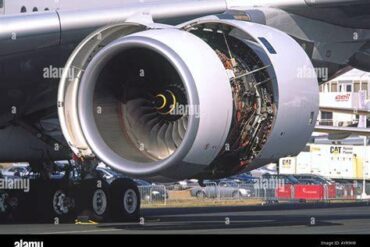
The arrival of the Boeing 777 marked a turning point. Its partnership with General Electric produced the GE90, a revolutionary engine that became famous for its enormous size and unmatched thrust capability. The GE90-115B variant powering the 777-300ER remains one of the most powerful commercial aircraft engines ever built, producing approximately 115,000 pounds of thrust.
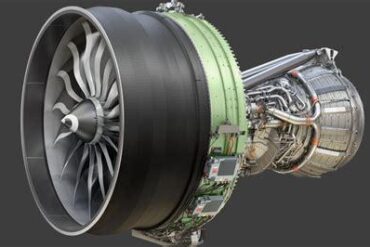
Boeing continued this philosophy with the 777X program, selecting the GE9X as its exclusive powerplant. The engine was designed specifically for the larger 777-8 and 777-9 models, creating what will become the largest commercial aircraft engine currently operating when the aircraft enters service.
However, Rolls-Royce believes the next breakthrough will not simply come from making engines bigger. Instead, the company is focusing on creating a flexible engine family capable of powering different aircraft categories.
Rolls-Royce UltraFan: The Giant Engine Designed for the Future
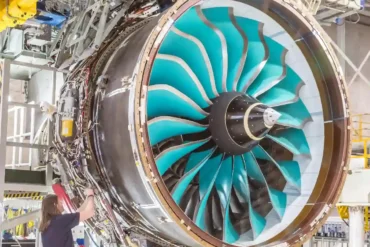
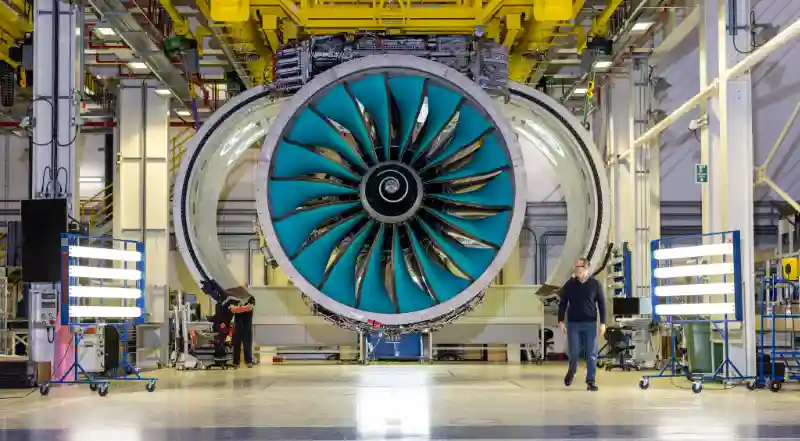
The UltraFan is Rolls-Royce’s next-generation engine architecture and represents a major technological leap beyond the company’s existing Trent engine family. Unlike previous engines designed for specific aircraft, UltraFan has been developed as a scalable platform that could support both widebody and narrowbody aircraft.
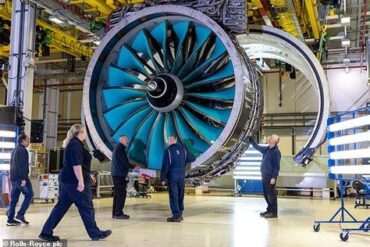
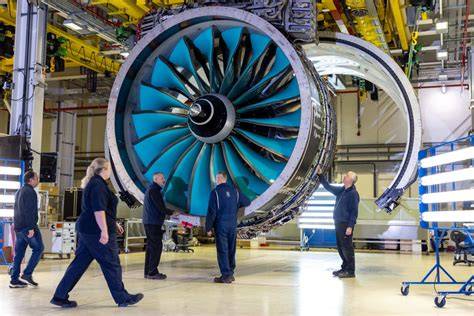
The most impressive feature of the UltraFan concept is its enormous fan diameter. The largest version, known as the UltraFan 80, is expected to feature a fan measuring approximately 140 inches, making it even larger than the GE9X’s 134-inch fan.
A larger fan allows an engine to move more air around the core rather than relying only on combustion power. This high-bypass approach improves efficiency because the engine produces more thrust from the airflow passing around the core. The result is lower fuel consumption, reduced emissions, and quieter operation.
The UltraFan is designed around an extremely high bypass ratio of up to 15:1, surpassing the GE9X’s already impressive 10:1 ratio. This demonstrates Rolls-Royce’s strategy of maximizing efficiency rather than simply increasing raw thrust.
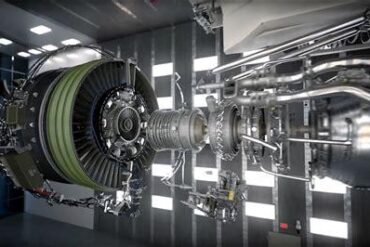
The engine also introduces several advanced technologies, including a geared architecture, carbon-titanium fan blades, lightweight composite casing materials, and an advanced lean-burn combustion system. Together, these innovations aim to reduce weight while improving performance.
Rolls-Royce estimates that UltraFan technology could provide fuel burn improvements of up to 25% compared with the Trent 700, representing a significant reduction for airlines facing increasing fuel costs and environmental pressure.
GE9X: Boeing’s Monster Engine Still Holds a Major Advantage
Although the UltraFan represents a serious future challenge, Boeing and General Electric are not standing still. The GE9X remains one of the most advanced commercial aircraft engines ever developed and will power the highly anticipated Boeing 777X family.
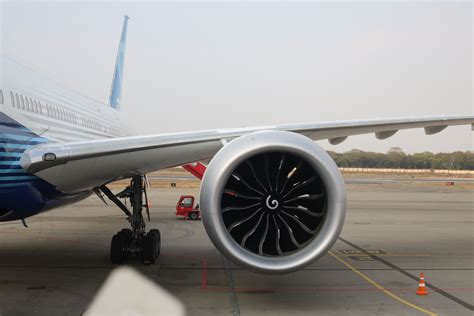
The GE9X was created as a successor to the famous GE90 and incorporates decades of aerospace engineering experience. With a fan diameter of 134 inches, a total engine diameter of approximately 14.5 feet, and a thrust rating of 110,000 pounds, it is a technological masterpiece.
One of its most important innovations is its 27:1 compressor pressure ratio, the highest ever achieved on a commercial jet engine. A higher compression ratio allows the engine to extract more energy from fuel, improving efficiency.
The GE9X also uses advanced materials, including ceramic matrix composites (CMCs), which can withstand extreme temperatures while reducing weight. Its 16 composite fan blades contribute to improved aerodynamic performance and durability.
Compared with the GE90-115B, General Electric expects the GE9X to deliver approximately 10% better fuel efficiency while also reducing noise emissions by around 10%.
The engine’s capabilities were demonstrated during testing when it achieved thrust levels exceeding 134,000 pounds, proving that it has significant performance reserves beyond its official rating.
For Boeing, the GE9X is critical to the success of the 777X program. The aircraft has accumulated hundreds of orders from major airlines, including launch customer Lufthansa, but repeated certification delays have pushed its expected entry into service to 2027.
Why UltraFan Could Give Airbus a Future Advantage
The biggest threat posed by UltraFan is not that it immediately replaces the GE9X. Instead, its potential advantage comes from flexibility.
Rolls-Royce is designing UltraFan as a family of engines. The company envisions a widebody version called UltraFan 80 and a smaller narrowbody variant known as UltraFan 30.
The UltraFan 80 is expected to deliver approximately 80,000 to 100,000 pounds of thrust, making it suitable for future long-range aircraft. Meanwhile, the UltraFan 30 could produce between 30,000 and 45,000 pounds of thrust, targeting next-generation single-aisle aircraft.
This approach is strategically important because narrowbody aircraft represent the largest segment of the global commercial aviation market. Aircraft such as the Airbus A320neo family and Boeing 737 MAX dominate airline fleets worldwide, meaning a successful future narrowbody engine could generate enormous demand.
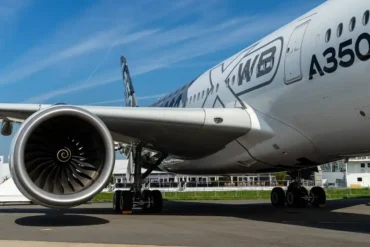
Airbus has already shown interest in future aircraft technologies and is studying next-generation commercial aircraft concepts. A smaller UltraFan variant could potentially become a major powerplant option for a future Airbus narrowbody aircraft.
Meanwhile, Boeing has discussed a future midsize aircraft concept, sometimes referred to as the New Midsize Airplane (NMA), but has yet to commit to a specific engine strategy.
If Rolls-Royce successfully develops a scalable engine family before Boeing finalizes its next aircraft programs, it could influence future aircraft design decisions.
Sustainable Aviation and the Battle for Engine Efficiency
The aviation industry faces increasing pressure to reduce carbon emissions. Airlines are seeking aircraft that lower operating costs while meeting stricter environmental targets.
Future engines must therefore do more than produce power. They must consume less fuel, generate fewer emissions, and support alternative energy sources such as sustainable aviation fuel (SAF).
UltraFan was designed with this future in mind. Rolls-Royce says the engine will be capable of operating with up to 100% SAF, helping airlines transition toward lower-carbon operations.
The engine’s lightweight materials and high bypass ratio also contribute to efficiency improvements. These advantages could become increasingly important as governments introduce stronger emissions regulations.
However, Rolls-Royce is not the only company exploring future engine technology.
Open Fan Technology Could Change the Next Generation of Engines
Beyond UltraFan, another major engine development path is the open fan concept. Instead of placing fan blades inside a traditional nacelle, open fan engines expose the blades externally, allowing even larger airflow volumes.
CFM International’s RISE program is one of the most advanced open fan projects currently under development. The technology aims to achieve up to 20% lower fuel consumption compared with existing engines.
Open fan engines could eventually surpass traditional turbofan designs by allowing manufacturers to create extremely large propulsion systems without the weight penalty of massive nacelles.
However, challenges remain. Engineers must solve issues related to noise reduction, safety certification, and integration with future aircraft designs.
Like UltraFan, open fan technology is expected to arrive sometime in the 2030s, meaning the next decade will be a crucial period for engine manufacturers.
The Future Battle Between Boeing, Airbus, and Engine Makers
The rivalry between Boeing and Airbus has always depended heavily on aircraft innovation, but engines have become one of the most important competitive factors.
Boeing currently holds a strong position with the GE9X and the 777X. The aircraft combines a proven airframe concept with one of the most powerful engines ever developed.
However, Rolls-Royce’s UltraFan could represent a different philosophy. Instead of focusing only on maximum thrust, it focuses on adaptability, efficiency, and future compatibility.
If Airbus adopts UltraFan technology for future aircraft programs, it could gain a significant advantage in the next generation of commercial aviation. A highly efficient engine platform could influence airline purchasing decisions for decades.
The future winner of the aviation engine race may not be the company producing the largest engine. It may be the manufacturer capable of creating the most efficient, flexible, and environmentally responsible propulsion system.
The UltraFan versus GE9X battle is therefore more than a competition between two giant engines. It represents the beginning of a new era where propulsion technology will determine the future direction of commercial aircraft development.