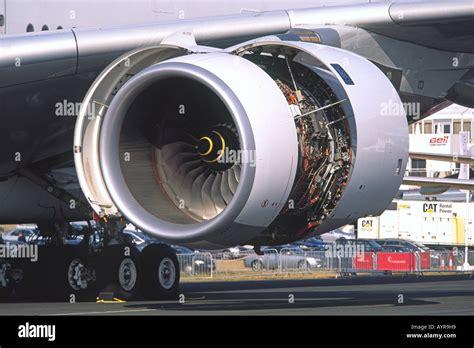
The story of modern aviation is often told through aircraft, but in reality, it is engines that quietly dictate what is possible. Nowhere is this more evident than in the relationship between the Airbus A380 and the Rolls-Royce Trent 900—a pairing so ambitious that it blurred the line between propulsion system and airframe design. This was not a case of fitting an engine to an aircraft. It was a case of building an aircraft around the immense potential of an engine.
A Superjumbo Born From Power Ambitions
The Airbus A380 remains an engineering anomaly—a full-length double-deck aircraft designed to carry more passengers than any commercial jet before or since. Its sheer scale demanded a propulsion system that could not merely support its mass but redefine efficiency at unprecedented size.
From the outset, Airbus envisioned an aircraft requiring engines in the 70,000 to 80,000 pounds of thrust class. That figure alone placed the project among the most demanding in aviation history. Enter Rolls-Royce, whose Trent family had already proven itself across multiple widebody platforms. But the Trent 900 was something different—an engine conceived not as an iteration, but as a leap.
Unlike conventional programs where engines are adapted to existing airframes, the A380 and Trent 900 were developed in parallel. This synchronized design philosophy meant that structural loads, aerodynamic characteristics, and propulsion capabilities were interwoven from the very beginning.
By the time the A380-800 variant entered service, the Trent 900 had matured into a powerhouse capable of delivering up to 84,000 pounds of thrust—placing it among the most formidable engines ever certified.
Engineering an Engine That Dictated Aircraft Design
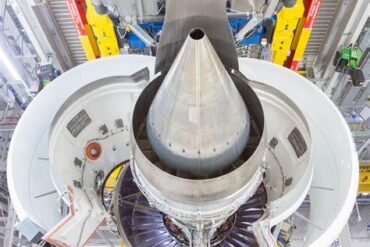
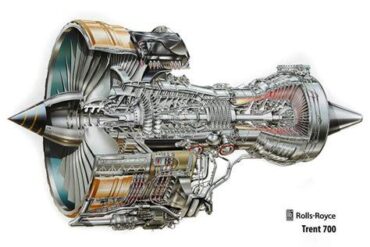
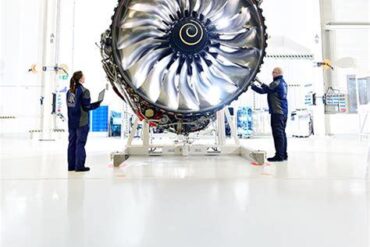
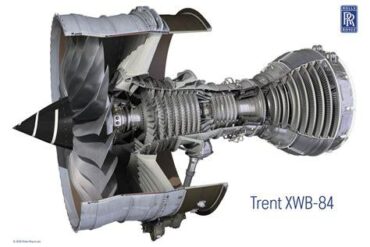
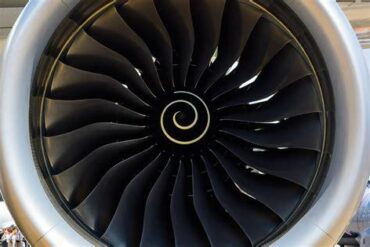
The Trent 900 did more than meet Airbus’ expectations—it reshaped them. Its massive fan diameter, measuring approximately 116 inches (2.95 meters), was central to its performance. This large fan enabled a high bypass ratio, significantly improving fuel efficiency while reducing noise output—two critical metrics for modern aviation.
But such size and power came at a cost: the aircraft had to adapt.
Designing the A380 to accommodate these engines required:
- Exceptionally robust wing structures capable of handling immense thrust loads
- Reinforced pylons engineered to distribute weight and vibration
- Advanced cooling and hydraulic integration systems to manage thermal and mechanical stress
These were not minor adjustments. They were foundational design elements, proving that the engine was not just a component—it was a defining force behind the aircraft’s architecture.
Interestingly, the A380’s wings were originally designed to support even larger variants, including the proposed A380-900. This left the production A380-800 with excess structural capability—an aircraft arguably overbuilt, yet perfectly balanced for long-haul efficiency.
Why Four Engines Changed the Equation
In an era where twin-engine aircraft dominate long-haul routes, the A380 took a different path. Instead of relying on fewer, more powerful engines like the Boeing 777, Airbus opted for four engines, each delivering slightly less thrust individually but collectively achieving extraordinary performance.
This design choice had profound implications.
With four engines, the A380 did not require each engine to reach the extreme thrust levels seen in twin-engine aircraft. For comparison, the GE90 engine powering the Boeing 777-300ER produces up to 115,300 pounds of thrust—far exceeding any single Trent 900 variant.
Yet the A380’s configuration allowed it to achieve a total thrust output surpassing 280,000 pounds, distributing power more evenly and enhancing redundancy.
This balance between individual engine output and total system performance highlights a key truth: power in aviation is not just about magnitude—it is about distribution and efficiency.

The Subtle Redesign: Thrust Reversers That Changed the Plan
One of the most fascinating examples of how the Trent 900 influenced the A380 lies in a seemingly small but critical feature: thrust reversers.
Initially, Airbus believed that the aircraft’s advanced braking systems and large wing spoilers would be sufficient for deceleration after landing. Given the immense stopping power of modern carbon brakes, this assumption was not unreasonable.
However, as testing progressed, real-world conditions told a different story.
Airbus ultimately decided to incorporate thrust reversers—but only on the two inboard engines. This selective implementation was a compromise between performance and weight. Adding reversers to all four engines would have increased complexity and mass, undermining efficiency gains.
Instead, engines two and three were equipped with reversers to:
- Enhance braking performance on wet or icy runways
- Reduce wear on braking systems
- Provide an additional safety margin during adverse conditions
This decision represents a rare mid-development adjustment, driven by the realities of operating an aircraft powered by engines of such scale and capability.
How the Trent 900 Compares to Aviation’s Most Powerful Engines
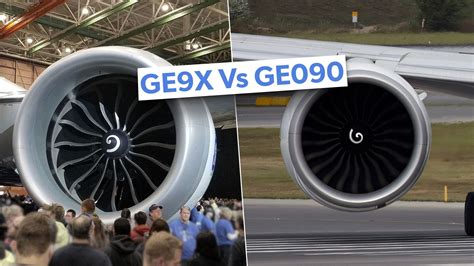
Despite its impressive credentials, the Trent 900 is not the most powerful jet engine ever built. That distinction belongs to engines like the GE90 and its successor, the GE9X engine, which power the latest generation of Boeing widebodies.
The hierarchy of engine power reveals a fascinating landscape:
- GE90: 115,300 lbf
- GE9X: 110,000 lbf
- PW4098: 99,040 lbf
- Trent XWB-97: 97,000 lbf
- Trent 900: ~84,000 lbf
At first glance, the Trent 900 appears modest by comparison. But this misses the bigger picture.
Unlike the twin-engine aircraft that require massive thrust from each engine, the A380 distributes its needs across four units. The result is a propulsion system that prioritizes efficiency, redundancy, and operational flexibility over raw individual power.
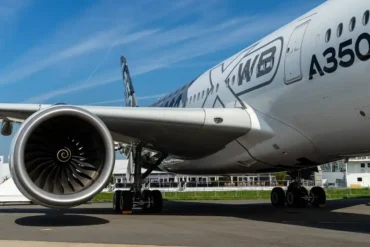
In fact, the Trent 900’s thrust level closely aligns with that of the Airbus A350 family’s engines, demonstrating how design philosophy influences engineering priorities.
Beyond the A380: Rolls-Royce’s Vision for the Future
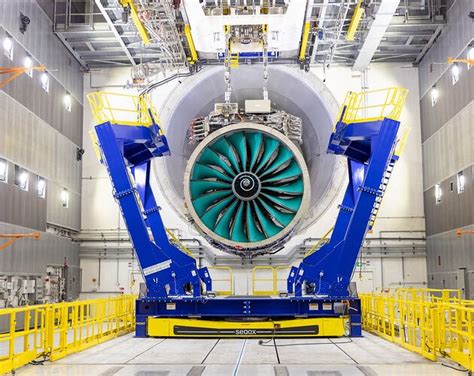
While the A380 program may have concluded, Rolls-Royce’s ambitions are far from grounded. The company is already looking ahead with its groundbreaking UltraFan program—a project that could redefine jet propulsion once again.
The Rolls-Royce UltraFan represents a new chapter in engine design. With a staggering 140-inch fan diameter, it surpasses even the largest engines currently in service.
But size is only part of the story.
UltraFan promises:
- Up to 25% improvement in fuel efficiency compared to early Trent engines
- 40% reduction in NOx emissions
- 35% lower noise levels
These advancements are not incremental—they are transformative. The engine is designed with modular architecture, allowing it to scale across a wide range of thrust requirements, from narrowbody to widebody aircraft.
A Strategic Shift: Returning to the Narrowbody Market
For years, Rolls-Royce has dominated the widebody engine segment, powering aircraft like the Airbus A350 and A330neo. However, it has been notably absent from the narrowbody market—a segment controlled by competitors like Pratt & Whitney and CFM International.
This absence represents both a challenge and an opportunity.
With the UltraFan 30 variant, Rolls-Royce aims to reenter this highly competitive space. Designed for the 30,000-pound thrust class, this engine targets the next generation of single-aisle aircraft expected to replace today’s A320neo and 737 families.
If successful, it would mark a significant shift in the company’s market position—bringing its engineering philosophy to a broader range of aircraft and airlines.
The Legacy of Power: When an Engine Shapes an Aircraft
The relationship between the Trent 900 and the Airbus A380 is a testament to what happens when engineering ambition meets collaborative design. This was not a case of incremental improvement. It was a bold reimagining of what a jet engine—and the aircraft it powers—could be.
The Trent 900 did not merely fit into the A380. It defined it.
From wing structure to braking systems, from noise profiles to operational philosophy, the engine’s influence is evident in every aspect of the aircraft. It forced engineers to think differently, to design beyond conventional limits, and to embrace a new scale of possibility.
In an industry driven by efficiency and optimization, such moments of radical innovation are rare. Yet they are precisely what push aviation forward.
As Rolls-Royce prepares for the next generation of propulsion systems, one thing remains clear: the legacy of the Trent 900 is not just measured in thrust, but in the boundaries it helped redefine.