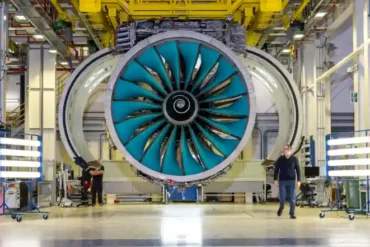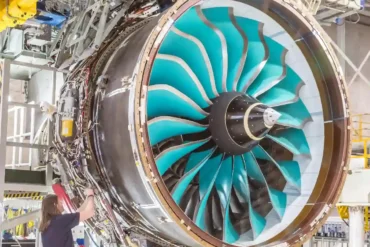
Rolls-Royce is preparing one of the most consequential challenges to the narrowbody engine market in decades. At the center of that effort is the UltraFan 30, a next-generation turbofan concept built around an enormous 90-inch (229 cm) fan, an ultra-high bypass ratio, and a 20-megawatt power gearbox. If the technology performs as planned, Rolls-Royce could return to a market it abandoned more than a decade ago and challenge the entrenched positions of CFM International and Pratt & Whitney.
The scale of the gamble is difficult to overstate. Rolls-Royce has reportedly committed billions of dollars to UltraFan development because the company sees the next generation of single-aisle aircraft as a rare opportunity to reshape the commercial engine industry. The timing is particularly important. Airbus and Boeing are eventually expected to replace their current narrowbody families, creating a potential market measured in thousands of aircraft. An engine supplier that wins a major position on those programs could secure decades of production, aftermarket support, and maintenance revenue.
The UltraFan concept is designed around a basic principle: move substantially more air through the engine while allowing the core to operate at highly efficient conditions. Its giant fan is therefore not simply a larger version of an existing turbofan. The architecture combines a huge low-pressure fan with a geared power system, allowing different sections of the engine to rotate at speeds better suited to their individual jobs. Rolls-Royce believes this combination can produce a major improvement in fuel efficiency without abandoning the fundamental advantages of a ducted turbofan.
The 90-Inch Fan Is the UltraFan 30’s Defining Feature
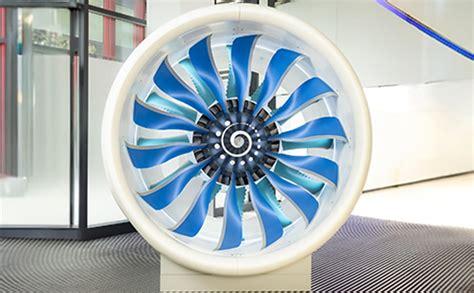
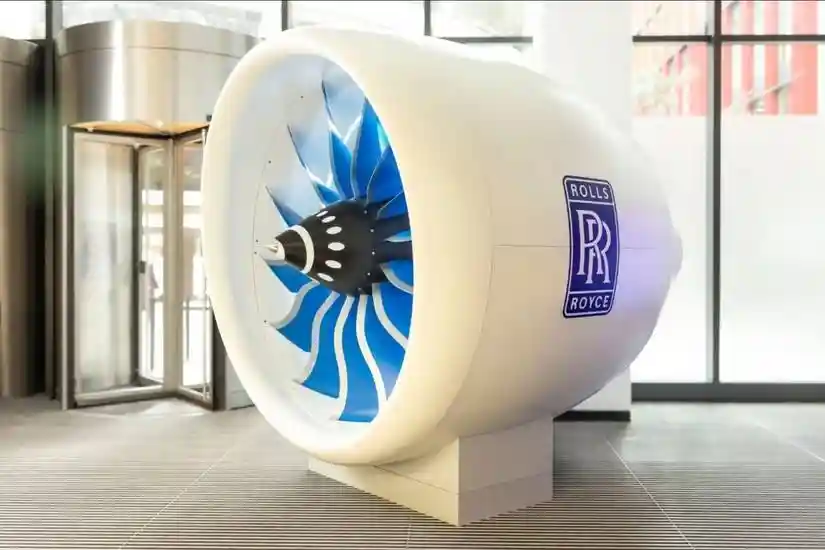
The most obvious feature of the UltraFan 30 is its 90-inch fan diameter. That enormous front section gives the engine an immediate visual distinction from today’s narrowbody powerplants, but the engineering rationale goes much deeper than appearance. A larger fan can move a greater mass of air without requiring the same high exhaust velocities, improving propulsive efficiency and reducing the amount of energy lost in the exhaust stream.
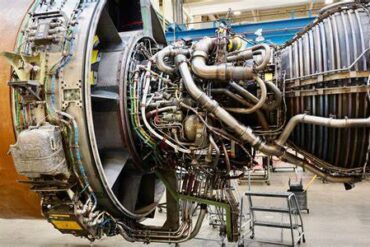
The challenge is that a fan this large cannot simply be connected directly to a conventional turbine and operated at the same rotational speed. The fan benefits from relatively slow rotation, while the turbine and other core components need much higher rotational speeds to operate efficiently. The solution is a 20-megawatt power gearbox positioned between the driving turbine and the front fan.
That gearbox allows the fan and core to operate independently at more appropriate speeds. In principle, the arrangement lets the enormous fan rotate more slowly and quietly while the turbine can continue operating closer to its ideal speed. This separation is fundamental to the UltraFan philosophy because it provides engineers with greater freedom to optimize the low-pressure and high-pressure portions of the engine independently.
The target is an ultra-high bypass ratio of as much as 15:1, compared with the lower ratios associated with many earlier-generation engines. The bypass stream therefore becomes an increasingly important part of the engine’s thrust production. Rather than extracting as much energy as possible from a relatively small quantity of air, the UltraFan aims to accelerate a much larger quantity of air by a smaller amount.
That approach could deliver substantial fuel savings while also reducing noise. The lower fan speed is particularly important for airport communities because fan tip speed is a major contributor to engine noise. Rolls-Royce is also investigating aerodynamic features such as curved guide vanes and a shorter inlet to improve efficiency while controlling the physical size and acoustic signature of the engine.
UltraFan 30 Targets a New Generation of Single-Aisle Aircraft
The UltraFan 30 is intended for the approximately 25,000- to 30,000-plus-pound thrust class, putting it in the territory required for future narrowbody aircraft rather than today’s largest widebody engines. Its reported overall pressure ratio is around 50:1, while its bypass ratio could range from roughly 12:1 to 15:1 depending on the final configuration.
Those numbers matter because Rolls-Royce is not simply trying to produce another engine for the existing Airbus A320neo or Boeing 737 MAX generation. The company is targeting aircraft that have yet to enter service. That distinction gives engineers more freedom to develop an engine whose dimensions, weight, nacelle requirements, and aerodynamic characteristics can be considered alongside a clean-sheet airframe.

The company’s larger UltraFan 80 demonstrator has provided the technological foundation for the smaller concept. Engineers have been able to study the larger architecture, identify potential problems, and apply lessons to the narrowbody-scale design. The next stage is considerably more important because a concept displayed at conferences is very different from an engine that has to operate continuously under real-world conditions.
The planned ground-testing campaign is expected to provide that missing evidence. Rolls-Royce is targeting a physical UltraFan 30 demonstrator around 2028, with the objective of demonstrating a 20% improvement in fuel burn compared with existing powerplants. The company has also discussed an improvement of roughly 25% compared with older Trent-era technologies.
Those figures remain targets rather than demonstrated production performance. The UltraFan 30 has not yet accumulated the extensive test hours required to establish reliability, maintenance intervals, fuel consumption, thermal margins, and operating costs. For airlines, those factors can matter just as much as headline fuel efficiency.
Rolls-Royce Is Trying to Reopen a Market Dominated by Two Suppliers
The commercial challenge may ultimately be harder than the engineering challenge. Rolls-Royce has been absent from the mainstream single-aisle engine market since leaving the International Aero Engines consortium in 2012. Since then, CFM and Pratt & Whitney have established exceptionally strong positions across the world’s narrowbody fleets.
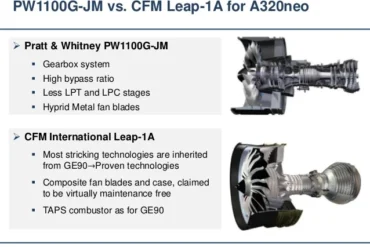
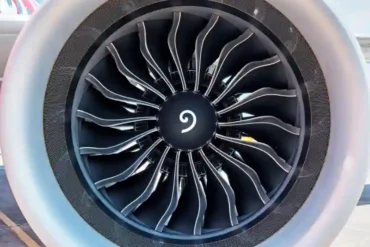
CFM’s LEAP family powers large numbers of Airbus A320neo and Boeing 737 MAX aircraft, while Pratt & Whitney’s Geared Turbofan has secured major positions on Airbus narrowbodies. Both companies therefore possess something Rolls-Royce cannot create simply by producing an efficient engine: an enormous installed customer base.
That installed base generates relationships with airlines, maintenance organizations, leasing companies, aircraft manufacturers, and suppliers. It also creates an aftermarket ecosystem that can be worth as much as the original engine sale over several decades. Airlines choosing a new aircraft are not evaluating only fuel burn. They are considering spare engines, maintenance infrastructure, training, parts availability, reliability records, financing, dispatch performance, and long-term support.
Pratt & Whitney’s recent difficulties demonstrate why these considerations are so important. Problems involving components in its GTF family resulted in inspections, accelerated removals, and aircraft groundings. Pratt has responded with the GTF Advantage, a revised version intended to improve durability and time on wing. Deliveries of the upgraded engine have begun, and the company expects the Advantage configuration to become increasingly important in future production.
Despite those problems, Pratt remains a formidable competitor. Its enormous order backlog means that Rolls-Royce cannot simply assume the GTF’s troubles will create a permanent opening.
CFM RISE Creates an Even Bigger Question for Rolls-Royce
The most intriguing part of the UltraFan story is that Rolls-Royce is not entering a market where conventional turbofan technology is guaranteed to remain dominant. CFM International’s RISE program is pursuing an even more radical architecture: the open fan.
Instead of placing the fan inside a conventional nacelle, RISE uses exposed fan blades to move a much larger quantity of air. CFM has publicly targeted fuel-burn improvements of around 20% compared with today’s engines. The technology could therefore challenge the basic assumptions behind the UltraFan before Rolls-Royce even reaches production.

The open-fan architecture also introduces substantial engineering complications. The absence of a conventional outer casing changes the aerodynamic environment, creates new noise-management challenges, and places greater demands on aircraft integration. Blade containment and structural protection are particularly important because the exposed rotating system operates in a very different configuration from today’s ducted turbofans.
Airbus is working with CFM to flight-test an early RISE configuration using an A380 test aircraft. That testing will be crucial because computer simulations and component rigs can only answer part of the question. Airlines ultimately need evidence that the technology can survive years of commercial operation while delivering the promised fuel savings without creating unacceptable maintenance or structural costs.
This uncertainty could actually help Rolls-Royce. If Airbus or another manufacturer decides that a fully open fan carries too much technological or certification risk, a highly efficient geared turbofan such as UltraFan could become a more conservative alternative. Rolls-Royce does not need the open fan to fail completely. It only needs aircraft manufacturers to want another propulsion architecture.
Airbus Could Decide the Future of UltraFan
Airbus may hold the most important card in the entire competition because its next-generation narrowbody aircraft is likely to become one of the industry’s biggest engine campaigns. The successor to the A320neo family could begin emerging around the 2030 timeframe, although the precise schedule and configuration remain dependent on technology development, market conditions, and Airbus’ assessment of when a clean-sheet aircraft makes economic sense.
The choice of propulsion architecture will have enormous consequences. Airbus could select CFM’s RISE technology, pursue a conventional ducted engine, support multiple suppliers, or create a framework in which different technologies compete.
For Rolls-Royce, securing a position on a major Airbus narrowbody would transform the UltraFan program from an expensive technology exercise into a potentially enormous commercial business. Even a minority engine share could translate into thousands of engines over the life of an aircraft family.
Boeing presents a different challenge. The company has been more cautious about committing to a radically new propulsion architecture while dealing with the certification and financial demands surrounding its existing aircraft programs. Its future clean-sheet narrowbody will need dramatically better efficiency, but Boeing must also consider development risk, production stability, certification requirements, and the ability of its engine partners to deliver at scale.
That creates an opening for Rolls-Royce, but it is not an easy one. The company needs an airframer willing to accept the risks of a new supplier and a new engine architecture at the same time.
Rolls-Royce Needs More Than an Efficient Engine
One reason Rolls-Royce is reportedly seeking strategic partnerships is the sheer financial burden involved. Developing a completely new commercial engine can consume billions of dollars before the first production unit reaches an airline. The company has already invested heavily in UltraFan, while additional research and development spending could push the overall commitment toward $4 billion.
That is a significant corporate risk even for a major aerospace manufacturer. The return depends on future aircraft programs that do not yet exist and airline orders that cannot be guaranteed.
Rolls-Royce’s history also explains the caution. The company experienced major difficulties with the Trent 1000, which powered Boeing 787 Dreamliners and suffered technical problems that created expensive maintenance and reliability challenges. Rolls-Royce has since undertaken a broad transformation of its commercial-engine business, but a new narrowbody program would still represent a substantial financial commitment.
The company’s defense business provides another source of strength. Major military programs, including work associated with re-engining the B-52 fleet, have helped support the wider organization. Rolls-Royce is also seeking government support for the development of a certified narrowbody engine, which could reduce the financial burden of returning to a market it left years ago.
The 2028 UltraFan Test Could Become a Defining Moment
The most important milestone now is the planned 2028 ground test. That campaign will determine whether the 90-inch fan, gearbox, high-pressure core, bypass system, and supporting technologies can work together as an integrated engine.
The test must demonstrate far more than thrust. Rolls-Royce will need to establish that the gearbox can withstand enormous mechanical loads, that the fan can operate efficiently across a broad range of conditions, and that the engine can meet acoustic and vibration targets. Thermal management, component durability, maintenance requirements, and bird-strike and foreign-object-ingestion performance will also be critical.
A successful test would not automatically secure a production aircraft. It would, however, give Rolls-Royce something it currently lacks: physical evidence that UltraFan can progress from an ambitious technology program to a commercially credible propulsion system.
Timing could be just as important as performance. If Airbus accelerates its next-generation narrowbody program, Rolls-Royce could arrive with a mature demonstrator at precisely the right moment. If manufacturers postpone their clean-sheet aircraft toward the late 2030s or beyond, CFM and Pratt & Whitney gain additional time to improve their existing technologies.
That is particularly relevant because the GTF Advantage and future CFM architectures will not remain static. Every additional year gives established manufacturers another opportunity to improve fuel efficiency, durability, manufacturing costs, and maintenance economics.
A Three-Way Narrowbody Engine Battle Could Reshape Aviation
The UltraFan 30 therefore represents much more than a new Rolls-Royce engine. It is a bet on how commercial aviation will evolve after the current generation of A320neo and 737 MAX aircraft reaches the later stages of its life cycle.
If conventional geared turbofans remain the preferred solution, Rolls-Royce has a chance to become a serious third player again. Its 90-inch fan and 20-megawatt gearbox offer a fundamentally different way of optimizing a ducted turbofan, potentially combining much of the efficiency of extremely high bypass propulsion with a more familiar architecture than an open fan.
If CFM successfully commercializes RISE, however, Rolls-Royce could face a different future. The open fan could establish a new benchmark that makes today’s ducted architectures increasingly difficult to justify. Conversely, if open-fan integration proves too complicated or expensive, UltraFan could become an attractive middle path between today’s engines and more radical propulsion systems.
Pratt & Whitney will not be standing still either. Its GTF architecture gives it a powerful technological foundation and an enormous installed fleet, while CFM possesses similarly deep relationships with Airbus and Boeing. Rolls-Royce must therefore prove not only that its engine works, but that it delivers enough economic value to justify switching away from established suppliers.
The 90-inch UltraFan 30 fan is the most visible symbol of that challenge. Behind it sits a much larger wager involving aircraft design, engine architecture, manufacturing investment, airline economics, certification, and decades of aftermarket support. By 2028, the first serious evidence should emerge about whether Rolls-Royce has built the technology capable of breaking into the CFM-Pratt & Whitney stronghold.
The narrowbody engine market has rarely offered room for a third major player. Rolls-Royce is betting that the transition to the next generation of aircraft will create exactly that opening. If UltraFan delivers the efficiency, reliability, and integration characteristics promised by its designers, the company’s $4 billion gamble could become one of the defining propulsion stories of the next decade. If the aircraft manufacturers decide that existing suppliers and alternative technologies offer less risk, the enormous 90-inch fan could instead become an impressive demonstration of technology that arrived without a sufficiently large aircraft program waiting for it.