The aviation industry is once again standing at the edge of a propulsion revolution. As Airbus and Boeing quietly sketch the contours of their next-generation narrowbody aircraft, the spotlight has swung to a bold concept promising double-digit efficiency gains: the open-fan engine. Sleek, exposed, and unapologetically radical, it is marketed as the propulsion breakthrough that will unlock the mid-2030s clean-sheet airliner cycle.
But revolutions in aerospace are rarely linear. Behind the confident messaging surrounding CFM International’s RISE program, a parallel effort has emerged—less flashy, more pragmatic, and arguably just as consequential. It is known internally as Advanced Ducted-Large (ADL), and it represents a calculated hedge against the risks inherent in betting billions on an unproven architecture.
In an industry still bruised by supply chain strain and engine durability surprises, this is not indecision. It is disciplined risk management at scale.
The Open-Fan Vision: A 20% Efficiency Leap
At the center of this propulsion gamble is CFM’s Revolutionary Innovation for Sustainable Engines (RISE) program, launched in June 2021 as the intended successor to the widely deployed CFM LEAP turbofan. The promise is compelling: approximately 20% lower fuel burn and CO₂ emissions compared to today’s most advanced single-aisle engines.
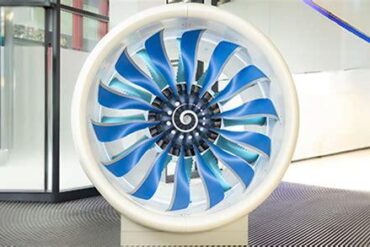
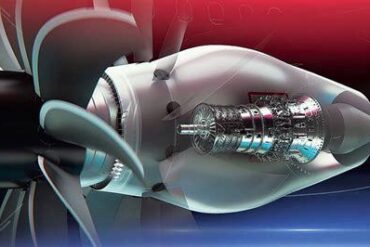
The physics underpinning the open-fan architecture is elegantly simple. Propulsive efficiency improves when an engine moves a larger mass of air more slowly rather than accelerating a smaller mass of air violently. Traditional turbofans achieve this through high bypass ratios, enclosing a large fan inside a nacelle. Open-fan designs remove that nacelle entirely, allowing for an even larger diameter fan and dramatically higher bypass potential.
The result is a configuration that visually breaks from decades of familiar engine design. The fan blades sit exposed, sculpted for aerodynamic precision, and positioned either at the rear of the fuselage or beneath the wing depending on integration strategy.
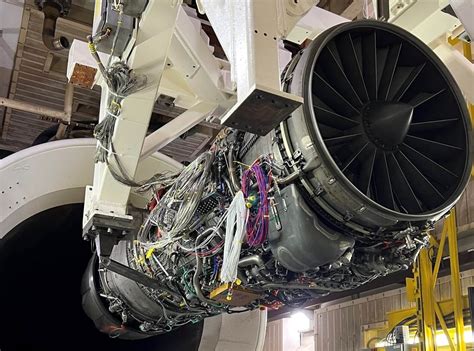
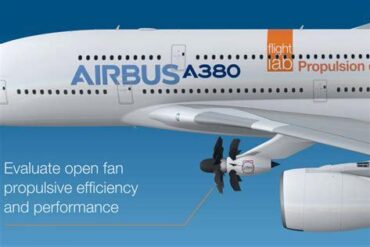
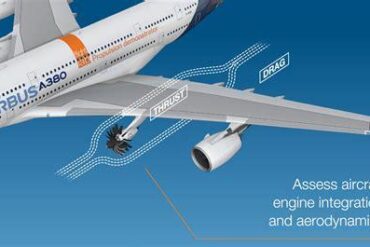
Airbus has taken the concept seriously enough to commit an A380 flying testbed, with flight evaluations planned for the second half of this decade. That move signals intent: Airbus sees open-fan propulsion not as a laboratory curiosity, but as a potential anchor technology for its A320-family successor.
Yet bold physics does not automatically translate into a bankable aircraft program.
The Job Posting That Exposed Plan B
The existence of CFM’s parallel effort surfaced not in a press conference, but through a job posting. Reuters reported that CFM—jointly owned by GE Aerospace and Safran—has been studying an alternative architecture described as “Advanced Ducted-Large.”
This was not a speculative whiteboard exercise. The language suggested an organized development track running alongside RISE. In practical terms, ADL represents the next evolutionary step in enclosed turbofan design—retaining a nacelle, but incorporating aggressive efficiency technologies derived from the RISE program.
An industry insider described it succinctly: imagine an engine that still looks recognizable—large fan, ducted casing—but is pushed to unprecedented efficiency levels using advanced materials, higher pressure ratios, hybrid-electric readiness, and aerodynamic refinements.
It is not the moonshot. It is the safety net.
Why CFM Needs a Safety Net
The mid-to-late 2030s narrowbody window is tightening. Airbus has signaled that its next-generation single-aisle aircraft could arrive toward the end of that decade. Boeing has indicated a similar timeline, suggesting that propulsion readiness will largely dictate launch timing.
Engine development is not a sprint. Even incremental evolutions historically required about a decade from initial design to entry into service. Consider recent programs:
- CFM LEAP: 2005 to 2016 – 11 years
- Pratt & Whitney PW1000G: 2006 to 2016 – 10 years
- GE GEnx: 2002 to 2011 – 9 years
- Rolls-Royce Trent XWB: 2005 to 2015 – 10 years
These engines were evolutionary, not revolutionary. They retained conventional ducted architectures and built upon prior core designs. By contrast, the open-fan concept fundamentally alters airflow, containment assumptions, acoustic profiles, and installation dynamics.
If Airbus intends to launch a new aircraft around 2035, and if certification surprises arise late in open-fan development, the calendar margin becomes razor-thin. A propulsion delay could ripple through the entire airframe program, forcing painful decisions between performance ambition and delivery schedule.
In that context, ADL is less about doubt and more about timing discipline.
Integration Realities: Where Engineering Gets Brutal
Open-fan engines promise efficiency on paper. Aircraft, however, operate in a world governed by trade-offs.
Noise is the most visible challenge. Exposed blades fundamentally change acoustic propagation patterns. Traditional nacelles serve as both structural housing and noise-mitigating shields. Removing them introduces new community noise questions—questions that regulators and airport authorities will not treat casually.
Airframe integration adds another layer of complexity. The diameter of an open fan affects ground clearance, wing structure, landing gear height, and aerodynamic interference. The interaction between exposed blades and airflow around the wing can influence drag and structural loading in ways that demand extensive validation.
Certification presents further unknowns. Conventional turbofans rely on containment structures designed to prevent blade fragments from penetrating the fuselage in rare failure scenarios. Open architectures will require alternative safety demonstrations and possibly new regulatory frameworks.
Maintenance durability cannot be overlooked. Airlines today are acutely sensitive to unexpected shop visits. Recent engine programs have strained maintenance networks and cash flows. A radically new propulsion system would be judged first and foremost on reliability metrics, not marketing claims.
This is the environment in which CFM’s ADL architecture becomes strategically powerful. It reduces integration risk, preserves conventional certification pathways, and allows manufacturers to pursue meaningful efficiency gains without reengineering entire airframes around untested assumptions.
Airbus vs Boeing: Diverging Appetites for Risk
Airbus has publicly leaned harder into open-fan advocacy. Its willingness to dedicate an A380 testbed underscores a belief that early, aggressive experimentation is necessary to secure leadership in the next cycle.
Boeing, meanwhile, has been more measured. Executives have emphasized technological readiness and industrial stability before committing to clean-sheet designs. Pratt & Whitney and Rolls-Royce have also expressed caution regarding open-fan timelines.
This divergence reflects strategic philosophy as much as engineering judgment. Airbus appears prepared to push architectural boundaries to secure sustainability gains. Boeing’s posture suggests a preference for incremental confidence over headline-grabbing breakthroughs.
CFM’s dual-track approach elegantly serves both customers. If open fan matures smoothly, Airbus gains a propulsion leap. If unforeseen integration or certification challenges emerge, ADL offers Boeing—and potentially Airbus—a high-efficiency, lower-risk alternative.
Manufacturability and Supply Chain Reality
An engine is not just a thermodynamic machine; it is a manufacturing ecosystem. Scaling production requires mature supply chains, predictable material flows, and robust quality control systems. The aviation industry’s recent experience with production bottlenecks and component shortages has sharpened awareness of industrial fragility.
Open-fan architectures introduce new blade materials, structural interfaces, and assembly complexities. Scaling such innovations globally while maintaining reliability standards is nontrivial.
ADL, by contrast, leverages the established industrial logic of turbofan production. While incorporating advanced composites, ceramic matrix components, and next-generation cores, it operates within a known assembly framework. That familiarity translates into reduced production risk—an advantage that becomes decisive when airlines demand hundreds of aircraft per year.
The Economics of Being Wrong
The open-fan concept may ultimately succeed. Its thermodynamic advantages are real, and sustained investment could overcome integration hurdles. Yet aerospace history is littered with programs that looked inevitable until reality intervened.
If Airbus or Boeing were to anchor a flagship aircraft exclusively around open fan and encounter late-stage setbacks, the financial consequences would be staggering. Delayed entry into service, redesign costs, and airline contract renegotiations could erode margins for years.
ADL functions as an insurance policy against that scenario. Even if it delivers slightly less than the headline 20% efficiency target, a double-digit improvement within a conventional architecture may prove more than sufficient to justify a new airframe program.
In strategic terms, CFM is ensuring that propulsion uncertainty does not paralyze aircraft decision-making.
The 2030s Narrowbody Battleground
The next single-aisle generation will define commercial aviation for decades. Narrowbody aircraft account for the majority of global fleet deliveries. Fuel burn reductions directly impact airline profitability and carbon compliance strategies.
The propulsion choice will shape wing design, fuselage proportions, and operational economics. A radical open-fan installation could lead to distinctive aircraft silhouettes. A highly optimized ducted engine might enable evolutionary airframe improvements without dramatic external change.
Both pathways aim at the same destination: lower operating cost per seat and reduced emissions footprint. The difference lies in risk tolerance and execution timeline.
CFM’s Plan B does not signal retreat from innovation. It signals recognition that aerospace progress is rarely a straight line. Breakthroughs require ambition; commercial programs require certainty.
As Airbus and Boeing refine their 2030s visions, propulsion will remain the gating factor. Whether the future narrowbody roars with exposed blades or hums with an ultra-efficient ducted fan, the real story is strategic flexibility.
CFM is not betting against the open-fan revolution. It is ensuring that if the revolution stumbles, the industry still moves forward.