Modern commercial aviation lives and dies by efficiency, and nowhere is that more visible than inside the engine nacelle. To passengers, a jet engine is background noise and thrust. To airlines, it is the single most expensive, most scrutinized, and most strategically important component on the aircraft. Fuel burn, maintenance intervals, dispatch reliability, noise compliance, and long-term support all hinge on engine choice. That is why the rivalry between Pratt & Whitney and CFM International matters so profoundly to the global airline industry.
Both companies dominate the narrowbody aircraft segment, often powering the exact same airframe with radically different engineering philosophies. The Airbus A320neo family, in particular, has become a living laboratory for comparing the two. On paper, both manufacturers promise similar gains. In reality, their engines reflect fundamentally different views on how efficiency should be achieved, how risk should be managed, and how airlines should operate fleets over decades rather than quarters.
Understanding the true differences between Pratt & Whitney and CFM engines requires stepping beyond headline fuel-burn percentages and into architecture, materials science, operational philosophy, and long-term reliability. The contrast is not about good versus bad. It is about disruptive innovation versus evolutionary refinement, and the trade-offs that come with each path.
Origins of Pratt & Whitney and Its Engineering DNA
Pratt & Whitney’s story is inseparable from the rise of modern aviation itself. Founded in 1925 and headquartered in East Hartford, Connecticut, the company built its reputation on robust piston engines that powered everything from early airliners to military aircraft during World War II. That wartime production embedded a culture of engineering ambition and scale, qualities that carried forward into the jet age.
As aviation transitioned to turbojets and turbofans, Pratt & Whitney became a key supplier for long-haul commercial aircraft and advanced military platforms alike. This dual civil–defense footprint allowed the company to invest aggressively in advanced aerodynamics, materials research, and manufacturing processes long before efficiency became an existential issue for airlines.
Today, as a subsidiary of RTX Corporation, Pratt & Whitney has leaned fully into architectural innovation. Rather than refining the traditional turbofan, it chose to rethink the relationship between the fan and the turbine altogether. That decision culminated in the Geared Turbofan, a design that defines the company’s modern identity and its willingness to accept complexity in pursuit of measurable efficiency gains.
The Birth of CFM International and a Different Philosophy
CFM International emerged from a very different origin story. Created in 1974 as a 50/50 joint venture between GE Aerospace in the United States and SNECMA of France (now Safran Aircraft Engines), CFM was global by design from day one. This transatlantic structure combined GE’s engine design expertise with Safran’s manufacturing depth and European market access, giving CFM an unusually balanced commercial posture.
The company’s defining breakthrough was the CFM56 engine. Initially slow to sell, it found its moment in the 1980s as airlines faced rising fuel costs and tightening noise regulations. Boeing’s selection of the CFM56 for the 737 Classic and Next Generation families, followed by Airbus choosing it for the original A320, transformed CFM into a dominant force. Over time, the engine became synonymous with durability, ease of maintenance, and exceptional dispatch reliability.
This legacy shaped CFM’s design philosophy. Rather than rewriting engine architecture, the company focused on refining what already worked, integrating new materials and manufacturing techniques without destabilizing proven systems. That mindset carried directly into the LEAP engine family, the successor to the CFM56 and the backbone of CFM’s modern dominance.
Two Design Philosophies, Two Definitions of Efficiency
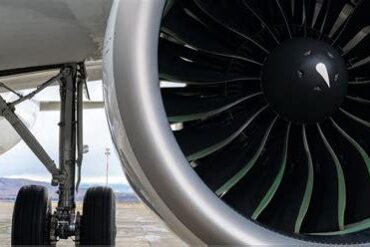
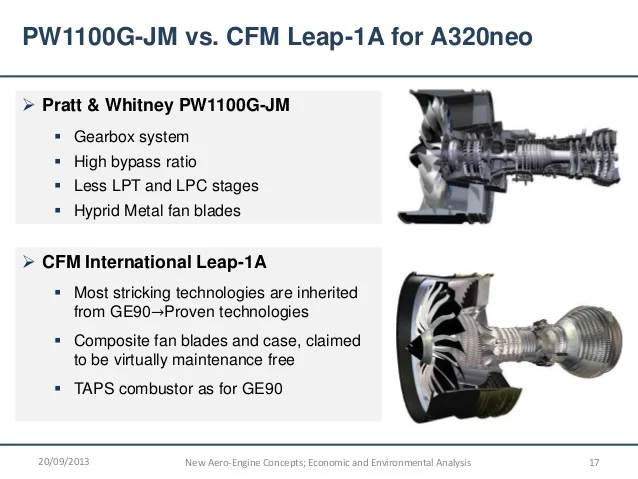
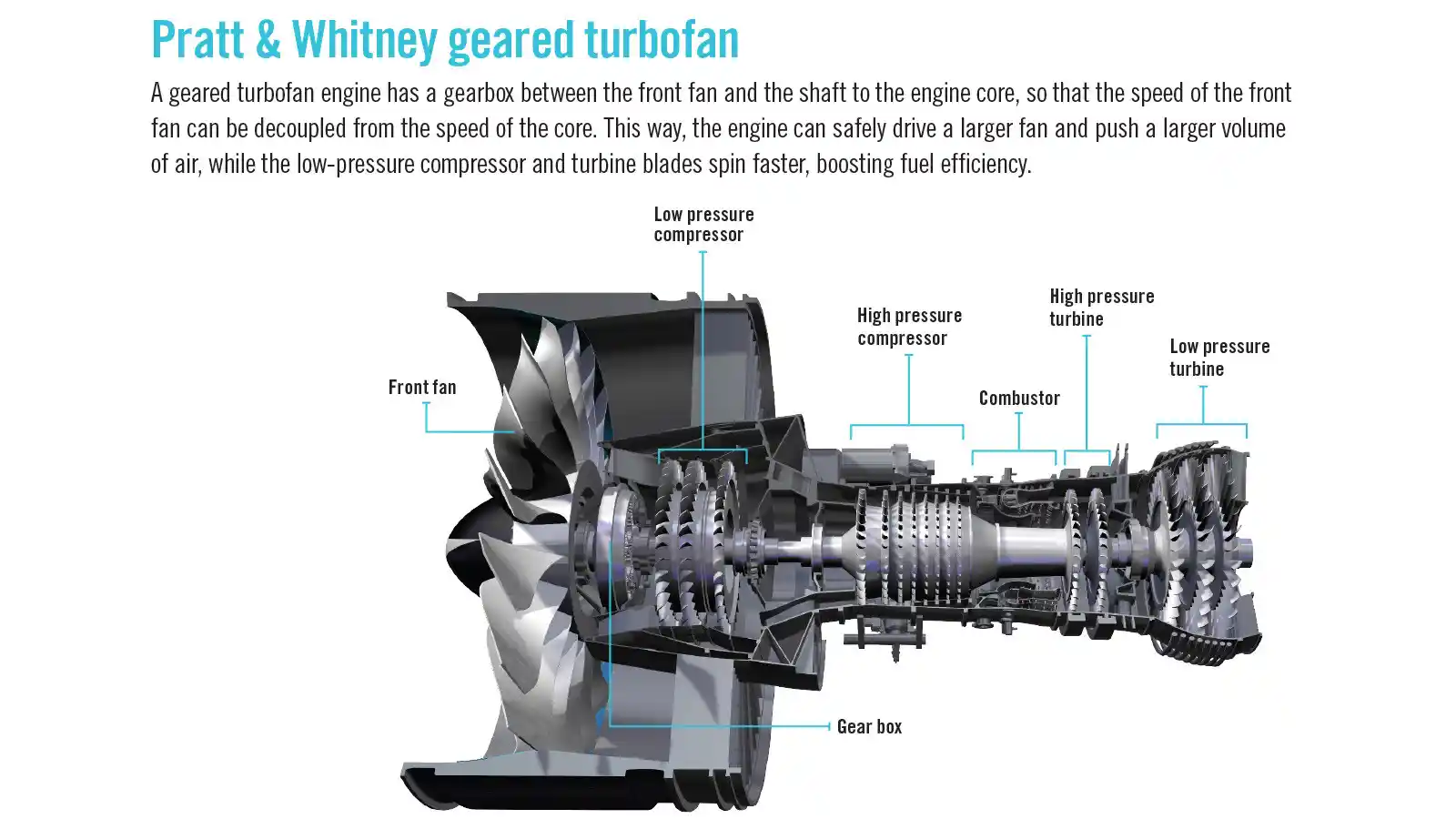
At the heart of the Pratt & Whitney versus CFM debate lies a philosophical divide. Pratt & Whitney’s Geared Turbofan (GTF) inserts a reduction gearbox between the fan and the low-pressure turbine. This allows each component to spin at its optimal speed. The fan turns slower for higher propulsive efficiency and lower noise, while the turbine spins faster for better thermodynamic performance. The result is a higher bypass ratio, lower fuel burn, and reduced acoustic footprint.
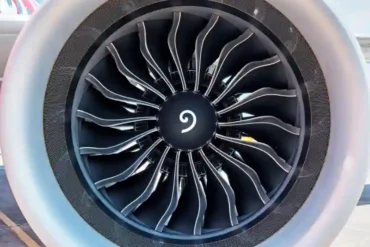
CFM rejected this architectural leap. Instead, the LEAP engine retains a conventional direct-drive layout while pushing efficiency through materials science. Composite fan blades and fan cases reduce weight. Ceramic matrix composites in the hot section tolerate higher temperatures, improving thermal efficiency without adding cooling complexity. Additive manufacturing enables intricate fuel nozzles that improve combustion uniformity and emissions.
In simple terms, Pratt & Whitney chases efficiency through mechanical innovation, while CFM achieves it through material and manufacturing evolution. Neither approach is inherently superior. Each shifts risk into different parts of the system, and airlines feel those differences most acutely in day-to-day operations.
The A320neo as a Real-World Test Case
No aircraft illustrates this rivalry better than the Airbus A320neo. Designed as an evolution of the wildly successful A320 family, the neo promised up to 20% lower fuel burn, with engines delivering the bulk of that improvement. Airbus offered airlines a rare choice: the Pratt & Whitney PW1100G-JM or the CFM LEAP-1A.
The PW1100G-JM embodies the geared turbofan concept at full scale. Its larger fan diameter and higher bypass ratio translate into impressive fuel efficiency and notably lower noise levels. The LEAP-1A counters with a lighter structure, composite fan blades, and hot-section materials that push thermal limits without introducing a gearbox.
On paper, the engines appear closely matched in thrust and overall performance. In practice, their operational personalities diverge. The Pratt & Whitney engine rewards airlines that prioritize fuel burn and noise margins, particularly on shorter sectors. The CFM engine appeals to operators seeking predictable behavior across diverse mission profiles and a maintenance ecosystem built on decades of CFM56 experience.

Maintenance, Reliability, and the Cost of Complexity
Airlines do not operate engines in laboratory conditions. Reliability, maintenance scheduling, and spare engine availability often matter more than fractional fuel-burn advantages. This is where the philosophical divide becomes tangible.
The GTF’s gearbox is an engineering triumph, but it introduces an additional mechanical system that must endure enormous loads over thousands of cycles. While the concept is sound, real-world service has exposed vulnerabilities. Manufacturing issues involving contaminated powdered metal in certain internal components have forced widespread inspections and removals, grounding aircraft and straining airline schedules. The ripple effects have been severe enough to influence fleet decisions, including early retirements of otherwise modern aircraft.
CFM’s LEAP has not been immune to challenges, but its issues have generally been incremental rather than systemic. By retaining a familiar architecture, CFM leveraged existing maintenance practices and global support networks. For many airlines, this translated into higher confidence in long-term dispatch reliability, even if peak fuel efficiency lagged slightly behind the GTF under ideal conditions.
Noise, Regulation, and Community Pressure
Noise has become a strategic factor rather than a regulatory afterthought. Airports impose curfews, communities resist expansion, and airlines face mounting pressure to operate quietly. Here, the geared turbofan’s slower fan speed delivers a clear advantage. The PW1100G-JM consistently achieves lower perceived noise levels, expanding operational flexibility at noise-sensitive airports.
CFM’s LEAP engines also represent a major improvement over previous generations, benefiting from optimized fan aerodynamics and advanced acoustic liners. However, physics favors the geared approach when fan speed drops significantly. For airlines operating in densely populated regions or under strict night-time restrictions, this difference carries real economic value.

Fuel Burn Versus Operational Consistency
Fuel efficiency remains the central metric in engine selection. Over an engine’s life, even a one-percent difference can translate into millions of dollars. Under controlled conditions, Pratt & Whitney’s GTF often demonstrates a slight edge in fuel burn, particularly on short- and medium-haul routes where propulsive efficiency dominates.
The LEAP, however, is frequently praised for its consistency. Across varying payloads, altitudes, and mission lengths, its performance remains predictable. Airlines with complex route networks value this stability, as it simplifies planning and reduces performance surprises that complicate scheduling and fuel forecasting.
In essence, Pratt & Whitney optimizes peak efficiency, while CFM optimizes reliability across the envelope. The choice reflects how an airline defines efficiency in practice, not just in brochures.
The Boeing 737 MAX and Engine Exclusivity
Engine choice is not always optional. The Boeing 737 MAX is powered exclusively by the LEAP-1B, a constraint driven by airframe geometry and certification realities. This exclusivity has reinforced CFM’s dominance in the narrowbody market and simplified engine support for MAX operators, albeit at the cost of competition-driven choice.
For airlines committed to mixed fleets of Airbus and Boeing aircraft, this dynamic often tilts decisions. Operating LEAP engines across both platforms can yield training, maintenance, and spare-parts synergies that outweigh marginal efficiency differences.
Future Trajectories and Strategic Risk
Looking ahead, both manufacturers face defining moments. Pratt & Whitney must restore confidence in the GTF through manufacturing fixes, improved inspection regimes, and transparent engagement with operators. The underlying architecture remains compelling, but trust is earned in service, not simulations.
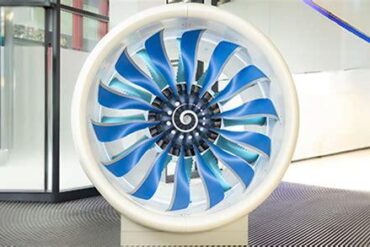
CFM, meanwhile, is charting a longer-term path through its RISE program, an open-rotor concept aimed at dramatically reducing fuel burn and emissions in the 2030s. Like the GTF once did, RISE represents a potential architectural leap, suggesting that even the most evolutionary company recognizes the limits of incrementalism.
The Real Difference That Matters
The true differences between Pratt & Whitney and CFM engines are not captured by a single metric. They are philosophical, operational, and cultural. Pratt & Whitney bets on architectural disruption, accepting complexity and short-term risk to unlock long-term gains. CFM bets on evolutionary refinement, prioritizing reliability, maintainability, and gradual improvement.
Neither approach is universally superior. Each aligns with different airline strategies, risk tolerances, and operational realities. What unites them is their role in powering a global narrowbody fleet that forms the backbone of modern air travel.
In the end, the rivalry is not about which engine is better in absolute terms. It is about how different visions of progress shape the machines that quietly carry billions of passengers across the sky, day after day, with remarkable efficiency and ever-tightening margins for error.