Rolls-Royce has quietly placed a marker down in the most lucrative battleground in commercial aerospace. Buried within strong financial results and confident shareholder messaging was a far more consequential signal: a deliberate plan to re-enter the narrowbody engine market. For a company that has spent over a decade focused almost exclusively on widebody propulsion, that statement represents a strategic pivot with global implications.
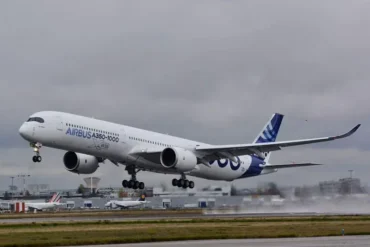
The narrowbody segment is not a niche. It is the volume core of global aviation. Every time a Boeing 737 MAX rotates off a runway or an Airbus A320neo family jet climbs toward cruise altitude, the economics of short- and medium-haul travel are being defined. Forecasts from Boeing and Airbus both project more than 33,000 single-aisle aircraft deliveries over the next two decades. That is not incremental opportunity; it is the backbone of commercial aerospace demand.
Rolls-Royce understands that scale. It also understands that sitting outside the segment means forfeiting the largest slice of engine production, aftermarket services, and long-term revenue streams in aviation. Its statement of intent to pursue narrowbodies using UltraFan technologies, and crucially to do so via partnership, signals that it is not merely experimenting. It is preparing for the next aircraft cycle.
Why Rolls-Royce Walked Away From Narrowbodies
Rolls-Royce did not stumble out of this market. It stepped away deliberately. Its historical foothold came through the V2500 engine, produced within the International Aero Engines consortium. The V2500 powered large portions of the Airbus A320ceo fleet and built a strong operational reputation.
When the narrowbody market transitioned to the re-engined era—ushering in the A320neo and 737 MAX families—Rolls-Royce restructured its involvement, ultimately exiting IAE. That decision removed it from direct competition in single-aisle propulsion. The field consolidated around two dominant players: CFM International and Pratt & Whitney.
CFM’s LEAP family became exclusive on the Boeing 737 MAX and a major option on the Airbus A320neo. Pratt & Whitney’s geared turbofan (GTF) secured the alternative A320neo slot and became sole-source power on aircraft like the Airbus A220 and Embraer E2 family. The result was a narrowbody duopoly that has defined the current generation.
Meanwhile, Rolls-Royce doubled down on widebody engines such as the Trent series. That strategy delivered technological prestige but left the company outside the highest-volume engine market in the world. As delivery counts compound year after year, the absence becomes increasingly strategic.
The Narrowbody Market: Aviation’s Volume Engine
Single-aisle aircraft represent the structural core of airline networks. They operate dense domestic routes, short-haul international sectors, and increasingly long-range missions with extended variants. Airlines depend on them for frequency, flexibility, and yield management.
With more than 33,000 projected deliveries over the next twenty years, narrowbodies dwarf widebody output in sheer numbers. Engines in this class generate not only initial sales revenue but decades of aftermarket services, maintenance contracts, and performance upgrades. In modern aerospace economics, the engine is often a lifecycle business rather than a one-time transaction.
For Rolls-Royce, regaining presence in this segment would mean tapping into recurring cash flows at unprecedented scale. It would also rebalance its portfolio, reducing reliance on the more cyclical widebody sector. The timing matters because both Airbus and Boeing will eventually move toward next-generation replacements for today’s A320neo and 737 MAX families. Engine selection decisions in that cycle will shape competitive dynamics well into the 2040s.
UltraFan: The Technological Wedge
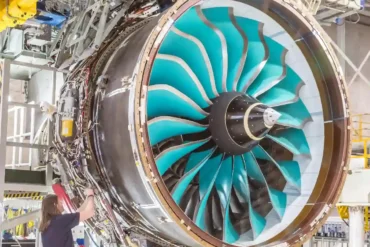
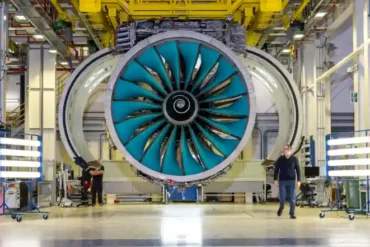
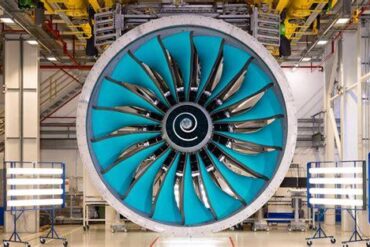
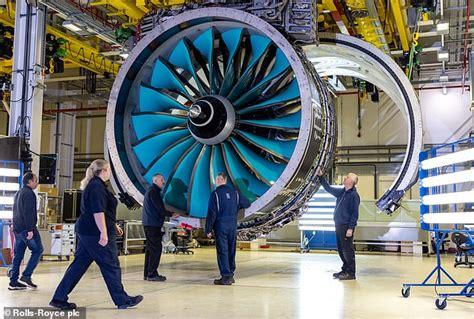
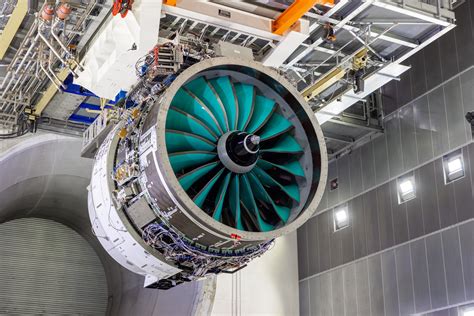
UltraFan is not yet a production engine. It is a next-generation architecture demonstrator designed to deliver a step-change in efficiency. Its importance lies in the technologies it integrates rather than in immediate airline availability.
At the heart of UltraFan is a geared turbofan architecture. In a traditional turbofan, the fan and the core rotate at linked speeds. A gearbox allows these components to operate at their optimal rotational speeds independently. The fan can turn slower for propulsive efficiency, while the core can operate faster to maximize thermodynamic efficiency. That decoupling is fundamental to squeezing more performance out of every kilogram of fuel burned.
UltraFan also incorporates a large composite fan system and advanced materials within the core. Weight is a ruthless constraint in narrowbody economics. Efficiency gains that add excessive mass undermine short-haul performance. Rolls-Royce’s challenge is to adapt UltraFan principles to a single-aisle context without creating a propulsion system too heavy for its mission profile.

Ground testing for a narrowbody-oriented demonstrator is reportedly targeted around 2028, with potential entry into service in the early 2030s. That aligns directly with the expected timeline for next-generation narrowbody programs. The clock is not leisurely; it is synchronized with aircraft development cycles.
The Partnership Strategy: Scale Without Overreach
The most revealing element of Rolls-Royce’s announcement is not the technology. It is the explicit commitment to partnership.
Narrowbody production rates are brutal in their scale. Hundreds of aircraft per year require industrial systems built for consistency, cost discipline, and global support. Entering alone would mean constructing a vast supply chain, assembly footprint, and maintenance network nearly from scratch.
Partnership offers leverage. By collaborating with an established industrial player, Rolls-Royce can combine its core design expertise with high-rate manufacturing experience and mature aftermarket infrastructure. MTU Aero Engines frequently emerges as a logical candidate due to its background in geared architectures and strong MRO capabilities.
The industrial dimension is inseparable from credibility. Airlines no longer evaluate engines solely on brochure efficiency. They scrutinize shop visit intervals, spare part availability, and maintenance turnaround times. Recent industry-wide supply chain bottlenecks have underscored that propulsion reliability extends beyond the engine’s thermodynamics.
By signaling a cooperative approach, Rolls-Royce is addressing the industrial trust question from the outset. It is positioning UltraFan not as an isolated engineering marvel but as a system embedded within a scalable support ecosystem.
Government Backing And Economic Leverage
The narrowbody engine initiative carries substantial economic implications. Reports indicate that Rolls-Royce is seeking UK government support for what could become a multi-billion-pound program. Early funding would accelerate demonstrator development, while long-term backing would anchor high-value engineering and manufacturing jobs domestically.
In aerospace, propulsion programs ripple across supply chains. Materials specialists, precision machining firms, digital modeling teams, and testing facilities all become integral participants. A successful narrowbody engine would represent not just a commercial victory but a national industrial asset.
Public funding discussions also reflect the strategic nature of propulsion technology. Advanced engine cores, composite fans, and gear systems are high-barrier technologies. Once established, they create enduring competitive positions.
Competitive Shockwaves In The Next Cycle
The re-entry of Rolls-Royce would alter the strategic calculus for Airbus and Boeing. Both airframers value competition among engine suppliers. It strengthens negotiating leverage and diversifies technical risk.
If UltraFan-derived propulsion demonstrates credible efficiency gains, aircraft manufacturers could view it as an opportunity to introduce meaningful performance improvements in the next narrowbody generation. Efficiency is not merely about fuel burn; it intersects with emissions targets, sustainable aviation fuel compatibility, and regulatory pressures.
CFM and Pratt & Whitney will not stand still. Both continue refining their current platforms while exploring advanced architectures of their own. A three-player field would intensify innovation cycles, benefiting airlines through performance gains and potentially improved commercial terms.

Timing Is Everything
The narrowbody replacement window will not remain open indefinitely. Aircraft development cycles are lengthy and capital-intensive. Engine partners are typically locked in early, with decades-long consequences.
Rolls-Royce’s timeline—demonstrator testing in the late 2020s and service entry in the early 2030s—suggests careful synchronization with that window. Arriving too late would mean missing the generational shift. Arriving too early without proven maturity would undermine airline confidence.
The company’s language signals discipline rather than haste. It has placed the intent on record, aligning shareholders, policymakers, and potential partners around a defined objective. Now the progression will unfold through quieter milestones: partnership agreements, demonstrator results, and incremental validation.
A Calculated Return To The Core Of Commercial Aviation
Rolls-Royce’s potential return to narrowbody engines is neither nostalgic nor reactive. It is a strategic recalibration toward aviation’s largest growth engine. UltraFan provides the technological foundation. Partnership provides the industrial credibility. Government engagement provides financial momentum.
If executed successfully, this move would restore Rolls-Royce to the center of commercial aviation’s highest-volume segment. It would diversify revenue streams, intensify competition, and potentially redefine propulsion efficiency standards for the next generation of single-aisle aircraft.
The narrowbody market is not forgiving. It demands scale, reliability, and relentless cost control. Yet it also rewards those who combine engineering ambition with industrial pragmatism. Rolls-Royce appears determined to attempt precisely that synthesis.
The coming decade will determine whether UltraFan evolves from demonstrator to dominant contender. What is clear now is that the company is no longer content to watch from the sidelines. It is positioning itself for aviation’s biggest prize, and the industry will be watching every development step with precision.