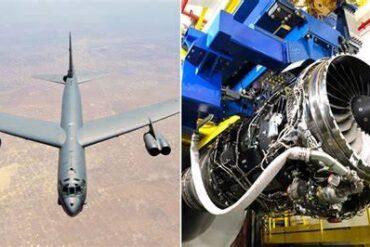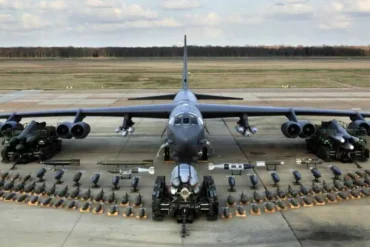
The Boeing B-52 Stratofortress has achieved something almost unheard of in military aviation. More than seven decades after its first flight in 1952, the aircraft remains one of the most important pillars of American strategic airpower. While countless combat aircraft have come and gone, the B-52 has survived multiple generations of technological change, geopolitical rivalry, and military doctrine. Today, instead of retiring this legendary bomber, the United States Air Force is investing billions of dollars to ensure it remains combat-ready well into the middle of the 21st century.
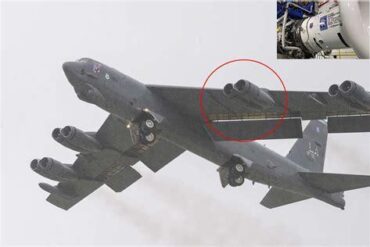
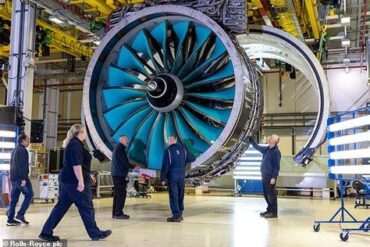
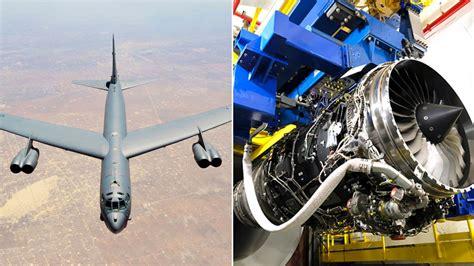
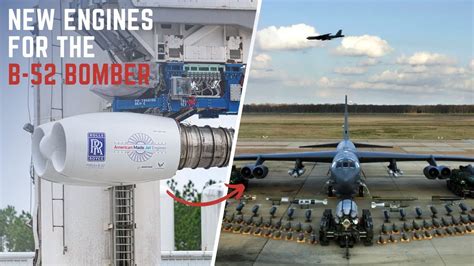
At the center of this transformation is the Commercial Engine Replacement Program (CERP), a sweeping modernization effort that replaces the aircraft’s aging Pratt & Whitney TF33 engines with brand-new Rolls-Royce F130 turbofans. The engine replacement represents far more than a routine upgrade. It fundamentally changes how the bomber flies, how it is maintained, how far it can travel, and how effectively it can operate in future conflicts.
For an aircraft whose youngest examples were built in the early 1960s, receiving an entirely new propulsion system is equivalent to receiving a new heart. The result is a bomber that will become significantly more fuel efficient, cheaper to operate, easier to maintain, and better suited to modern warfare than at any point in its remarkable history.
The aircraft emerging from this modernization effort will be designated the B-52J, and it is expected to remain operational until at least 2050, with many experts believing service could continue even beyond that milestone.
The prospect of a military aircraft serving for nearly a century may sound extraordinary, but the B-52 has never been an ordinary airplane.
The Aging TF33 Engines Finally Reach The End Of Their Service Life
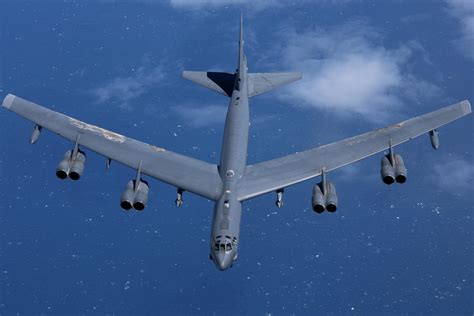
For decades, the B-52H fleet has relied on eight Pratt & Whitney TF33-P-103 turbofan engines. These engines entered service during the Cold War and were originally designed during an era when fuel efficiency, digital diagnostics, and low-maintenance operation were not primary engineering priorities.
Although the TF33 proved remarkably durable, it gradually became one of the bomber’s most significant operational limitations.
The engines consume large amounts of fuel, require intensive maintenance, and depend on outdated analog control systems. Their hydro-mechanical architecture reflects 1950s engineering philosophies rather than modern aerospace standards. As the engines aged, sustaining them became increasingly expensive and logistically challenging.
The Air Force faced a critical decision: continue pouring resources into maintaining obsolete propulsion systems or invest in a complete replacement that could extend the bomber’s relevance for decades.
The answer became clear when engineers evaluated the long-term benefits of modern commercial engine technology.
Why The Rolls-Royce F130 Is A Game-Changer
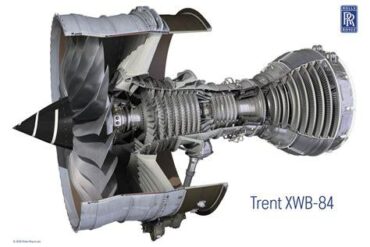
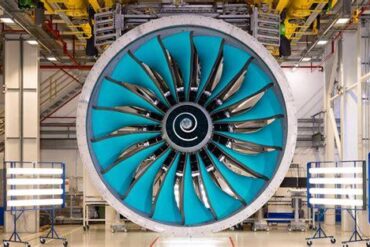
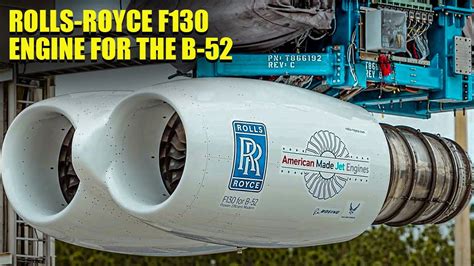
The Rolls-Royce F130 is derived from the highly successful BR725 commercial business jet engine family. Unlike the TF33, the F130 incorporates modern high-bypass turbofan technology that dramatically improves efficiency.
A high-bypass engine generates thrust by moving a large volume of air around the engine core rather than relying primarily on combustion gases. This approach produces equivalent thrust while consuming substantially less fuel.
The numbers tell the story.
While maintaining approximately 17,000 pounds of thrust per engine, the F130 increases bypass ratio from 1.4:1 to 4.2:1. This allows the engine to generate thrust far more efficiently than the TF33.
Fuel consumption is expected to decrease by roughly 30 percent. For a strategic bomber that often undertakes missions lasting many hours and covering thousands of miles, that reduction translates into enormous operational advantages.
Every gallon of fuel saved extends range, reduces logistics requirements, lowers operating costs, and increases strategic flexibility.
The Air Force is essentially gaining the performance benefits of a new aircraft without having to develop an entirely new bomber platform.
Extending Range And Reducing Dependence On Tankers
One of the most important consequences of the F130 installation is the dramatic increase in unrefueled range.
Strategic bombers rely heavily on aerial refueling during long-distance missions. While tanker aircraft such as the KC-135 Stratotanker and KC-46 Pegasus are indispensable assets, they are also limited in number and highly valuable targets during wartime.
Every refueling operation introduces operational complexity and risk.
By reducing fuel consumption by nearly one-third, the B-52J can remain airborne longer before requiring tanker support. This creates several important advantages.
First, fewer tanker sorties are required to sustain bomber operations.
Second, tanker aircraft can be reassigned to support other combat assets.
Third, bomber missions become more flexible because planners are less constrained by refueling schedules and tanker availability.
In a large-scale conflict across the Indo-Pacific, where distances between bases can stretch thousands of miles, these improvements could have profound strategic implications.
A bomber capable of traveling farther on internal fuel becomes significantly more valuable in contested environments.
Improved Survivability Through Cleaner Engine Operation
The TF33 engines have long been associated with one highly visible characteristic: thick black smoke trails.
These dark exhaust plumes became one of the defining visual signatures of the B-52 throughout the Cold War and beyond. While iconic, they represent inefficiency and create an unnecessary visual marker that can help adversaries track aircraft movements.
The F130 virtually eliminates this issue.
Modern combustion technology enables cleaner and more complete fuel burn, producing dramatically lower visible emissions.
The reduction in smoke improves environmental performance, but the military implications are equally important.
An aircraft that leaves a less visible signature in the sky becomes harder to detect and track visually. While smoke reduction alone will not make a B-52 stealthy, every decrease in observability contributes to overall battlefield survivability.
Modern Digital Controls Replace Cold War Technology
Another transformational improvement comes from the adoption of Full Authority Digital Engine Control technology, commonly known as FADEC.
The TF33 relies on hydro-mechanical control systems that require extensive manual management and maintenance.
The F130 introduces dual-channel digital engine controls capable of continuously optimizing performance throughout all phases of flight.
FADEC systems monitor engine conditions in real time and automatically adjust operating parameters for maximum efficiency and reliability.
The benefits extend far beyond fuel savings.
Pilots experience simplified workload.
Maintenance personnel gain access to comprehensive engine health monitoring.
Potential mechanical issues can be identified before they become major failures.
Mission readiness improves because aircraft spend less time undergoing unscheduled repairs.
The transition from analog engine management to digital control represents one of the most significant technological leaps in the bomber’s history.
Enabling Agile Combat Employment
Modern warfare increasingly emphasizes operational unpredictability.
The Air Force’s Agile Combat Employment doctrine seeks to disperse aircraft across numerous locations rather than concentrating them at a handful of major bases vulnerable to missile attack.
The legacy B-52 struggled to support this concept because of its extensive logistical requirements.
TF33 engines required pneumatic starting systems, specialized support equipment, and large maintenance footprints.
Operating from remote or austere airfields was considerably more difficult than operating from established strategic bases.
The F130 changes that equation.
Modern electric starters eliminate the need for cumbersome support equipment.
Maintenance requirements decline significantly.
Engine reliability increases substantially.
As a result, B-52J bombers can deploy more effectively to dispersed locations while maintaining operational readiness.
This flexibility complicates enemy targeting efforts and increases the survivability of the bomber force during major conflicts.
Lower Maintenance Costs And Greater Reliability
One of the most expensive aspects of operating older military aircraft is maintenance.
The TF33 requires regular overhauls, specialized parts, and extensive manpower to remain airworthy.
As components become increasingly scarce, sustainment costs continue to rise.
The F130 was selected partly because of its strong commercial heritage.
Derived from a widely used business aviation engine family, it benefits from an active industrial base and established global supply chains.
Replacement parts can be sourced more efficiently.
Technical expertise is widely available.
Long-term support becomes significantly easier to sustain.
Perhaps most importantly, the F130 is expected to remain installed on the aircraft for its entire service life without requiring major midlife depot overhauls.
This dramatically reduces maintenance downtime and increases fleet availability.
For the Air Force, higher readiness rates mean more bombers available for training, deterrence missions, and combat operations.
A Massive Modernization Effort Beyond Engines
Although the engine replacement program receives the most attention, it is only one component of a broader modernization initiative.
The B-52J will also receive advanced radar systems derived from modern fighter aircraft.
New communications equipment will improve connectivity across joint-force networks.
Enhanced data links will enable better integration with modern command-and-control systems.
Together, these upgrades transform the bomber into a highly connected platform capable of operating effectively within future digital battle networks.
The result is not merely an upgraded B-52.
It is effectively a re-engineered strategic weapons platform built around a proven airframe.
The Engineering Challenge Of Modernizing A 1960s Bomber
Replacing engines on a sixty-year-old bomber is far more complicated than mounting new hardware beneath the wings.
The F130 engines differ significantly from the TF33 in physical dimensions and aerodynamic characteristics.
Engineers had to redesign nacelles and pylons to accommodate the new powerplants while preserving aerodynamic stability.
Advanced digital scanning technologies were employed to create accurate three-dimensional models of aircraft originally built decades before computer-aided design existed.
These scans revealed a surprising reality: no two B-52 airframes are exactly alike.
Decades of service, repairs, and structural modifications created subtle variations across the fleet.
Boeing engineers therefore faced the unusual challenge of integrating modern digital systems into aircraft designed during the dawn of the jet age.
The complexity of this undertaking underscores the scale of the modernization effort.
Why The B-52J May Become The Most Cost-Effective Strategic Bomber In History
Building an entirely new strategic bomber fleet would require hundreds of billions of dollars and many years of development.
By contrast, upgrading the existing B-52 fleet leverages proven airframes while incorporating modern technologies where they matter most.
The total modernization effort is expected to cost approximately $11 billion to $12 billion, a substantial investment but far less expensive than procuring dozens of additional new heavy bombers.
The Air Force plans to convert all 76 operational B-52H aircraft into the B-52J configuration.
With more than 600 new engines required, plus spares, the project represents one of the largest military aircraft propulsion modernization programs ever undertaken.
Yet the payoff is enormous.
The upgraded fleet will offer lower operating costs, greater mission flexibility, improved reliability, enhanced combat effectiveness, and decades of additional service life.
Securing America’s Strategic Strike Capability For The Next Generation
The B-52 has survived because it consistently adapts to changing military realities. From Cold War nuclear deterrence to conventional precision strike operations in the Middle East and Indo-Pacific, the aircraft has repeatedly evolved to meet new challenges.
The Rolls-Royce F130 engine upgrade represents the most important evolution yet.
By dramatically reducing fuel consumption, extending range, simplifying maintenance, enabling dispersed operations, and improving reliability, the new engines breathe new life into one of the most iconic aircraft ever built.
When the first operational B-52J squadrons enter service, they will not merely represent upgraded bombers. They will demonstrate how intelligent modernization can transform a Cold War legend into a highly capable strategic asset for the decades ahead.
Few aircraft in history have remained relevant for seventy years. Even fewer will approach a century of operational service. Thanks largely to its new Rolls-Royce engines, the B-52 Stratofortress is poised to achieve exactly that while becoming more efficient than ever before.