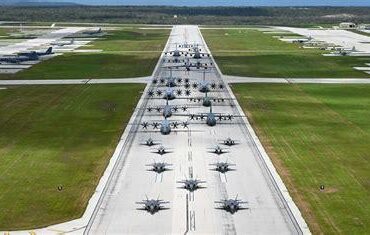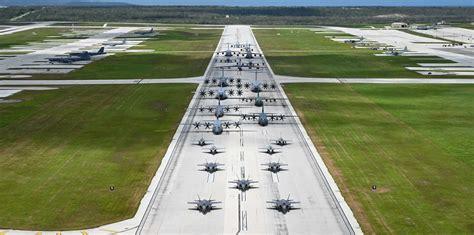
Andersen Air Force Base on Guam has become one of the most important pieces of the United States military posture in the Indo-Pacific. Its location gives American aircraft a forward operating position far closer to potential flashpoints in East Asia than bases in Hawaii or the continental United States. Yet that geographic advantage creates a serious vulnerability: Andersen AFB is also an obvious target in any major conflict with China.
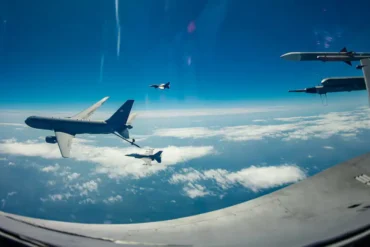
The Pentagon’s answer is not simply to build a larger fortress on Guam. Instead, the United States is developing a network of alternative airfields across the western Pacific and Australia. These locations fit into the Air Force’s increasingly important Agile Combat Employment (ACE) concept, which seeks to distribute aircraft, personnel, fuel, weapons, and support equipment across multiple locations rather than concentrating them at one vulnerable base.
This strategy matters because modern air warfare increasingly rewards dispersion. A runway can be damaged. Fuel storage can be attacked. Aircraft parked in the open can become easy targets. If dozens of combat aircraft, bombers, tankers, and support aircraft are concentrated at Andersen, a successful missile strike could temporarily remove a major American airpower hub. A distributed network gives commanders alternatives and makes it much harder for an adversary to eliminate American air operations with a single attack.
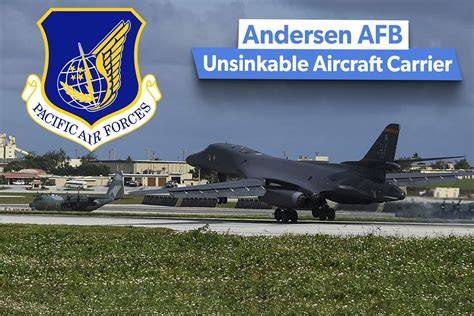
Roman Tmetuchl International Airport, Palau
Around 820 miles from Andersen AFB, Roman Tmetuchl International Airport on Palau provides one of the most strategically interesting alternatives in the western Pacific. Palau is not a US territory. It is a sovereign nation and a member of the United Nations. However, its relationship with Washington is unusually close because of the Compact of Free Association (COFA).
Under the compact that entered into force in 1994, the United States has responsibility for Palau’s defense and enjoys extensive military operating rights. That arrangement gives Washington access to an independent country without making Palau another American territory. Strategically, the island nation’s location also matters because it lies farther south than Guam, creating additional geographic separation from likely Chinese missile and air threats.
The United States has increasingly demonstrated that Palau is more than a theoretical contingency location. In 2021, the commander of Pacific Air Forces visited the country as American planners explored its usefulness for Agile Combat Employment. The concept is particularly valuable here because Palau can potentially provide another operating node if Guam becomes unavailable.
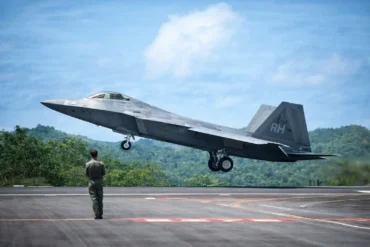
American aircraft have already put that theory into practice. In 2023, US Air Force F-35A fighters operated from Roman Tmetuchl International Airport during Northern Edge. The following year, six C-17 Globemaster III aircraft used the airport during an exercise involving a US Army Rangers airfield-seizure scenario. These activities demonstrate the importance of proving that aircraft and personnel can actually move through these locations rather than merely identifying them on a map.
Palau also has another piece of the puzzle. The United States is rehabilitating the previously abandoned Peleliu Airfield on the island of Peleliu. That creates the possibility of another dispersed operating location within Palau itself, further reducing dependence on a single runway.
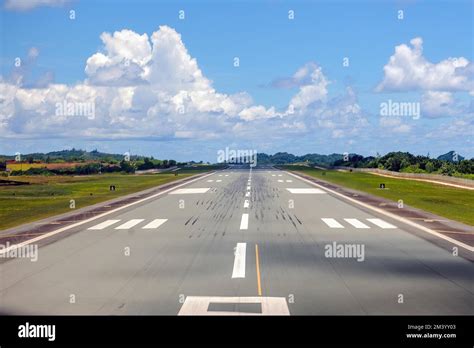
Yap International Airport, Micronesia
About 540 miles from Andersen, Yap International Airport in the Federated States of Micronesia represents another important component of America’s Pacific access strategy. Like Palau, Micronesia is a sovereign country operating under a Compact of Free Association with the United States. The arrangement gives Washington full authority and responsibility for defense and security matters concerning the country.
Yap’s geography is especially useful because it sits considerably closer to Guam than Palau while still providing a separate island operating location. That combination makes it potentially valuable for aircraft diversions, expeditionary operations, logistics, and distributed military deployments.
The problem is that the airport was not originally designed to function as a major military airfield. Its runway is too short for some military aircraft operations, and it lacks critical infrastructure, including aircraft arresting capabilities. Those limitations explain why American investment is increasingly focused on upgrading the location rather than simply treating it as an existing wartime base.
The US Air Force requested approximately $400 million in fiscal year 2025 for improvements that included extending the runway in both directions and expanding facilities. Subsequent budget planning has also included funding for a military runway extension intended to support deployment, readiness exercises, and Agile Combat Employment activities.
That investment illustrates an important characteristic of the Pacific strategy. The United States does not necessarily need every location to become a full-scale Andersen replacement. Instead, individual airfields can perform specialized roles. Yap could become a divert and deployment location, helping aircraft continue operating when larger bases are threatened, congested, or damaged.
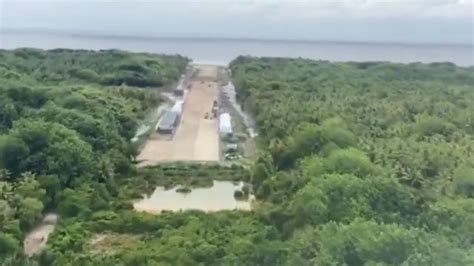
Rota International Airport, Northern Mariana Islands
Only about 50 miles from Guam, Rota International Airport is geographically the closest alternative on this list. Rota belongs to the Northern Mariana Islands, a US commonwealth in the same island chain as Guam. That political and geographic relationship makes the Northern Marianas particularly important to American planners seeking to distribute air operations around Andersen.
Rota itself is not being transformed into a giant military installation. Its value comes from being one of several smaller airfields that can absorb aircraft and personnel when required. The airport has a single runway and relatively limited infrastructure, meaning its role is better understood as a dispersed operating location rather than a conventional secondary air base.
Exercises have repeatedly tested that concept. During Cope North 2023, Rota participated in activities designed to distribute military assets across multiple islands. In 2022, a Terminal High Altitude Area Defense unit deployed to Rota to test remote launch capabilities, demonstrating that the island can support specialized military systems despite its limited infrastructure.
More recently, the island has appeared in broader US and allied exercises. The Boeing Australia MQ-28 Ghost Bat was seen operating during Exercise Valiant Shield 2026, reinforcing the wider movement toward distributed operations across the Mariana Islands.
Rota’s importance therefore comes less from the number of aircraft it can permanently accommodate and more from the options it creates. In a conflict, even a modest runway can matter if it allows aircraft to escape a threatened base, refuel, rearm, repair, or temporarily operate from another location.
Saipan International Airport, Northern Mariana Islands
About 125 miles from Andersen, Saipan International Airport provides another layer of redundancy. Saipan is historically significant because it played a major role in the US island-hopping campaign during World War II. Today, its civilian airport can serve a very different purpose: supporting expeditionary military operations when normal Pacific basing arrangements are disrupted.
The airport is a dual-use civilian and military facility, which makes it different from a purpose-built air base. Washington is not simply constructing another giant permanent installation there. Instead, exercises have demonstrated that military units can rapidly establish a temporary presence and operate from the existing infrastructure.
In April 2024, approximately 225 personnel from Joint Base Pearl Harbor-Hickam established a bare-base operation at Saipan during Exercise Agile Reaper. The exercise was designed to test how the 11th Air Force could transition from normal peacetime operations to an expeditionary posture on the island.
That distinction is crucial. The value of Saipan lies in its ability to become useful quickly rather than necessarily remaining heavily militarized during peacetime. The 2025 REFORPAC exercise also demonstrated that the airport could support US Air Force operations as an austere location.
For American planners, this creates another option if Andersen is damaged or temporarily unusable. Aircraft do not necessarily need a permanent squadron, large hardened shelters, or enormous ammunition stockpiles at every location. A prepared runway, trained personnel, communications, fuel access, and rapidly deployable equipment can be enough to keep an air campaign moving.
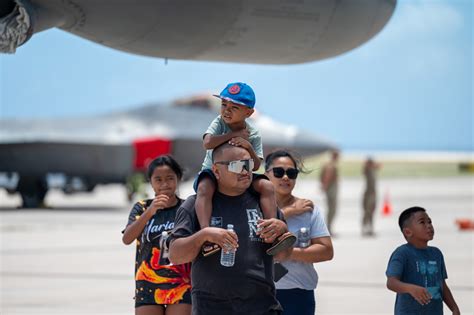
Tinian International Airport and North Field
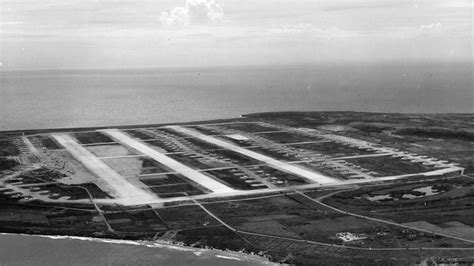
Around 120 miles from Guam, Tinian may be the most significant backup location in the entire network. The island is part of the Northern Mariana Islands and contains both Tinian International Airport and the historic North Field, the enormous World War II-era airfield associated with American B-29 operations.
The location is now being brought back into strategic relevance. Plans to upgrade Tinian’s military infrastructure have been developing for years, and the United States has been investing in the island as part of a broader effort to create alternatives to Guam. Publicly available plans have included a major modernization program estimated at roughly $800 million, reflecting the scale of the long-term ambition.
Tinian’s importance is not simply theoretical. In 2024, US Marines operating F/A-18 Hornets conducted Agile Combat Employment operations at Tinian International Airport alongside forces from Australia, Japan, Canada, South Korea, and France. The multinational participation demonstrated that Tinian can function as a practical node within a distributed coalition airpower network.
The island also offers something that smaller civilian airports cannot: space and historical airfield infrastructure suitable for significant redevelopment. The rehabilitation of North Field and investment around the international airport could eventually give US forces a much more capable alternative to Andersen.
The strategic logic is straightforward. Guam remains essential, but the United States does not want Guam to become indispensable. Tinian provides depth only about two hours away by many military aircraft, while its location inside the Northern Mariana Islands places it within the broader American territorial framework.
If Andersen were damaged by missile attacks, Tinian could potentially absorb aircraft, support personnel, and missions that would otherwise have nowhere nearby to go. That makes it one of the clearest examples of the Pentagon’s emerging Pacific resilience strategy.
RAAF Tindal, Darwin and Amberley, Australia
Australia represents the most geographically distant component of this network, but distance is precisely what makes it valuable. RAAF Base Tindal and RAAF Base Darwin, near Australia’s northern city of Darwin, are roughly 2,000 miles from Guam. RAAF Base Amberley, near Brisbane, is even farther away.
These bases cannot simply replace Andersen for short-range fighters. Instead, their value lies in supporting long-range bombers, tankers, maritime aircraft, and other strategic assets that can operate across enormous distances.
That distinction is increasingly important as the United States considers how vulnerable aircraft are when parked at forward bases. Guam is close enough to East Asia to provide tremendous operational reach, but that same proximity can make it vulnerable to Chinese long-range missiles. Keeping high-value bombers at Guam during a major conflict could therefore expose some of America’s most important aircraft to attack while they are still on the ground.
Australia offers greater geographic depth without forcing American bombers to return all the way to Hawaii or the continental United States. That can preserve sortie rates while placing aircraft farther from the immediate threat environment.
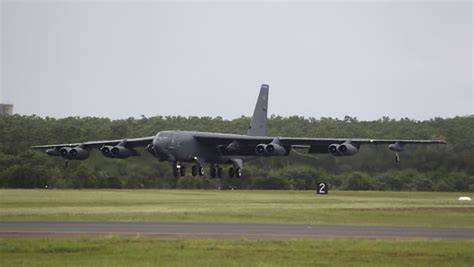
At RAAF Base Tindal, the runway is being extended from approximately 9,000 feet to 11,000 feet. The base is associated with Australian F-35A operations and has been identified as a potential location for US bombers, including B-52s and eventually the B-21. RAAF Base Darwin has also supported American bomber and tanker activity, while Amberley has infrastructure relevant to heavy aircraft operations.
US investment in Australian facilities is therefore part of a larger basing equation. The objective is not merely to create another Andersen. It is to build strategic depth behind Andersen, allowing the United States and Australia to move aircraft between locations depending on the threat.
Why the Six Bases Matter for Andersen AFB
Taken together, these six locations reveal a major shift in how the United States is approaching Pacific airpower. Andersen AFB remains indispensable because Guam offers exceptional range, infrastructure, and political reliability. But the Pentagon increasingly recognizes that concentrating too much combat power there would create a dangerous single point of failure.
The answer is distributed airpower. Palau and Micronesia provide sovereign-country access under defense agreements. Rota, Saipan, and Tinian provide options inside the Northern Mariana Islands. Australia offers strategic depth for aircraft that can travel thousands of miles and still deliver combat power across the region.
Each location has different capabilities and limitations. Some have long runways but limited infrastructure. Others are close to Guam but relatively austere. Australia is far away but provides substantially greater survivability for large aircraft. That diversity is actually the strength of the system.
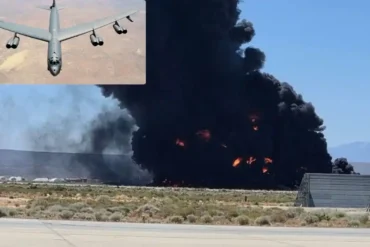
The emerging network also reflects a broader understanding of modern missile warfare. A military base does not need to be completely destroyed to become operationally irrelevant. Runway cratering, fuel fires, damaged communications, destroyed maintenance equipment, or temporary airspace restrictions could be enough to disrupt operations. Redundancy therefore becomes a form of protection.
The United States is consequently building something more sophisticated than six backup runways. It is developing a web of airfields that can allow aircraft to move, disperse, recover, and return to combat from multiple directions. If Andersen remains operational, these bases increase flexibility. If Andersen is damaged, they become essential.
That is ultimately why the quiet buildup matters. The most important feature of the strategy may not be any single runway or facility. It is the growing assumption that no single Pacific air base should be allowed to determine whether American airpower can continue fighting.