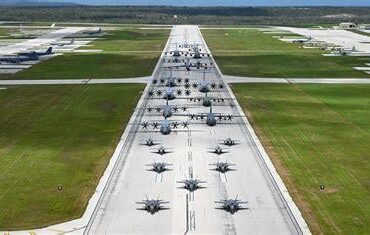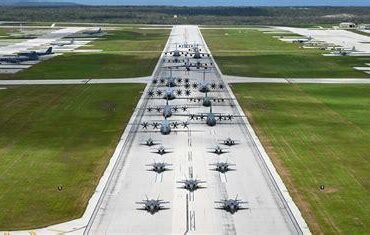
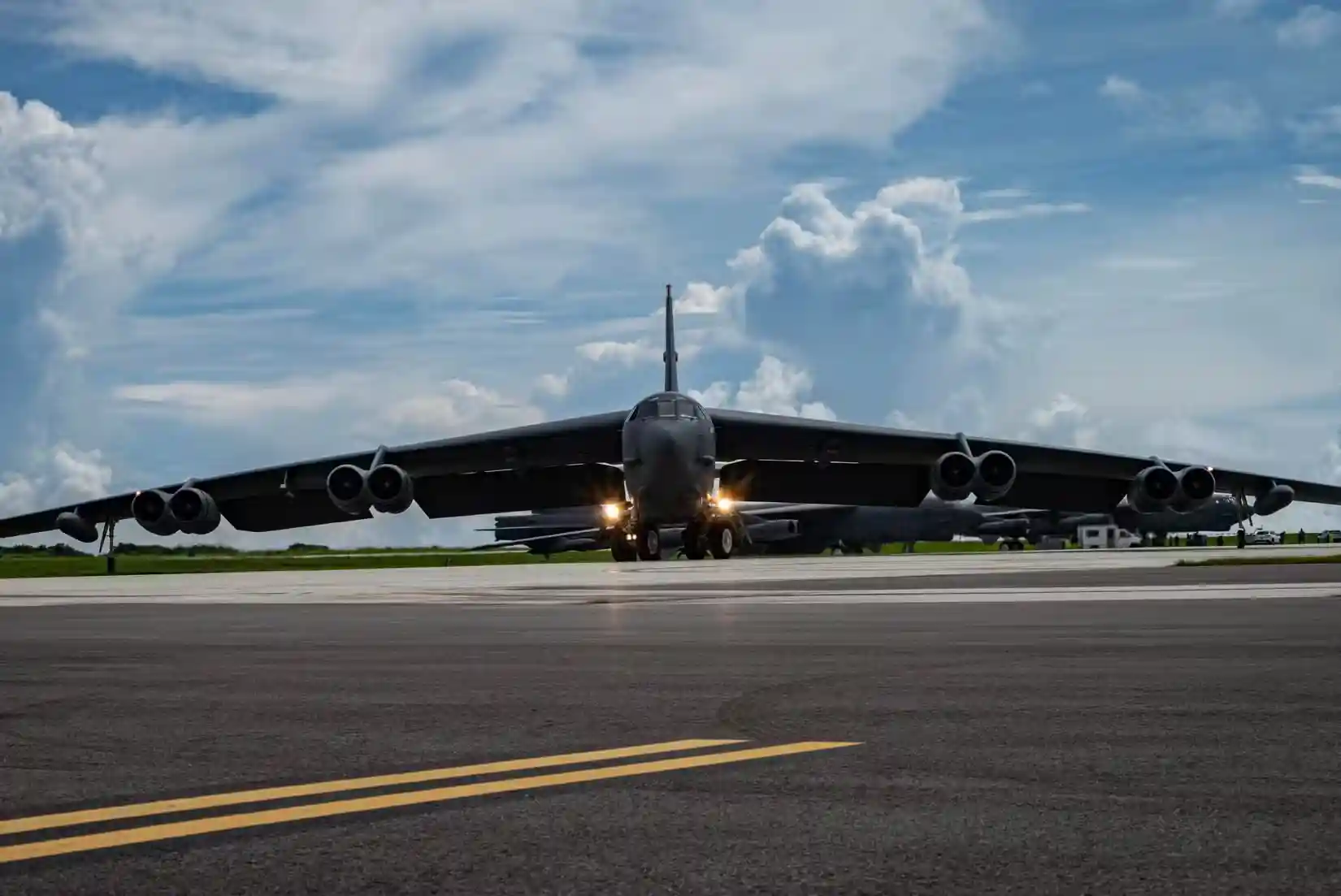
The United States Air Force is preparing to pour roughly 20 acres of concrete at Andersen Air Force Base on Guam, expanding the apron where bombers, fighters, tankers, and patrol aircraft park between missions. The program was originally conceived as a joint venture with the Republic of Singapore Air Force, but Singapore has since withdrawn, and the Air Force is pressing ahead anyway. That decision has drawn scrutiny: Washington is spending heavily on open tarmac in the middle of the Pacific while declining to build hardened aircraft shelters at one of its most exposed and most strategically important airfields. The apparent contradiction dissolves once the construction program is read against the Air Force’s new operating doctrine, the aircraft it expects to base there, and its assumptions about what a missile exchange with China would actually look like.
Andersen sits in the second island chain, north of the first island chain that runs from Japan through Taiwan and the Philippines. As Washington draws down forces in Europe and the Middle East and pivots to the Pacific, Guam has become the anchor of a theater spanning thousands of miles of ocean. Andersen is one of the very few airfields capable of hosting the Northrop Grumman B-2 Spirit, and its runway, fuel infrastructure, and weapons storage already support continuous bomber rotations, maritime patrol sorties, and the air bridge that links the continental United States to expeditionary forces in Asia. Adding twenty acres of apron does not change the character of the base nearly so much as it changes its throughput, and throughput is the variable the Air Force now cares about most.
Andersen AFB and the Agile Combat Employment Gambit
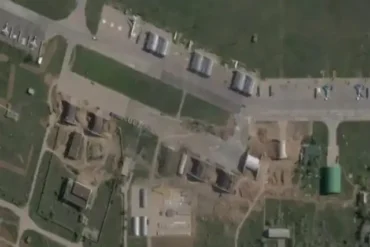
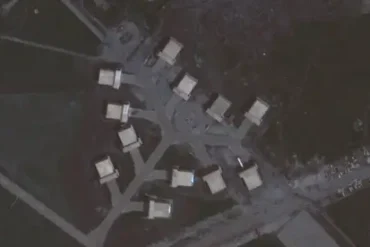
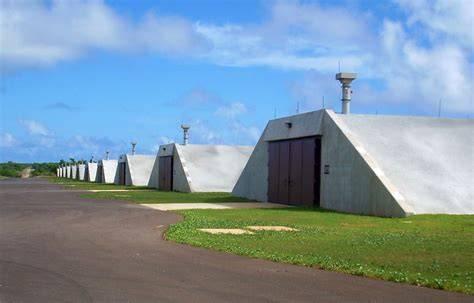
The decision to pour massive open aprons rather than build protective shelters reflects a genuine rethinking inside the Pentagon about how to survive a missile exchange in the Indo-Pacific. In a conflict with China, permanent hangars are liabilities as much as assets. Modern commercial and military satellite imagery guarantees that every hardened shelter, every fuel farm, and every runway intersection on Guam has been mapped to precise coordinates, and those constants are exactly what planners for the People’s Liberation Army Rocket Force would build their targeting packages around. A shelter that cannot move and cannot be duplicated is a fixed target with a known location, and adversaries have spent two decades refining the ballistic and cruise missiles meant to strike precisely such points. Rather than try to absorb a missile strike with concrete walls, the Air Force is betting on speed, dispersion, and mobility through its Agile Combat Employment concept, known across the service as ACE.
ACE reframes the airfield as one node in a distributed network rather than a fortress to be defended in place. Small teams of maintainers, munitions specialists, and command personnel move aircraft through a rotating set of bases, some of them austere, some of them allied, some of them little more than a runway and a fuel bladder. The enemy is forced to guess where high-value aircraft will be at any given hour, and every guess costs missiles that could have been spent elsewhere. Open aprons serve that logic directly: they are cheap, fast to pour, easy to repair after an attack, and indifferent to the wingspan of whatever happens to land on them. A cratered shelter can take months to restore, while a crater in open concrete can be filled and capped in days by a small engineering crew.
Parking Spots Over Bunkers: The Economics of Open Apron Space
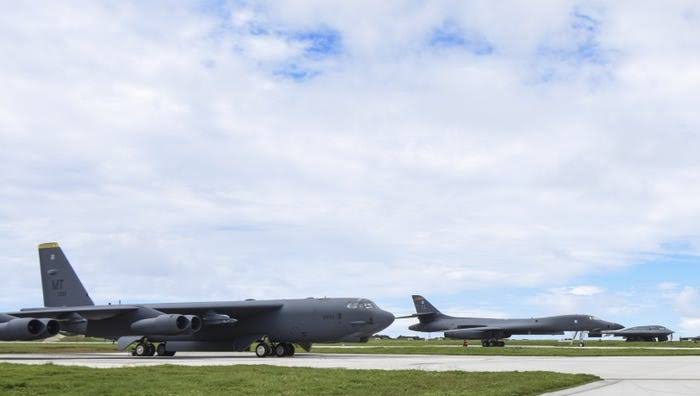
The Air Force’s reasoning rests on a simple observation about what protected shelters actually deliver. Hangars reduce the vulnerability of a single aircraft, but they also fix the geometry of the flight line, constrain which airframes can use which spots, and create bottlenecks when oversized aircraft like the B-52 or the C-5M Super Galaxy arrive and find themselves waiting for space sized for fighters. A large open apron has no such hierarchy. A B-2, an F-35, a KC-46A Pegasus, and a P-8A Poseidon can all be parked, refueled, rearmed, and launched from the same contiguous slab, and the ground crews can shuffle aircraft without first checking whether a shelter door is wide enough or a taxiway clearance is adequate.
There is also a hard accounting argument. The same concrete budget that might produce a limited number of shelters produces dramatically more parking positions, and parking positions are what determine how many aircraft can be surged into a theater at once. When the Air Force talks about greater operational tempo and larger deployments, it is describing the arithmetic of sortie generation, and sortie generation begins with how many aircraft can be on the ground simultaneously without blocking one another. Concrete is the cheapest lever the service has for increasing that number, and pouring it at Andersen buys capacity that cannot be replicated by building a handful of bunkers.
The Aircraft Mix Driving Guam’s Construction Boom
The apron is designed around a fleet far broader than the stealth bombers that make Andersen famous. Fifth-generation fighters, including Air Force Lockheed Martin F-22 Raptors and F-35 variants from the Air Force, Navy, and Marine Corps, operate on the leading edge of any Pacific fight. Because their stealth profiles require weapons to be carried internally, their magazine depth is limited, and their real value lies in penetrating contested airspace, mapping enemy radars and missile batteries, and data-linking those coordinates to the rest of the force. The heavy ordnance is carried by aircraft that never have to enter the threat envelope.
The Boeing F-15EX Eagle II fills that role as a standoff missile truck. It lacks stealth, but it carries a payload capacity of 29,500 pounds, or 13,380 kilograms, and it can fire outsized hypersonic weapons at targets identified by F-35s. Behind it, B-52 and B-21 bombers execute long-range strike sorties from Andersen’s expanded parking slips, while Navy P-8 Poseidon aircraft use the base to sustain continuous maritime patrol loops that protect sea lines of communication and track adversary submarines in the Philippine Sea. Transports and tankers pass through the same flight line in constant rotation, including the C-5M Super Galaxy, the aging but indispensable KC-135 Stratotanker, and its larger successor, the KC-46A Pegasus, which is built on Boeing’s 767 wide-body airframe. Every one of those aircraft has different footprint requirements, and only unrestricted apron space allows them to share a flight line without expensive and time-consuming shuffling.
Why the B-21 Raider Changes the Shelter Equation
The arrival of the Northrop Grumman B-21 Raider, the world’s first sixth-generation aircraft, is the single most important factor behind the concrete program. The Raider is substantially smaller than the B-2 it will eventually replace. Based on public estimates, its wingspan is expected to fall between roughly 132 feet and 150 feet, or 40.2 to 45.72 meters, against the Spirit’s 172 feet, or 52.42 meters. Its maximum takeoff weight is projected at 225,000 to 260,000 pounds, or 117,934 kilograms, compared with more than 330,000 pounds, or 149,685 kilograms, for a fully loaded B-2, and its payload is expected to run 25 to 30 percent lower.
Those reductions matter because they mean the Raider can fit inside hardened shelters built for Cold War fighter jets, opening an enormous range of deployment options that never existed for the Spirit. An aircraft that can use a standard fighter shelter does not need a bespoke super-hangar, and the Air Force has evidently concluded that dedicating new construction at Andersen to large bomber shelters would waste money on a capability the B-21 will not require. Instead, the concrete buys dispersed parking that lets the Raider rotate through Andersen alongside other aircraft without demanding a specialized facility that would have to be defended and rebuilt after every attack.
A Storm, a Crashed B-2, and the Lessons of Spirit of Kansas
The B-2’s fragility in weather is not an abstraction at Andersen. The only B-2 ever written off in a mishap was destroyed there. On February 22nd, 2008, a bomber named Spirit of Kansas was parked overnight on the tarmac at Andersen while a flight of B-2s transited back to the continental United States and was forced to stop because of weather. That night, Guam experienced a torrential downpour, and the aircraft sat exposed in the rain. The next morning it lifted off and immediately crashed back to earth because of an avionics malfunction caused by moisture intrusion.
The episode became a case study in why the Spirit’s finicky radar-absorbent coatings and environmental sensitivities made it a difficult aircraft to operate from forward bases in humid, storm-prone climates. The B-21 is designed with a baked-in radar-absorbent material coating that eliminates that specific vulnerability, and its smaller airframe allows it to deploy to bases that the Spirit could never use. That combination reduces the ability of a near-peer adversary to target the Raider on the ground, because the aircraft could plausibly appear at dozens of airfields rather than the handful of bomber-capable bases in the theater.
The B-52J Stratofortress as a Networked Missile Truck
The newly upgraded B-52J will be the other half of the Hi-Lo fleet that Air Force Global Strike Command intends to field alongside the B-21. The Stratofortress is receiving a long list of new communication systems that will let it serve as a flying command center and a hub for battlefield data. Critically, the BUFF is finally getting Link 16, the jam-resistant tactical data link used across NATO and the US military, which allows the bomber to share a common operating picture with F-35s, Navy destroyers, and Patriot missile batteries. That single upgrade turns a 1960s airframe into a node in the same network as the newest fighters in the inventory.
The airframe itself is being re-engined through the Commercial Engine Replacement Program, a roughly $2 billion transformation from the B-52H to the B-52J. The program replaces the 1960s-era TF33 engines with eight Rolls-Royce F130 turbofans, which are expected to be 30 to 40 percent more fuel-efficient. The added loiter time and range compound with a feature the B-52 has carried since it was first built: the cartridge start, which allows all eight engines to fire simultaneously so the bomber can launch in roughly ten minutes rather than the lengthy preparation other aircraft require. Recent exercises have shown B-52s landing at non-bomber airfields, receiving rapid repairs and resupply, and returning to the air within hours, while an unrefueled range of 8,800 miles, or 14,162 kilometers, allows rapid repositioning across the vast expanse of the Pacific.
Fuel, Stormwater, and the Supporting Punch List
The airfield is getting upgrades well beyond concrete. New fuel storage and refueling infrastructure will expand the base’s capacity and expedite hot pit refueling, the practice of refueling an aircraft with engines running so it can return to the fight without shutting down. That capability pairs naturally with flexible apron parking that is not obstructed by hard shelters dictating wingspan limits and forcing ground crews to waste hours repositioning aircraft. Major upgrades to the stormwater management system are also included, ensuring the facilities can withstand the heaviest monsoon rains without diminished capacity, a detail that matters on an island that has already demonstrated what standing water can do to parked stealth bombers.
To protect the new investment, Guam is receiving an $8 billion enhanced integrated air defense system intended to shield everything on the ground. According to Arms Control, the architecture will create a 360-degree, multi-layer defensive shield built around 16 batteries scattered across the island, designed to intercept threats at different altitudes ranging from high-altitude ballistic missiles down to low-flying cruise missiles and drones. The Air Force is also allocating multimillion-dollar contracts for renovations to secure communications facilities and personnel barracks, because a larger concentration of aircraft means more troops, more equipment, and far more classified information moving through the base.
How the Raider Fits the ACE Doctrine at Andersen
ACE demands dispersed deployment across a wide range of bases and continuous repositioning, both to support friendly forces and to deny the enemy any predictable pattern. The B-21 fits that doctrine far better than the B-2 did, not only because it can use austere and allied airfields but because its performance and durability make dispersed operations less of a gamble. An aircraft that can land at a small forward strip, refuel from a modest fuel bladder, and depart again within hours turns every marginal runway in the theater into a potential launch point, and no adversary can target all of them at once.
Andersen’s expanded aprons make the base a far superior staging and launch point for operations into the first island chain, and an even more valuable rally point for the air bridge connecting the continental United States to expeditionary forces in the Pacific. The additional real estate reduces the friction of surge operations, allows bombers, tankers, and patrol aircraft to coexist without competing for parking, and gives commanders the ability to flow aircraft through Guam rapidly rather than in a single vulnerable wave. That is the trade the Air Force has made: instead of betting that concrete walls can survive a missile strike, it is betting that enough open pavement, enough fuel, enough defensive layers, and enough aircraft moving unpredictably will make the base harder to neutralize than any bunker could.