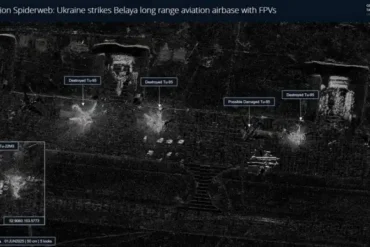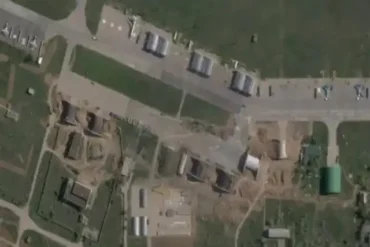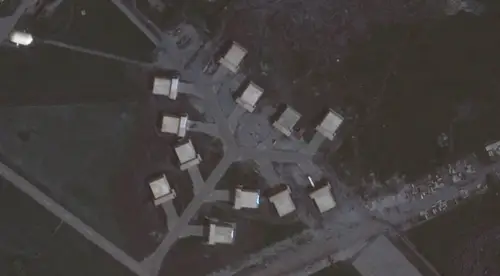
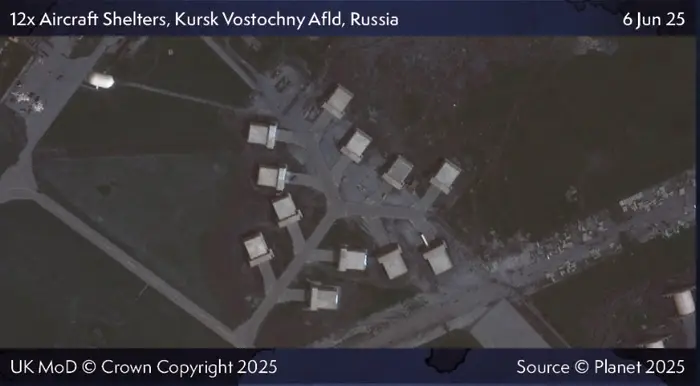
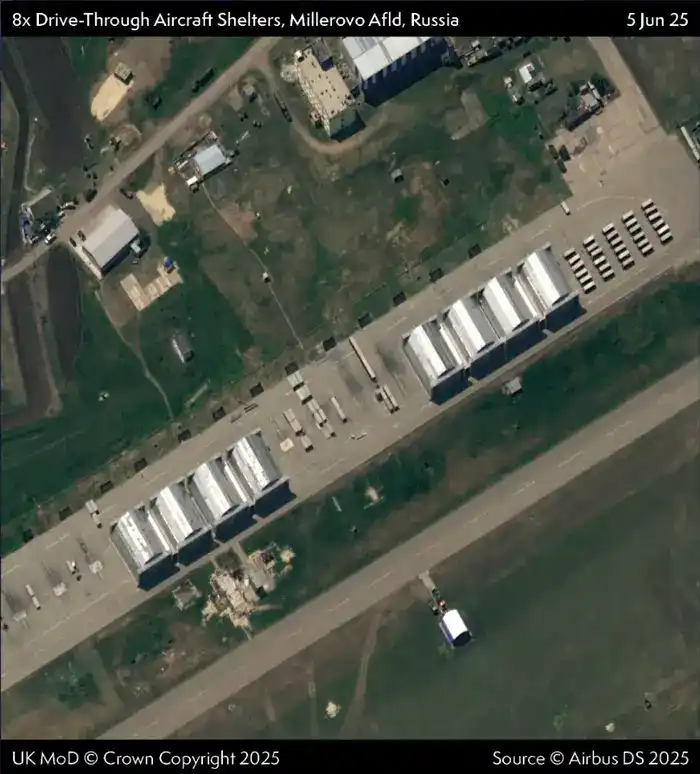
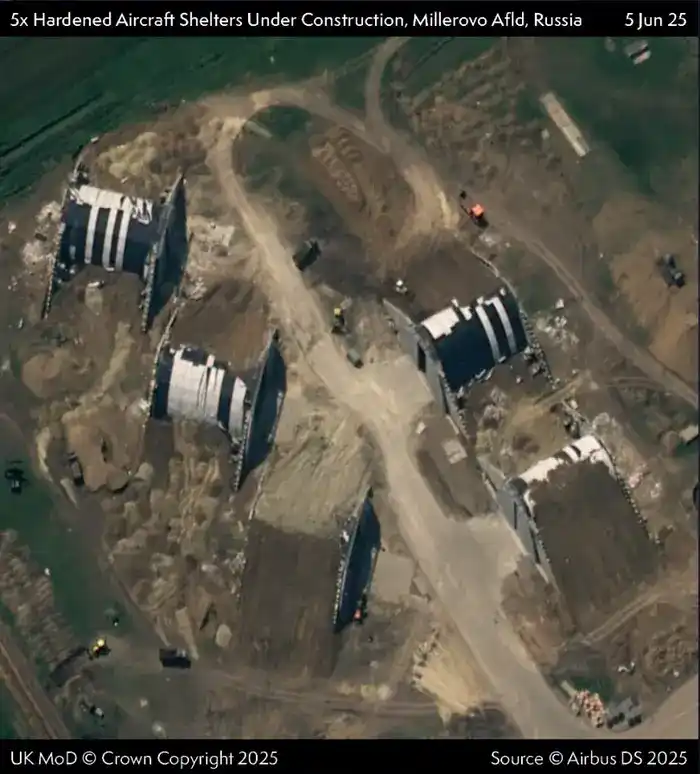
Satellite imagery released by the UK Ministry of Defence has exposed Russia’s frantic efforts to protect its air power from Ukraine’s relentless long-range drone attacks. The June 2025 intelligence assessment, based on high-resolution images provided by Planet Labs, offers clear evidence that Moscow has begun constructing hardened aircraft shelters at key air bases deep within Russian territory. The construction spree at Millerovo, Kursk Vostochny, and Hvardiiske underscores how vulnerable Russian aviation assets have become under the sustained pressure of Ukraine’s evolving drone warfare capabilities.
Drone Warfare Reshaping Russian Airfield Defense Strategy
The new satellite images, captured between June 4 and June 6, reveal a series of fortified dome-shaped shelters erected at the three Russian air bases. These shelters, some featuring thick blast-resistant doors and earthen coverings, appear to be designed to withstand the explosive force of Ukrainian drone strikes. Each site is positioned well behind the front lines, emphasizing that Ukraine’s drone capabilities have reached far into Russian-held territory, defying geographical boundaries.
Kursk Vostochny, for example, located hundreds of kilometers from the Ukrainian border, was among the sites where the UK MoD confirmed new structures. The Ministry’s update concluded that Russia initiated these measures explicitly “in response to numerous successful Ukrainian drone attacks.”
Millerovo and Kursk Under Siege: Ukrainian Drones Redefine Range and Reach
Among the affected air bases, Millerovo, situated mere kilometers from the border with eastern Ukraine, has been hit repeatedly. Ukraine has maintained a strategic focus on Russian staging areas, targeting bases used to launch missile and guided bomb attacks against Ukrainian forces and civilian areas. The strikes have forced Moscow to re-evaluate its entire air defense posture, resulting in the rapid deployment of physical countermeasures like aircraft shelters and visual decoys.
Ukrainian forces have not only struck airfields but have also aimed at vital military-industrial infrastructure, such as arms factories, refineries, and logistical hubs. The Institute for the Study of War (ISW) reported that Ukraine is intensifying these long-range precision attacks to disrupt Russia’s war-making capabilities. The attacks are expected to continue escalating as Ukraine improves its domestic drone production, now considered central to its asymmetric strike doctrine.
Hardened Shelters: Russia’s Tactical Response to Unseen Aerial Threats
The visible shift in Russian infrastructure at airfields reflects Moscow’s growing recognition of the tactical threat drones pose, not only as tools of sabotage but as direct anti-air power weapons. Hardened aircraft shelters—long used by NATO and other modern militaries—are now being hastily constructed across Russia’s military aviation network.
Key features observed in the new structures include:
- Dome-shaped reinforced concrete roofs capable of deflecting shockwaves
- Blast doors sealed against shrapnel and incendiary payloads
- Earth-covered exteriors designed to blend with surroundings and absorb impacts
These are consistent with Cold War-era hangar fortification techniques but adapted to defend against low-flying, precision-guided UAVs rather than cruise missiles or manned bombers.
Visual Deception: Decoys, Tires, and Russian Improvisation
Russia has also supplemented its shelter construction with deceptive tactics designed to confuse or mislead drone guidance systems. These include:
- Painting fake silhouettes of aircraft on runways
- Placing used tires atop bombers to mask heat signatures or disrupt visual targeting
- Erecting inflatable decoys resembling real fighter jets
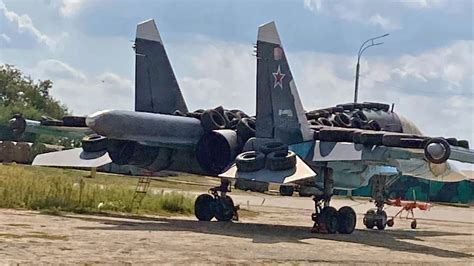
While these unconventional tactics seem crude, they reflect the seriousness with which Russia is addressing the increasing accuracy and lethality of Ukraine’s drone arsenal. Western analysts remain skeptical of their effectiveness, especially against drones equipped with AI-assisted visual identification or infrared tracking systems.
Kyiv’s Drones: The Technological Edge Driving Russia’s Reaction
Ukraine’s use of domestically developed drones has been a game-changer in a war that has otherwise devolved into attritional stalemate. As early access to Western long-range weapons like ATACMS and Storm Shadow missiles was restricted by political constraints, Ukraine turned inward, accelerating the research, development, and production of UAVs capable of carrying warheads hundreds of kilometers into enemy territory.
Over the past year, Ukraine’s homemade long-range drones have struck:
- Oil terminals vital to Russian military logistics
- Ammunition depots near active fronts
- Weapons factories producing guided bombs and missile systems
- Forward air bases critical for staging sorties against Ukraine
Notably, Russian airfields have become one of the most frequently hit targets, as they host squadrons of Su-34 and Su-35 fighter jets as well as long-range bombers like the Tu-22M3. The strategic value of disabling or destroying these assets is immense. A single grounded bomber can eliminate dozens of potential sorties.
Geopolitical Implications: Russia’s Defensive Posture Signals Strategic Strain
The widespread adoption of hardened shelters is not only a tactical adaptation but a signal of Russia’s mounting defensive posture in the face of Ukrainian innovation. These investments in protective infrastructure come at a cost—both in resources and in perception. Every drone strike that penetrates deep into Russian territory further erodes the image of Russian airspace invulnerability, a myth cultivated by the Kremlin over decades.
Moreover, the urgency with which these shelters are being constructed suggests that Russia is reacting, rather than controlling, the tempo of conflict. This inversion of strategic initiative—in which a smaller, embattled nation imposes reactive behavior on a much larger adversary—marks a significant psychological and tactical shift in the war.
The Future Battlefield: Unmanned Warfare and Infrastructure Vulnerability
As the war enters its fourth year, the battlefield has morphed from sweeping armored movements to high-tech, long-distance engagements. The introduction of autonomous and semi-autonomous drones has changed the nature of air base defense forever. In such a climate, infrastructure becomes both a weapon and a weakness.
Ukraine’s success with drones has forced the Russian military to reallocate personnel, materials, and engineering units to backline facilities, slowing offensive operations. Conversely, it has allowed Kyiv to wage war inside Russian territory without crossing traditional combat boundaries or risking crewed aircraft.
This evolution sets a precedent not only for this war but for future global conflicts. Nations observing the Ukraine-Russia conflict are now likely to reassess their own air base vulnerability to unmanned strikes. The need for modular, fortified aircraft shelters may soon become standard, especially in regions where adversaries are developing or deploying low-cost drone swarms.
Conclusion: Shelters Are a Symptom of the Pressure, Not a Cure
While Russia’s construction of hardened shelters marks a necessary step toward defending its aviation assets, the broader implication is clear: Ukraine’s drones have redefined the war’s strategic balance. The tempo, reach, and psychological impact of drone warfare have forced Russia into a largely defensive posture across several domains.
The satellite imagery, widely shared by Western intelligence, sends a signal not only to Ukraine’s allies but also to military observers worldwide. In this theater of war, adaptation and improvisation are paramount—and in that regard, Kyiv’s asymmetric warfare model is proving exceptionally disruptive. Aircraft shelters may blunt the impact of drone strikes in the short term, but they do little to address the deeper issue: Ukraine is no longer merely defending; it is striking first, striking deep, and reshaping the war from the sky.