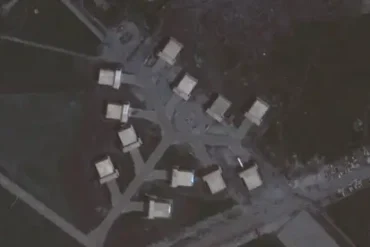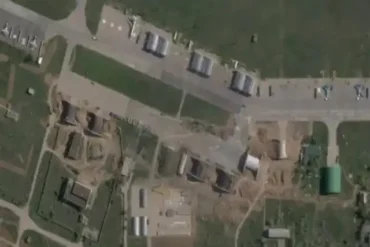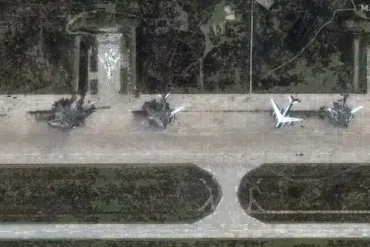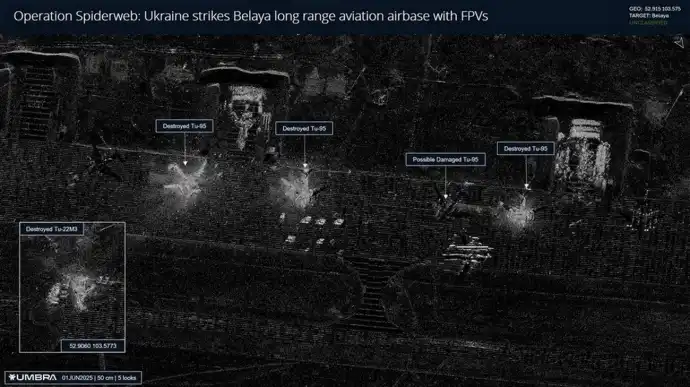
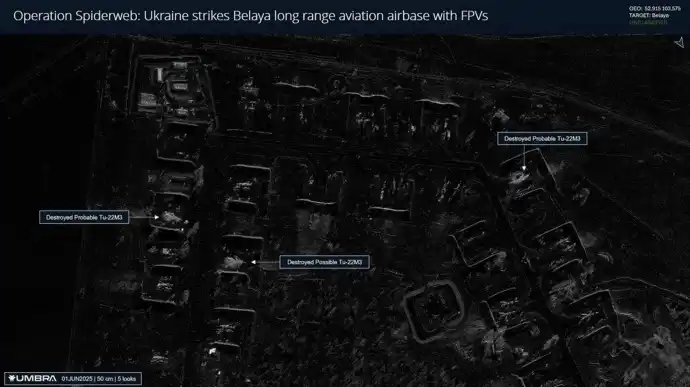
In a significant escalation of long-range warfare tactics, newly released satellite imagery has confirmed the extent of damage inflicted by Ukrainian forces on the Belaya airbase in Russia’s Irkutsk Oblast. The images, made public by GEOINT consultant Chris Biggers, depict the smoldering aftermath of a meticulously executed special operation by the Security Service of Ukraine (SBU), code-named Pavutyna (Spider’s Web), which unfolded on June 1, 2025.
The imagery conclusively shows the destruction of four Tu-22M3 long-range bombers and three Tu-95MS strategic bombers, with a fourth Tu-95MS appearing to have suffered significant damage. This is one of the most consequential attacks on Russian air power deep in its territory since the beginning of the full-scale invasion of Ukraine.
Unprecedented Reach: The Pavutyna Operation’s Deep Strike Capabilities
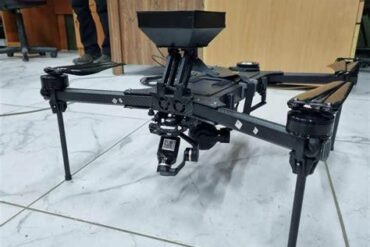
The scale and precision of the Pavutyna operation point to a dramatic evolution in Ukraine’s asymmetric warfare capabilities. According to Ukrainian President Volodymyr Zelenskyy, the strike utilized 117 drones, each individually piloted and coordinated, in a joint mission that targeted four separate Russian airbases: Belaya, Olenya, Dyagilevo, and Ivanovo. What sets this operation apart is not just the scale, but the audacity—penetrating deep into Russian airspace to strike targets often presumed to be insulated from Ukrainian attacks.
Zelenskyy revealed that the coordination of this intricate operation occurred next to an FSB headquarters inside Russian territory, further highlighting Ukraine’s expanding intelligence and operational reach within enemy lines. The strategic targeting of cruise missile carriers, responsible for a significant portion of Russia’s long-range bombing capability, represents both a symbolic and tactical blow.
Heavy Losses: A $7 Billion Blow to Russia’s Air Power
Preliminary assessments estimate the financial cost of the destroyed Russian aircraft at approximately $7 billion. The Tu-22M3 and Tu-95MS bombers are not only financially expensive, but also strategically crucial. They are core platforms in Russia’s strategic deterrence and long-range cruise missile campaigns, which have been widely used to target infrastructure across Ukraine.
The Tu-95MS, known for its extended range and ability to launch Kh-101 and Kh-55 cruise missiles, is one of the few aircraft in Russia’s arsenal capable of performing nuclear delivery missions. Its partial or total destruction represents a direct degradation of Russia’s strategic strike capability. Similarly, the Tu-22M3 has been used extensively for conventional precision strike missions, especially in Ukraine’s south and eastern fronts.
A Tactical Masterclass: Ukraine’s Use of Drones as Strategic Assets
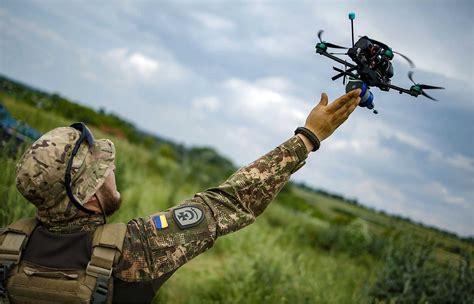
This operation may well mark a turning point in the use of drones in modern warfare. What was once regarded as a tactical reconnaissance and short-range strike tool has evolved into a long-range strategic weapon system. By leveraging drones, Ukraine has managed to nullify several of Russia’s advantages in air defense and early warning systems.
The drones likely flew hundreds of kilometers into Russian airspace, exploiting blind spots or perhaps aided by internal sabotage or jamming. The idea that such an advanced and secure airbase—housing aircraft with nuclear delivery capabilities—could be penetrated and devastated without direct aerial engagement is a stark indicator of changing war paradigms.
Furthermore, the operation’s scale—using 117 drones—required sophisticated coordination, real-time communication, and intelligence sharing. Each drone operator functioned within a broader battle network, suggesting Ukraine’s capacity to synchronize large-scale multi-drone strikes across multiple targets simultaneously.
Intelligence Coup: Operational Planning Near FSB HQ
Perhaps the most extraordinary detail of the Pavutyna operation is the revelation that its command center was allegedly situated near an FSB headquarters within Russia itself. This astonishing development implies not only deep infiltration but also a comprehensive intelligence operation capable of collecting, processing, and acting on sensitive data from within the heart of Russia’s security apparatus.
Such proximity to an FSB location indicates potential espionage or sabotage efforts, or at minimum, a coordinated insider network. The psychological impact of this revelation on Russian military leadership and public morale cannot be overstated.
Strategic Implications: Decimating the Russian Cruise Missile Arsenal
According to the Security Service of Ukraine, the operation destroyed 34% of Russia’s strategic cruise missile carriers across its primary airbases. This is a staggering figure that drastically alters the balance of long-range strike capabilities in the ongoing war.
Russia’s reliance on cruise missiles for its most devastating strikes on Ukrainian civilian infrastructure has been well documented. By decimating the aircraft responsible for these launches, Ukraine is effectively preempting future waves of strategic bombardment, thus buying time and space to further strengthen its air defense infrastructure.
While exact figures of remaining operational aircraft are not confirmed, open-source intelligence suggests that the loss of seven high-value bombers at a single airbase would require months—if not years—to fully replenish, particularly under the strain of international sanctions limiting the availability of aviation-grade materials and electronics.
Psychological Warfare: A Direct Challenge to Russian Air Superiority
Beyond the raw military figures, the Belaya airbase strike serves as a potent psychological blow. Until now, Russia has largely operated on the presumption that its rear-echelon assets were beyond Ukraine’s reach. This operation shatters that assumption and showcases Ukraine’s resolve and creativity in adapting to a war of attrition.
Moreover, the fact that such an attack could be planned and executed near FSB facilities sends a chilling message to Moscow: internal security is no longer guaranteed. It implies that Ukraine, either through human assets or technological surveillance, is capable of mapping and exploiting Russia’s own vulnerabilities.
This contributes to growing internal dissent and a shaken confidence in the Kremlin’s ability to maintain strategic depth and homeland security. Public images of destroyed Russian bombers, released and widely shared online, feed into an information warfare campaign aimed at delegitimizing the Russian military establishment.
Escalation Risks: Red Lines and Response Scenarios
Such a high-profile success for Ukraine inevitably raises the specter of retaliation and escalation. Russia may be compelled to strengthen its rear airbase defenses, redistribute surviving bombers, and reconsider the deployment of strategic assets within reachable zones.
There’s also a real possibility of increased cyber operations and counter-sabotage missions, both inside Ukraine and abroad. However, any heavy-handed or indiscriminate response by Russia could further alienate its shrinking pool of international allies and drive deeper support toward Ukraine from Western partners.
From a NATO perspective, this operation further underscores the necessity of continued aid and intelligence sharing with Ukraine, which has now proven capable of decisively striking deep into Russian military infrastructure.
Conclusion: A Historic Blow to Russian Military Aviation
The first satellite-confirmed images of the destroyed aircraft at Belaya airbase serve as irrefutable evidence of Ukraine’s expanding capabilities and the evolving nature of 21st-century warfare. No longer restricted to its own territory or reliant on borrowed tools, Ukraine has demonstrated the ability to plan, execute, and triumph in high-stakes strategic operations.
As the war grinds on, the Pavutyna operation may be remembered as a critical inflection point—a moment where Ukraine moved from defense to strategic preemption, challenging Russia’s air dominance not just at the front, but at the very heart of its military infrastructure.
It signals a new phase in the conflict—one where distance no longer guarantees safety, and where the rules of engagement continue to be redefined by innovation, intelligence, and sheer will.