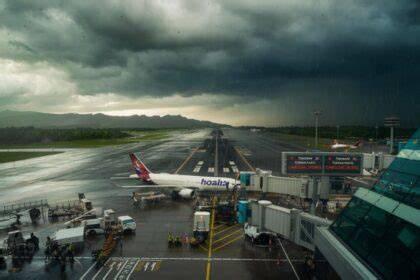
Hurricane Lala caused a major three-day disruption to commercial aviation across Hawaii, forcing more than 140 flight cancellations involving Hawaiian Airlines and its parent company, Alaska Airlines. From Friday, August 14, through Sunday, August 16, the storm produced a combination of cancellations and delays across the islands, with Daniel K. Inouye Honolulu International Airport (HNL) experiencing some of the most significant operational problems.
The disruption began before Lala reached its peak intensity and continued after the hurricane moved northwest away from the Hawaiian Islands. While the storm itself passed south of Hawaii’s Big Island on Saturday, August 15, its effects on aviation were much broader. Strong weather conditions, operational restrictions, and the need to protect passengers and aircraft created a difficult environment for airlines attempting to maintain normal schedules.
For Hawaiian Airlines, the disruption became particularly severe as the weekend progressed. FlightAware tracking data repeatedly placed Honolulu among the world’s airports experiencing the highest levels of flight delays and cancellations. The airport’s central role in Hawaii’s aviation network meant that disruptions there could quickly affect connecting and inter-island services throughout the state.
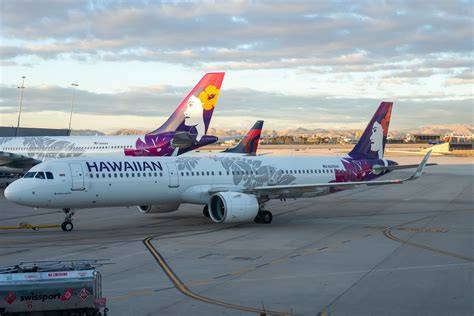
Hawaiian Airlines Cancellations Increased Sharply as Hurricane Lala Approached
Friday initially looked less severe than the following two days. Hawaiian Airlines canceled five flights on August 14, representing approximately 2% of its daily schedule, while another 54 flights, or 23%, were delayed. According to Alaska Airlines, all five cancellations affected inter-island services involving Hilo, highlighting how quickly local weather conditions could affect Hawaii’s short-haul network.
The situation changed dramatically on Saturday as Hurricane Lala reached peak intensity while passing south of the Big Island. Hawaiian Airlines recorded 63 cancellations, equivalent to 27% of its flights, while 32 flights, or 14%, were delayed. The numbers demonstrated that the greatest disruption did not necessarily coincide with the storm’s direct passage over an airport. Instead, the broader operational impact affected aircraft rotations, crews, airport operations, and the ability to reposition aircraft safely.
Sunday became the most disruptive day for Hawaiian Airlines by cancellation volume. The carrier recorded 72 cancellations, representing 32% of its flights, while 121 flights, or 54%, were delayed. In other words, more than half of the airline’s scheduled operations experienced delays that day, even as the hurricane itself was moving away from Hawaii.
143 Flights Canceled Across Hawaiian and Alaska Airlines Operations
By Sunday afternoon, Alaska Airlines reported that its combined operations with Hawaiian Airlines had resulted in 143 canceled flights to and from Hawaii during the storm-related disruption. The overwhelming majority were inter-island services. Of the 143 cancellations, 112 flights, or 78%, were inter-island operations, while the remaining 31 flights, or 22%, involved longer transpacific services.
That distinction is important because Hawaii’s inter-island network depends heavily on frequent aircraft rotations between Honolulu, Maui, the Big Island, and Kauai. When weather disrupts one part of the network, aircraft and crews can quickly become displaced from their planned positions. A cancellation on one island can therefore create consequences several flights later, even when weather conditions at the next destination have improved.
Honolulu experienced especially heavy disruption on Saturday. The airport recorded 49 canceled departures, representing 17% of departing flights, alongside 37 delayed departures. Arrivals were similarly affected, with another 49 flights canceled and 25 delayed. Other major airports, including Hilo International Airport, Kahului Airport, Kona International Airport, and Lihue Airport, also experienced substantial disruption.
Honolulu Airport Faced Severe Delays Even After the Storm Passed
The aviation situation at Honolulu remained difficult on Sunday, despite the worst of Hurricane Lala having moved away. The airport recorded 34 canceled departures and 39 canceled arrivals, but delays became an even bigger problem. Around 51% of departures and 40% of arrivals were delayed, showing that removing the immediate weather threat did not instantly restore normal operations.
This is a familiar challenge after major weather events. Once cancellations accumulate, airlines must rebuild their schedules while simultaneously handling passengers whose original flights were canceled. Aircraft may be out of position, crews can reach their legal operating limits, and airport resources can become congested as travelers attempt to depart on replacement flights.
The result is a cascading recovery process. Even when weather improves, an airline may need many hours to return aircraft, crews, and passengers to their planned positions. For travelers, this can make the day after a major storm almost as frustrating as the storm itself.
Hawaiian Airlines Begins Restoring Normal Operations
By Monday, August 17, the situation had improved considerably. Alaska Airlines said Hawaiian Airlines and Alaska Airlines were gradually restoring operations across Hawaii, with both carriers planning to operate a normal schedule as Hurricane Lala moved farther northwest.
Early operational figures suggested a significant improvement compared with the weekend. Honolulu was seeing only a small number of cancellations and delays in each direction, a sharp contrast with the extensive disruption recorded on Saturday and Sunday.
However, restoring the published schedule does not mean every passenger affected by the storm can immediately reach their destination. Thousands of travelers may have had their journeys disrupted over the previous three days, creating additional demand for available seats as airlines work through the backlog.
Alaska Airlines Offers Travel Flexibility for Affected Passengers
Recognizing the exceptional circumstances, Alaska Airlines issued a travel waiver covering eligible passengers booked on Alaska Airlines and Hawaiian Airlines flights to and from Hawaii between August 14 and August 17. The policy allowed affected travelers to change or cancel their bookings and rebook onto qualifying flights operating through Thursday, provided the change was made before the original departure.
The flexibility is particularly important following a disruption of this scale because passengers may not be able to find immediate replacement seats. Allowing travelers to move their journeys gives the airline greater room to manage the recovery while reducing pressure on already crowded flights.
Hurricane Lala therefore produced a concentrated but significant disruption to Hawaii’s aviation system. More than 140 cancellations and hundreds of delays affected Hawaiian Airlines and Alaska Airlines operations over three days, with Honolulu serving as the center of the disruption. As the storm moved away and schedules began returning to normal, the focus shifted from avoiding the hurricane’s immediate effects to clearing the backlog of aircraft, crews, and passengers left behind by one of Hawaii’s most challenging aviation weekends.