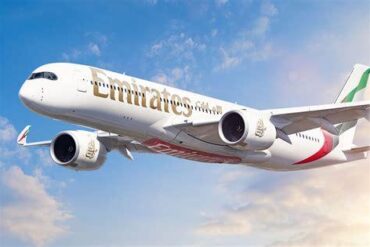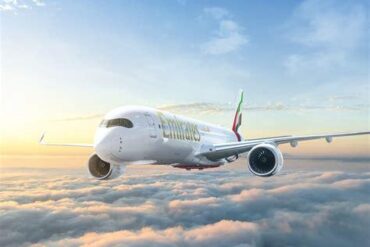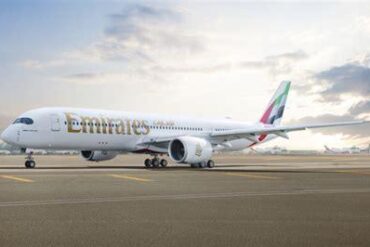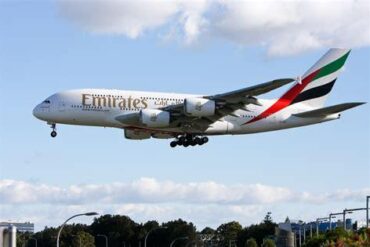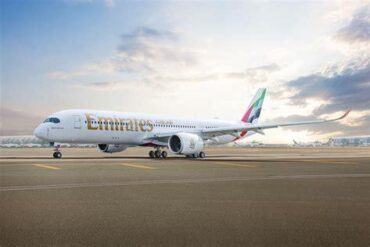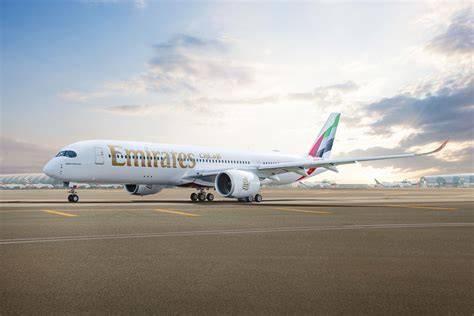
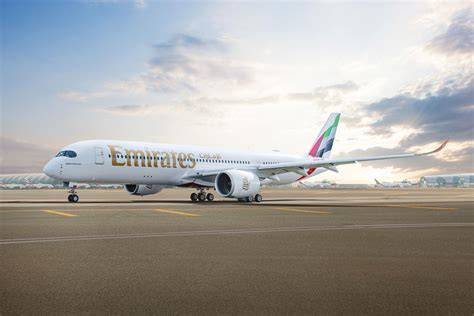
Emirates has officially brought the Airbus A350-900 to the United States, launching a daily service between Dubai International Airport (DXB) and Orlando International Airport (MCO) on November 1. The inaugural westbound departure, EK219, was operated by aircraft registration A6-EXT, delivered to the airline in May 2026. The route becomes Emirates’ second A350 service to North America, following Montreal, which received the twinjet in January 2026, and it marks a significant milestone in the carrier’s long-term fleet transition away from the Boeing 777-200LR and toward its newest widebody.
Emirates’ A350-900 Brings Latest Cabin Product but Drops First Class to Orlando
The switch to the 298-seat A350-900 represents more than a simple equipment substitution. Emirates’ newest twinjet carries the airline’s latest hard product in every cabin class, giving Orlando travellers access to the most advanced seating and inflight experience in the fleet. The trade-off, however, is the removal of first class from the Dubai–Orlando corridor. That absence is less disruptive than it first appears: Cirium Diio data shows no flight-class seats were available on the route in four of the past eleven months, precisely when the smaller 777-200LR was deployed. The on-again, off-again nature of premium demand suggests Orlando has never justified the cabin on a permanent basis.
Daily Frequency Ends Years of Sub-Daily Scheduling to Orlando
The most tangible passenger benefit is frequency. Because the A350-900 offers slightly lower capacity than the departing 328-seat 777-300ER, Emirates has been able to lift the route from five weekly flights to a daily, year-round service. That restores a schedule Emirates last maintained in 2018 and removes Orlando’s long-standing status as the carrier’s least-served destination in North America. The eastbound and westbound timings are generous by long-haul standards:
- EK219 DXB–MCO: departs 3:05 AM, arrives 10:30 AM local time (16 hours 25 minutes)
- EK220 MCO–DXB: departs 8:20 PM, arrives 7:10 PM the following day (13 hours 50 minutes)
Eleven Years of Emirates Service and a Shifting Florida Strategy
Emirates has served Orlando for more than eleven years, with the inaugural flight — operated by an Airbus A380 — arriving in September 2015. MCO was the airline’s first Florida destination, predating Fort Lauderdale-Hollywood International Airport (FLL), which joined the network in December 2016 largely through the carrier’s partnership with JetBlue. That route ended in March 2020, and Emirates instead launched flights to Miami International Airport (MIA) in July 2021, a far more intuitive gateway for premium traffic.
Booking Data Reveals Orlando’s Role as a Connecting Hub Through Dubai
The A350 deployment is underpinned by demand patterns that have little to do with leisure travel to Central Florida alone. Booking data for the twelve months to July 2026 shows approximately 70% of MCO passengers originated or ended their journey in Orlando but connected to another flight in Dubai. India was comfortably the largest country market, and the route’s top ten segments were Orlando to and from Mumbai, Manila, Bali, Hyderabad, Bengaluru, Johannesburg, Delhi, Jakarta, Chennai, and Bangkok. In effect, the Dubai–Orlando link functions as a one-stop bridge between Florida and South and Southeast Asia.

Where the A350 Fits in Emirates’ Fourteen-Airport North American Network
Emirates currently operates passenger flights to fourteen airports across the US and Canada, with sixteen daily departures in November 2026. Orlando is the only route to record a year-over-year frequency increase. The only market with more than a single daily flight remains New York JFK, served three times daily by the A380 plus one additional frequency via Milan Malpensa. The remaining thirteen routes operate daily: Boston, Chicago O’Hare, and Washington Dulles on the 777-300ER; Dallas/Fort Worth, Seattle, and Miami on the 777-200LR; Los Angeles, San Francisco, Houston Intercontinental, and Toronto on the A380; Newark on the 777-300ER via Athens; and Montreal and Orlando on the A350-900.
What the A350 Rollout Means Next for Emirates’ US Routes
The debut of the A350 in the US is the opening move in a broader equipment reshuffle. Emirates has taken delivery of the type at pace, and the aircraft’s lower capacity and improved economics make it a logical replacement on routes where the 777-300ER is over-provisioned and the 777-200LR is under-specified. The 200LR-operated services to Dallas/Fort Worth, Seattle, and Miami are the most obvious candidates, since each currently depends on a model Emirates has been steadily phasing out. For American travellers, the shift promises newer cabins, quieter cabins, and more consistent year-round schedules — and for Orlando, a daily link to Dubai that finally matches the market’s connecting demand.