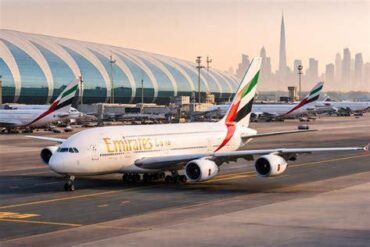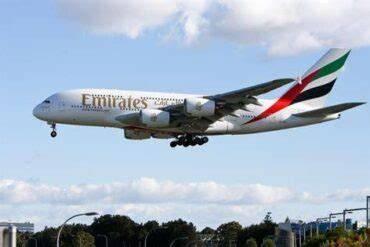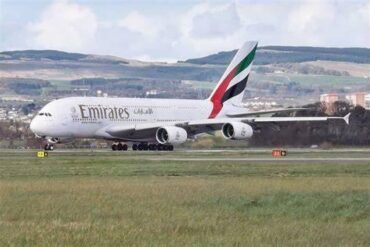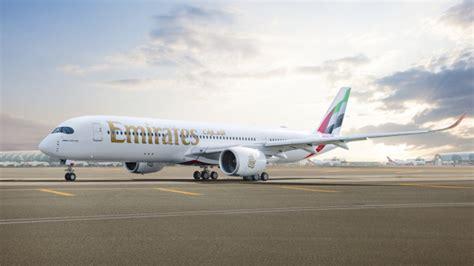
Emirates is preparing to bring its Airbus A380 back to regular service between Dubai and Delhi, giving one of the world’s busiest international city pairs a daily dose of the airline’s flagship double-decker aircraft. Starting October 25, 2026, Emirates will deploy the four-class A380 on one of its four daily Dubai–Delhi rotations, marking the first time the superjumbo has operated scheduled service to the Indian capital since a one-off flight more than 16 years ago.
The move is notable because the A380 is generally associated with long-haul routes connecting major global hubs. The Dubai–Delhi sector, however, is relatively short, with Emirates scheduling approximately 3.5 hours for the journey. The aircraft’s enormous capacity makes it particularly useful on markets where demand is consistently strong, allowing Emirates to add substantial seat capacity without simply increasing the number of daily departures.
For passengers, the change also means that Delhi will become the airline’s third regular Airbus A380 destination in India, following Mumbai and Bengaluru. Emirates is the world’s largest operator of the type, with more than 100 A380s in its fleet, giving the airline unusual flexibility to use the aircraft on both long-haul and high-demand regional routes.
Emirates Airbus A380 Flights to Delhi Begin October 25, 2026
The new A380 service is scheduled to begin on October 25, 2026, with the aircraft operating the EK512/EK513 rotation between Dubai International Airport (DXB) and Indira Gandhi International Airport (DEL). Emirates confirmed the plan earlier in 2026, more than 16 years after the airline previously sent an A380 to Delhi.
That earlier appearance was a special occasion rather than the beginning of a regular service. In July 2010, Emirates operated an A380 from Dubai to Delhi to commemorate 25 years of its operations in India. The aircraft’s return in October will therefore represent a significant expansion of the carrier’s A380 footprint rather than simply another equipment change on an established route.
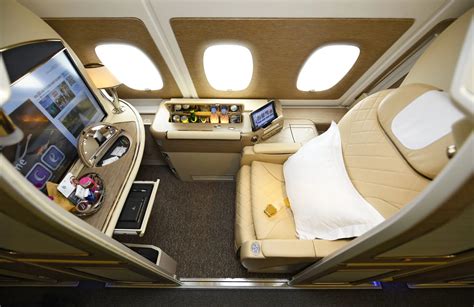
The scheduled aircraft will feature Emirates’ four-class configuration, with 14 First Class seats, 76 Business Class seats, 56 Premium Economy seats and 322 Economy Class seats. That gives the aircraft a total capacity of 468 passengers. Premium Economy is particularly relevant because Emirates has progressively expanded the cabin across its A380 network, providing another option between its Business Class and traditional Economy Class products.
The deployment reflects the unusually strong demand between the United Arab Emirates and India. Adnan Kazim, Emirates’ Chief Commercial Officer, said the carrier was expanding its A380 presence in India because of strong demand for travel to and from the country, with Delhi joining Mumbai and Bengaluru as an Emirates A380 destination.
Emirates Will Still Operate Three Boeing 777 Flights to Delhi
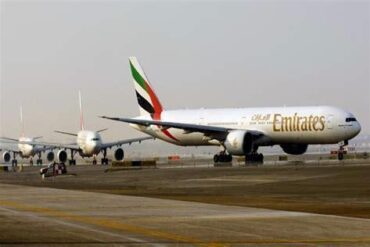
Despite the arrival of the A380, passengers should not expect Emirates’ Delhi operation to become an all-superjumbo schedule. The Boeing 777-300ER will remain the dominant aircraft on the route, operating three of the airline’s four daily round trips.
The three 777 departures from Dubai are scheduled for 4:20 AM, 9:55 AM and 3:10 PM, while the A380 will operate the later 9:30 PM departure. This spread gives Emirates a broad range of departure times while maintaining connections through Dubai for passengers traveling between India and destinations across Europe, Africa, the Middle East and beyond.
The 777-300ER aircraft assigned to the route also offer four classes of service, although their capacity is substantially lower than the A380. Depending on the configuration, Emirates’ 777-300ERs on the route have either 324 or 328 seats.
The difference demonstrates why the A380 can be useful even on a relatively short flight. A single 468-seat A380 rotation can provide considerably more capacity than a 777 without requiring an additional departure slot. For an airport pair already handling multiple daily services, that can be an efficient way to accommodate demand.
Dubai–Delhi Route Has Extremely Strong Passenger Demand
The scale of the Dubai–Delhi market becomes clearer when the wider competitive landscape is considered. According to Cirium data cited in the reference material, 382 flights are scheduled to depart Dubai for Delhi during November 2026 alone. That figure includes Emirates and several Indian and UAE-based competitors serving the route.
Air India operates four daily flights between the two cities, using three Boeing 787-8s and one Airbus A320neo. IndiGo operates two daily services with the Airbus A321neo, while SpiceJet also operates two daily flights using the Boeing 737-800. flydubai adds another five weekly Boeing 737-800 services.
This combination gives travelers a wide range of departure times and aircraft types. Emirates’ A380 therefore enters a market that already has considerable capacity, but the aircraft’s role is less about creating a completely new connection and more about increasing the number of seats available on one of Emirates’ existing departures.
The route itself covers roughly 1,357 miles, making it much shorter than many of the world’s A380 services. Yet Emirates has repeatedly demonstrated that the superjumbo does not have to be restricted to ultra-long-haul flying. When demand is sufficiently high, its enormous passenger capacity can make the aircraft practical on shorter international routes as well.
Emirates Operates a Major India Network From Dubai
Delhi is only one part of Emirates’ extensive Indian network. India remains an important market for the airline because of both local travel demand and the enormous volume of connecting traffic that passes through Dubai International Airport.
In November 2026, Emirates is scheduled to operate 720 India-bound rotations from Dubai, averaging approximately 14 departures per day across the month. The airline’s fleet deployment on those services illustrates how it matches aircraft size to individual markets.
The Boeing 777-300ER is by far the most common aircraft, accounting for 522 departures from Dubai to Indian destinations during the month. The Airbus A350-900 contributes another 99 departures, while the Airbus A380 accounts for 90. Nine additional departures are scheduled with the Boeing 777-200LR.
Delhi will have four daily Emirates rotations, but Mumbai is even more heavily served, with five daily flights. Bengaluru, Chennai and Hyderabad each receive three daily rotations, while Kochi receives two. Thiruvananthapuram has a daily service, and Emirates also maintains frequent operations to Ahmedabad and Kolkata.
Delhi Becomes Emirates’ Third A380 Destination in India
The addition of Delhi gives Emirates another major Indian destination capable of supporting regular A380 operations. Mumbai and Bengaluru already form part of the airline’s A380 network, and the Delhi service further underlines the importance of India within Emirates’ international strategy.
The aircraft’s presence also provides something that cannot be replicated simply by adding another smaller aircraft: a very large concentration of passengers on a single departure. With 468 seats, the A380 can carry substantially more travelers than the 777-300ERs that will operate Emirates’ other Delhi rotations.
For travelers specifically interested in flying the world’s largest passenger aircraft, the new schedule creates another opportunity to experience the A380 on a comparatively short international journey. For Emirates, meanwhile, the October launch represents a practical use of its substantial A380 fleet on a route where demand can support the aircraft’s extraordinary capacity.
The October 25, 2026 launch therefore marks more than the return of an iconic aircraft to Delhi. It establishes a regular A380 presence on one of Emirates’ most important Indian routes while leaving the airline’s broader four-flight-per-day schedule intact. With three Boeing 777 services and one nightly A380 rotation, Emirates will have a combination of frequency and capacity designed to serve the continuing demand between Dubai and India’s capital.