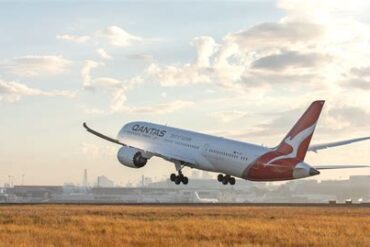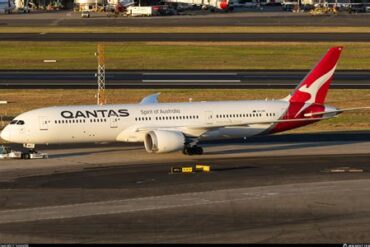
Qantas operates the most demanding Boeing 787-9 Dreamliner network in the world today, and five of its routes push well past the 8,000-mile threshold that separates ordinary long-haul flying from the rarefied world of ultra-long-haul. Measured by great circle distance, those five services climb from Perth to Rome at roughly 8,300 miles (13,357 km) all the way to Perth to London at 9,010 miles (14,500 km). The jet’s published range of 8,706 miles (14,010 km) suggests that four of the five should not exist at all, yet Qantas makes them work through a disciplined combination of low seat counts, wind-aware scheduling, and a premium-heavy cabin mix. The Dreamliner has effectively redefined the classic Kangaroo Route, and this countdown examines exactly how each of these five sectors succeeds.
How the 787-9 Reaches Beyond Its Published Range
The arithmetic behind these routes is unforgiving. The 787-9 was certified with a range of 8,706 miles (14,010 km), and by simple conversion four of the five Qantas sectors exceed that figure on paper. The airline closes the gap in two ways. First, it flies only 236 seats on each aircraft, roughly 50 fewer than a typical two-class layout, a decision documented by Airways that trims weight in both passengers and hold cargo. Second, it builds schedules around the wind, accepting that eastbound and westbound flights of the same route can differ by ninety minutes or more because of high-altitude jet streams. Together, these choices turn a jet that should be marginal into an aircraft that comfortably carries a profitable load on some of the planet’s most punishing city pairs.
5. Perth to Rome Fiumicino
Qantas flight QF5 departed Perth on the night of June 22, 2022, marking the airline’s return to Rome after an absence stretching back to 2003, when multi-stop Boeing 747 services routed through Singapore and Bangkok. The sector covers about 8,300 miles (13,357 km), with the westbound leg lasting 16 hours and 25 minutes. That distance sits roughly 700 miles (1,126 km) shorter than Perth to London, and the margin matters: this is the only route on the list where the 787-9 can carry a genuinely full load of passengers and cargo. QF5 has also remained fully nonstop in both directions, even as other long-haul itineraries were forced into layovers after Russia closed its airspace in 2022.
The operation runs for roughly six months from spring to fall, and demand has been exceptional, with well over 70,000 passengers carried since launch. Qantas leans on Perth connections so travelers from Australia’s east coast can step off a domestic flight and walk directly onto a Rome-bound Dreamliner. More than 50% of the route’s passengers originate in Sydney, Melbourne, and Brisbane, which is why a seasonal Western Australian service became a resilient commercial asset rather than a post-pandemic experiment.
4. Auckland to New York-JFK
The Auckland to New York corridor is one of the most fiercely contested battlegrounds in modern ultra-long-haul aviation. Covering 8,828 miles (14,207 km), it replaces the old model of connecting Australia and New Zealand to the US East Coast through Los Angeles or San Francisco with a direct trans-Pacific air bridge. Today it operates as a high-stakes duopoly between Qantas (QF3/QF4) and its cross-Tasman rival Air New Zealand (NZ2/NZ1), which pioneered the nonstop link in 2022. Qantas launched its own service on June 14, 2023, after a gap of more than three years, using Auckland as the staging point in place of LAX and striking directly at Air New Zealand’s core market.
Flight times regularly stretch between 16 and 17.5 hours, dictated almost entirely by jet streams shifting across the Pacific. Only about 33% of the total passenger load originates in Sydney; the remaining two-thirds funnels in from Brisbane and Melbourne alongside local New Zealand travelers. Weekday traffic skews toward top-tier business travelers moving between the financial districts of Sydney, Melbourne, and Manhattan, while weekends shift toward premium leisure. To lift the fuel needed for the trans-Pacific sortie, the Dreamliner must trade payload, which pushes Qantas toward a cabin that maximizes appeal to higher-paying customers and trims economy capacity. The result is a highly lucrative year-round route with an average load factor of 84%, operating five times weekly from Monday to Friday with weekend service during surges.
3. Perth to Paris Charles de Gaulle
Qantas began nonstop flying from Perth to Paris in July 2024, establishing the first nonstop twinjet service between Australia and France. The inaugural QF33 was scheduled for 17 hours and 20 minutes across 8,863 miles (14,263 km), a little shorter than London but still well past the 787-9’s full payload range. The route immediately injected 75,000 annual seats into the Europe-Australia market, and it revived a connection Qantas had abandoned in 2004 when it retired its aging Boeing 747-400 multi-stop service via Singapore.
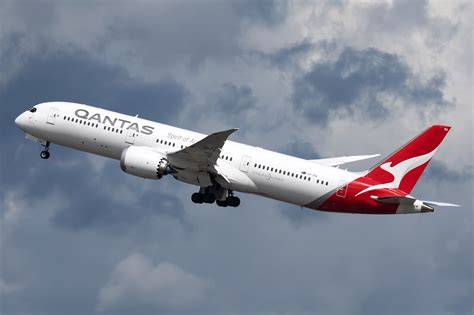
Like its sister route to London, the Perth-Paris sector became a case study in adapting to complex geopolitics. When volatile Middle East airspace closures made a strict nonstop westbound leg impractical, Qantas rerouted the flight through a technical and commercial stop at Singapore Changi Airport. Rather than absorbing the detour as a pure operational penalty, the airline converted it into a commercial win. By permanently routing through Singapore, Qantas expanded Paris frequencies from three weekly flights to five. The service officially originates at Sydney, the airline boosted Perth-Singapore feeder capacity, and the result is a route that commands premium fares from travelers eager to avoid a middle-of-the-night stopover in the Gulf.
2. Melbourne to Dallas/Fort Worth
When Qantas launched Melbourne to Dallas/Fort Worth flights in December 2022, the airport’s chief executive called it the longest route ever flown from the city, and Airways noted it ranked as the fourth longest in the world at the time. The sector covers 8,992 miles (14,471 km), or 7,862 nautical miles, nearly as far as Perth to London. Qantas framed the mission as a companion to its existing Sydney-Dallas service, and it flies the same 236-seat 787-9 split into 42 business, 28 premium economy, and 166 economy seats.
The schedule reveals how much wind shapes the operation. QF21 from Melbourne is blocked at 16 hours and 10 minutes, while QF22 from Dallas runs 17 hours and 40 minutes because it battles sustained headwinds across the Pacific, producing a one-and-a-half-hour asymmetry between the two directions. As a strategic bridge, the route links Australia to the heart of American Airlines’ network in North America: Melbourne is a Qantas stronghold, DFW is American’s top mega-hub, and the pairing lets the two carriers function as a single harmonized network. It operates on a stable, year-round schedule of four weekly flights with an average load factor of approximately 81.9%.
1. Perth to London Heathrow
The Perth to London Heathrow route is the crown jewel of Qantas’ international network. Covering 9,010 miles (14,500 km), it famously became the first nonstop passenger service between Australia and the United Kingdom when it launched on March 24, 2018. For nearly seven decades, traveling between Australia and Britain required multiple stops, and the Dreamliner upended that entire concept by linking Western Australia directly with London. Travelers now routinely pay a 20% to 30% price premium for nonstop convenience compared with one-stop itineraries from competitors, a premium that validates the economics of ultra-long-haul flying.
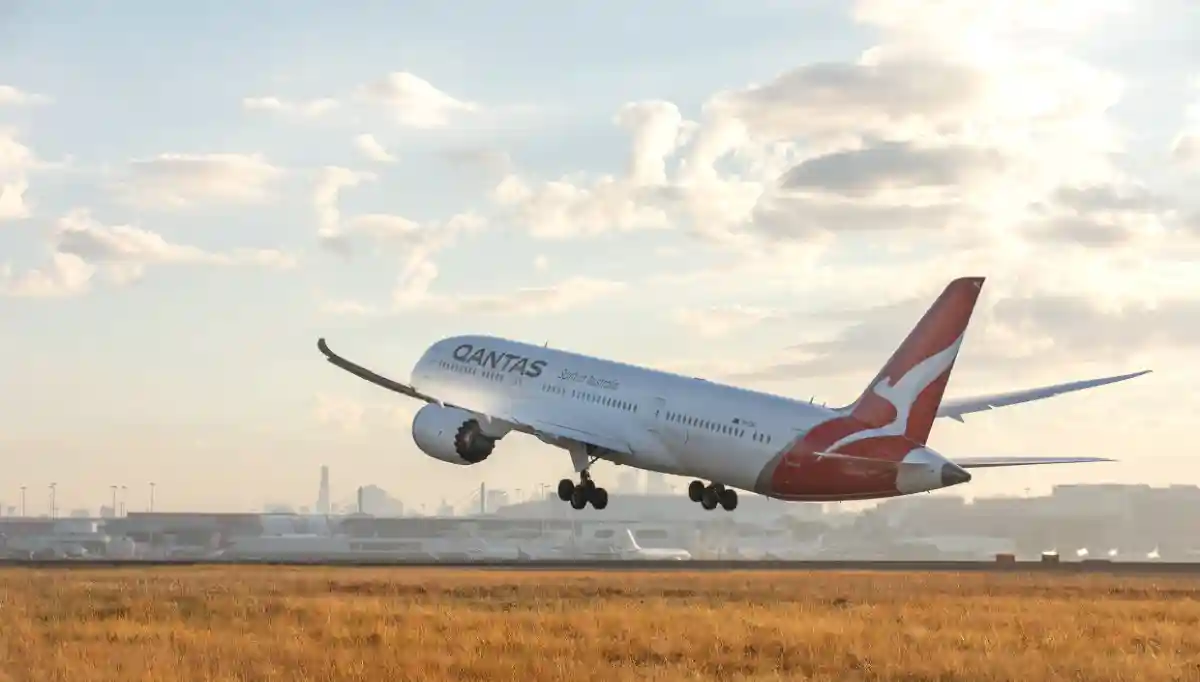
The scheduled block time is 17 hours and 30 minutes outbound and 16 hours and 50 minutes on the return, and the wind advantage in the eastbound direction is unmistakable. Following volatile Middle East airspace closures, flying entirely nonstop outbound became too fuel-intensive, so Qantas introduced a brief stopover in Singapore on the westbound leg, mirroring the strategy deployed on its Paris route. Even with that adjustment, demand for QF9/QF10 remains robust, with cabins regularly clearing 94% to 95% load factors on a permanent, daily, year-round schedule carrying roughly 155,000 passengers annually. No other route better illustrates how the 787-9, flown at 236 seats and scheduled around the wind, turned the longest Kangaroo Route into a routine daily service and rewrote what airlines can do with a mid-size twinjet.