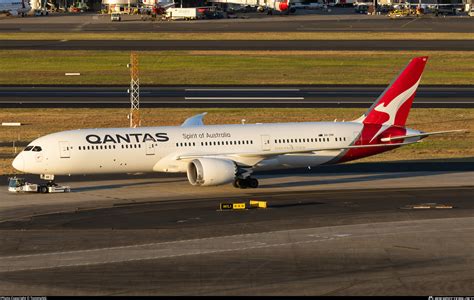
Qantas is preparing to operate one of the world’s most demanding long-haul networks during the upcoming Northern Hemisphere winter, with its schedule featuring 13 exceptionally long nonstop flights. Several of these services approach or exceed 17 hours in scheduled maximum block time, placing them firmly among the longest commercial passenger flights in the world.
The Australian flag carrier is scheduled to offer 8,818 long-haul departures during the five-month winter period from October 25, 2026, through March 27, 2027. That represents a modest year-over-year increase, while January 2027 is expected to become Qantas’ third-busiest month ever for long-haul activity. The network is also gaining a completely new destination, with nonstop flights between Sydney and Las Vegas beginning in December.
The ranking below uses maximum block time, rather than pure airborne time. Block time includes the scheduled period from leaving the gate to reaching the gate at the destination, incorporating taxiing and an allowance for operational delays. The distinction matters on flights this long, because a route advertised at 17 hours can spend considerably less time actually airborne.
Qantas’ Longest Nonstop Flight: Perth to London
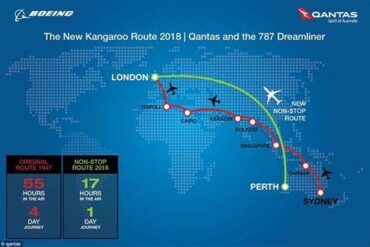
At the top of the list is the Perth–London Heathrow route, with a maximum scheduled block time of 17 hours and 50 minutes. Qantas plans to resume nonstop operation on February 1, although the schedule could change. The service is expected to operate daily with a Boeing 787-9 and will be structured to originate or terminate in Melbourne.
The route has particular significance because Qantas has spent years developing its ultra-long-haul capabilities around Australia’s geographic isolation. A nonstop connection between Perth and London eliminates the need for a traditional intermediate stop, giving passengers a direct link between Western Australia and the United Kingdom despite the enormous distance involved.
New York to Auckland and Dallas to Melbourne
The second-longest service in the examined schedule is New York JFK to Auckland, reaching 17 hours and 40 minutes. Qantas plans four weekly Boeing 787-9 flights, with the aircraft continuing onward to Sydney. Although the route involves three major cities in the broader journey, the JFK–Auckland sector itself is one of the most demanding nonstop segments in the Qantas network.
Close behind is Dallas/Fort Worth to Melbourne, scheduled at up to 17 hours and 35 minutes. Four weekly Boeing 787-9 flights are planned. Qantas has operated the Melbourne–Dallas connection for almost four years, linking two important oneworld hubs and relying heavily on its joint venture relationship with American Airlines.
More than six in ten passengers on the Melbourne–Dallas route also fly American, highlighting how an ultra-long-haul service can depend on a much broader connecting network rather than solely on local traffic.
Perth–Paris and Dallas–Sydney Add More 17-Hour Flights
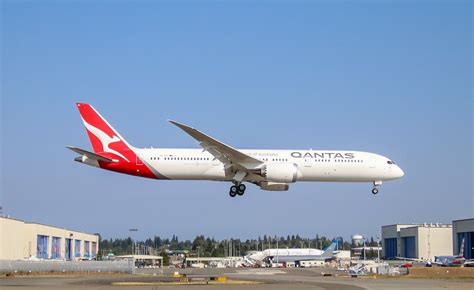
Qantas’ Perth–Paris Charles de Gaulle service is scheduled at 17 hours and 30 minutes, putting it fourth in the ranking. Like the Perth–London service, nonstop flights are expected to return on February 1, subject to changes in the operating schedule. The route will begin and end in Sydney and operate three times weekly with a 787-9.
Meanwhile, Dallas/Fort Worth–Sydney has a maximum block time of 17 hours and 10 minutes. Unlike several other routes in the ranking, it is scheduled to operate daily using the much larger Airbus A380. That gives Qantas substantial capacity on a route connecting Australia directly with one of North America’s major aviation hubs.
Los Angeles, Vancouver and Las Vegas Push Beyond 15 Hours
The next group remains firmly within ultra-long-haul territory. Los Angeles–Melbourne is scheduled at 15 hours and 40 minutes, with daily 787-9 service. The A380 is due to leave the route on October 22, allowing Qantas to use the smaller and more flexible Dreamliner.
Vancouver–Sydney follows at 15 hours and 25 minutes, with up to five weekly 787-9 flights. The route gives Qantas another direct link between Australia and North America while demonstrating how the 787-9 has become central to its longest missions.
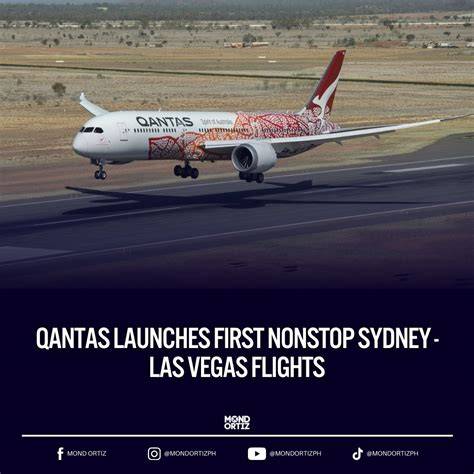
Then comes the brand-new Sydney–Las Vegas service, scheduled at 15 hours and 15 minutes. The route covers approximately 6,708 nautical miles, or 12,423 kilometers, each way. Qantas plans to launch the service on December 29, operating three times weekly with a 236-seat Boeing 787-9.
The new Las Vegas route is particularly notable because OAG Traffic Analyzer data showed that about 52,000 round-trip local passengers traveled indirectly between Sydney and Las Vegas during the 12 months through July 2026. Many connected through Los Angeles. Qantas therefore expects the nonstop service to capture passengers who previously had to make an intermediate connection.
The Remaining Longest Qantas Routes
Qantas’ Los Angeles–Sydney service reaches 15 hours, with six weekly A380 flights. The San Francisco–Sydney route follows at 14 hours and 40 minutes and is scheduled three times weekly using the 787-9.
Also reaching 14 hours and 40 minutes is Singapore–London Heathrow, although its configuration is unusually complex. Until January 31, Qantas plans two daily flights using a combination of A380 and 787-9 aircraft, with some services beginning or ending in Perth. From February 1, the schedule is expected to return to daily A380 service between Sydney and London, subject to change.
The final two routes are Sydney–Johannesburg, at up to 14 hours and 30 minutes, and Singapore–Paris, at 14 hours and 20 minutes. The latter is scheduled three times weekly until January 31, after which Perth–Paris is expected to return as a nonstop operation.
Why Qantas Continues to Push Ultra-Long-Haul Flying
Taken together, these routes show how Qantas is using different aircraft for different types of long-distance demand. The 787-9 provides the range and flexibility needed for thinner markets, while the A380 remains valuable where passenger volumes justify substantially greater capacity.
The network also illustrates how Australia’s distance from Europe and North America naturally creates exceptionally long flights. Rather than treating geography as an unavoidable limitation, Qantas has increasingly turned long nonstop travel into a defining feature of its international network.
With flights approaching 18 hours, a new Sydney–Las Vegas route and several major services returning to nonstop operation, Qantas’ 2026–27 winter schedule demonstrates just how far commercial aviation can stretch while still connecting major cities with a single flight.