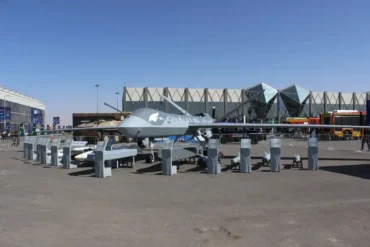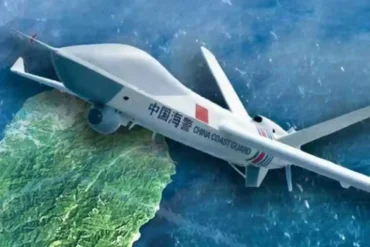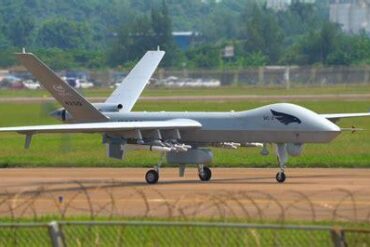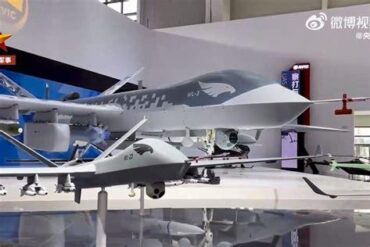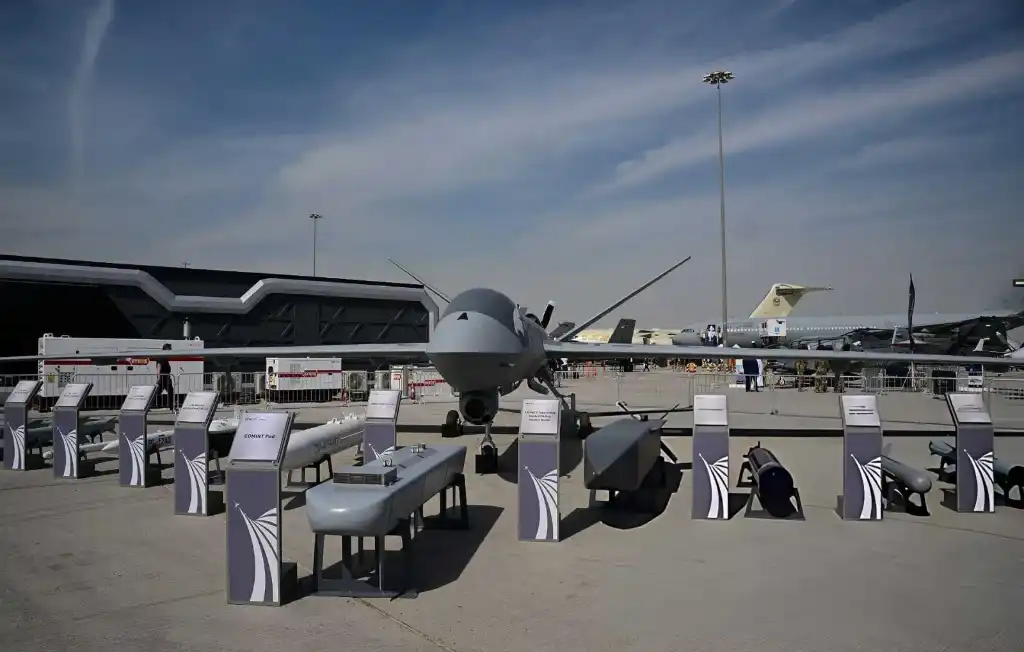
China’s bold push into maritime dominance took a dramatic leap at the Dubai Airshow 2025, as the Aviation Industry Corporation of China (AVIC) unveiled the Wing Loong X, the world’s first unmanned aerial vehicle capable of autonomously detecting, tracking, and engaging submarines. This high-profile reveal signals a significant escalation in China’s naval ambitions, combining aerial endurance, autonomous warfare, and sub-surface engagement in a single unmanned platform.
A New Era in Naval Drone Warfare
The Wing Loong X represents more than an incremental upgrade in UAV technology—it embodies China’s strategic reorientation toward integrated maritime warfare. Boasting a wingspan exceeding 20 meters, the Wing Loong X is now the largest and heaviest armed reconnaissance drone in China’s arsenal. It is engineered for high-altitude, long-endurance (HALE) missions, with a maximum altitude of 10,000 meters and an endurance of up to 40 hours. This performance places it among the most capable drones globally, particularly in terms of blue-water surveillance and persistent maritime operations.
This endurance translates to extended loitering over critical chokepoints such as the South China Sea, Taiwan Strait, and Western Pacific, where China has been increasingly assertive. With such persistent presence, the Wing Loong X dramatically enhances Beijing’s ability to conduct round-the-clock patrols, reducing reliance on manned aircraft and increasing survivability in contested environments.
Submarine Hunting from the Sky
The most revolutionary feature of the Wing Loong X lies in its anti-submarine warfare (ASW) capabilities. Traditionally the domain of manned aircraft and surface ships, ASW is a complex task involving vast ocean coverage and acoustic signal interpretation. The Wing Loong X breaks new ground by incorporating:
- Sonobuoy dispensers for wide-area underwater acoustic monitoring
- Lightweight torpedoes for direct submarine engagement
- Maritime surveillance radar and optical sensors for surface and sub-surface tracking
- Acoustic analysis systems embedded with AI for real-time target classification
These capabilities suggest a drone that does more than scout—it can hunt and kill submarines autonomously. AVIC engineers confirmed the UAV’s ability to interpret sonar and radar inputs with limited human input, a feat underscoring advances in onboard artificial intelligence and data fusion algorithms.
A Multi-Mission Arsenal
The Wing Loong X is not confined to a single domain. Its modular payload bays and multi-mission capabilities enable it to switch between roles in:
- Anti-submarine warfare
- Maritime surface surveillance and strike
- Aerial reconnaissance and interdiction
This adaptability is supported by an extensive armament suite that includes air-to-air missiles, precision-guided bombs, and smart torpedoes. The Wing Loong X can function as a solo hunter or as part of a networked drone swarm, collaborating with other UAVs, surface ships, and underwater assets in coordinated maritime operations.
The drone also features secure datalink systems for integration with existing naval command and control infrastructure. This ensures compatibility with joint-force operations and extends its reach across theaters.
Strategic Significance and Geopolitical Implications
The deployment of such a UAV reflects China’s intent to disrupt Western dominance in undersea warfare. Western nations—particularly the U.S.—have long held an edge in anti-submarine capabilities through a combination of manned aircraft like the P-8 Poseidon, surface vessels, and undersea sensor networks. However, these assets are costly and vulnerable. By contrast, the Wing Loong X offers cost-effective endurance and expendability, ideal for sustained presence in highly contested zones.
Moreover, autonomous systems like Wing Loong X reduce the operational risk of sending manned aircraft near adversary shores. With real-time targeting decisions driven by AI and minimal human supervision, China is pursuing a doctrine of accelerated engagement cycles—reacting and striking faster than traditional manned systems can.
Western Scrutiny and Operational Doubts
While the Wing Loong X’s capabilities appear groundbreaking, the defense community remains cautiously skeptical. Western analysts point out China’s history of prematurely showcasing advanced systems that take years to reach full operational capacity. Key concerns include:
- Reliability in complex acoustic environments, such as thermal layers or shallow coastal zones
- Data latency and fidelity in sensor fusion under electromagnetic warfare conditions
- Integration challenges with existing naval command systems
- Rules of engagement and ethical boundaries with semi-autonomous targeting
Despite these valid concerns, the trend is undeniable: China is investing aggressively in unmanned systems that blur the lines between ISR (intelligence, surveillance, reconnaissance) and kinetic warfare.
Engineering Innovation or Strategic Messaging?
By choosing the Dubai Airshow—a global stage with heavy defense representation from the Middle East, Asia, and Europe—China is signaling both technological confidence and export ambition. The UAE, Saudi Arabia, and other regional players are already major buyers of Chinese UAVs. A system like the Wing Loong X, if cleared for export, could further cement China’s influence across strategic naval theaters, particularly in regions seeking alternatives to U.S.-supplied platforms.
The drone’s public debut comes at a time when regional tensions are rising and undersea security is becoming central to naval doctrines. Whether for monitoring maritime trade routes, tracking adversary submarines, or securing energy corridors, a persistent airborne ASW capability can reshape defense planning for any navy.
The Coming Race Beneath the Waves
The introduction of the Wing Loong X could act as a catalyst for a new technological arms race—not just in the skies, but under the sea. Already, the U.S., UK, and Australia are fast-tracking robotic sub-hunters, AI-enhanced sonar arrays, and autonomous undersea vehicles (AUVs). However, these programs remain largely in experimental or pilot phases, with few entering full deployment.
China’s operationalization of an airborne ASW drone could leapfrog that development cycle. If the Wing Loong X proves capable in real-world operations—especially in the turbulent maritime zones near Taiwan or the Spratlys—the strategic implications could be profound. It would mean the world’s second-largest military has established a persistent, unmanned, multi-domain maritime threat capable of monitoring and striking across three dimensions.
Conclusion: Redefining Naval Power Projection
The Wing Loong X stands as a symbol of China’s evolving doctrine—autonomy, persistence, and multidimensionality. It is more than just a drone; it is a strategic gambit to control the unseen theaters of modern warfare, where submarines lurk and surveillance satellites fall short.
As nations grapple with the implications of unmanned maritime operations, the Dubai Airshow 2025 may well be remembered as the event where submarine warfare ascended into the sky. The Wing Loong X could be the future blueprint of naval air power: silent, relentless, and always watching.