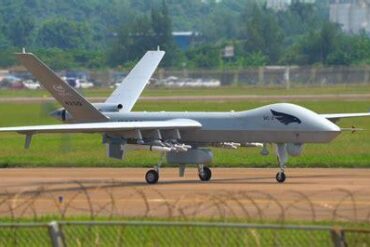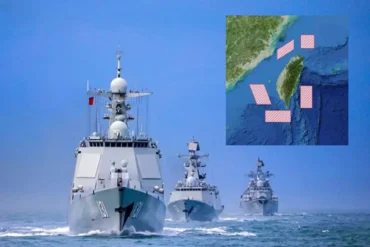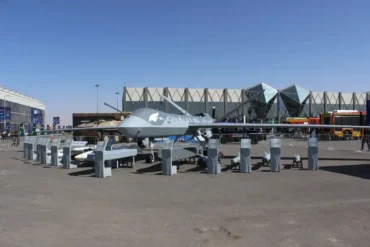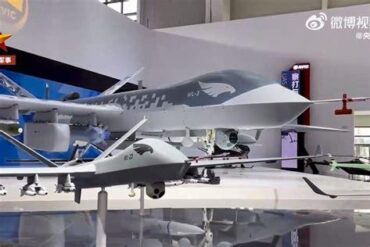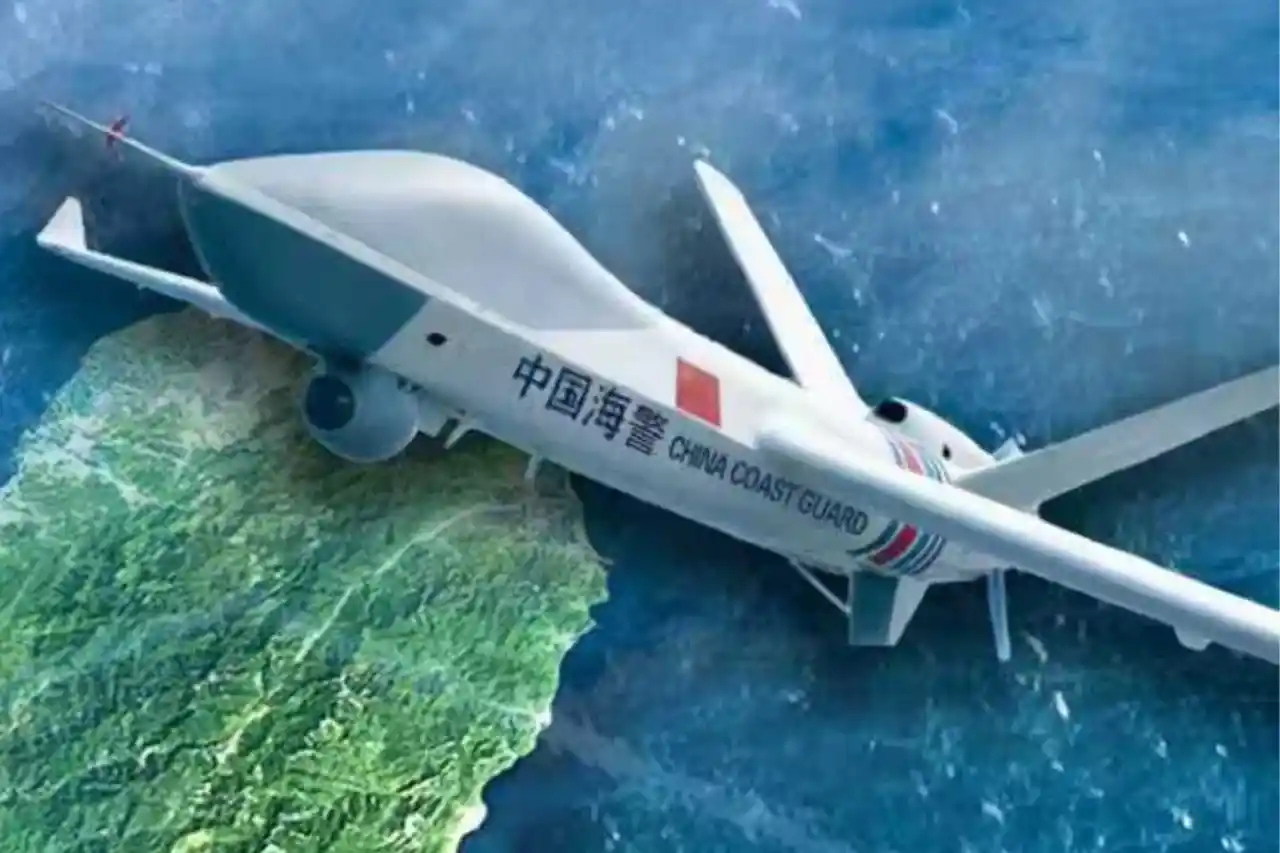
On December 30, 2025, the China Coast Guard (CCG) released imagery hinting at the deployment of the Wing Loong II unmanned aerial vehicle (UAV) during its Justice Mission-2025 drill, marking a pivotal moment in China’s maritime strategy. This appearance, if confirmed operational, would be the first publicly acknowledged deployment of the Wing Loong II in a law enforcement capacity—an act that may signal a profound shift in the militarization of China’s paramilitary maritime forces.
Wing Loong II’s Integration into the China Coast Guard: A Tactical Evolution
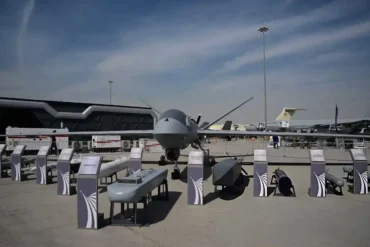
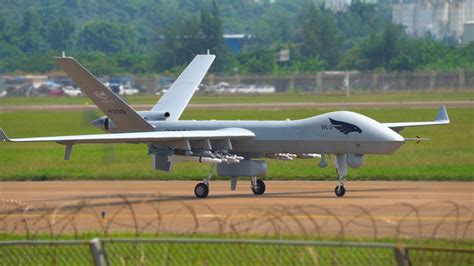
The incorporation of the Wing Loong II into CCG operations was first foreshadowed in March 2025, when China’s Legal Daily covered a CCG exercise that openly displayed the drone adorned with official coast guard insignia. Built by the Aviation Industry Corporation of China (AVIC), the Wing Loong II—also designated GJ-2—is a Medium-Altitude Long-Endurance (MALE) UAV capable of both reconnaissance and strike missions. This move reflects a significant doctrinal evolution, embedding military capabilities in a paramilitary framework under the guise of law enforcement.
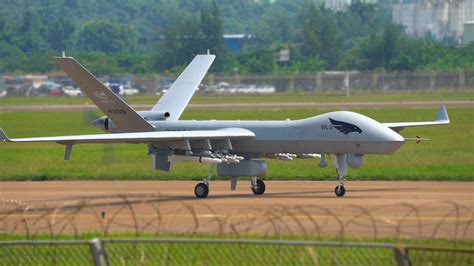
Measuring 20.5 meters in wingspan and stretching 11 meters in length, the Wing Loong II boasts a service ceiling of 9,900 meters and an endurance exceeding 20 hours. It is powered by a rear-mounted turbocharged engine and equipped with satellite communication systems, enabling remote operation over distances exceeding 2,000 kilometers—ample range to monitor the South China Sea and Taiwan Strait in near real-time.
Maritime Surveillance Redefined: Sensors Over Firepower
While the drone can carry up to 12 guided munitions, the version operated by the CCG appears unarmed, focusing instead on advanced surveillance payloads. Imagery confirms the presence of synthetic aperture radar (SAR), electro-optical/infrared (EO/IR) cameras, and laser rangefinder-designators, allowing continuous surveillance in all weather and light conditions. These systems are tailored for persistent monitoring of maritime traffic, illegal incursions, and foreign naval maneuvers.
This configuration enables the CCG to conduct surveillance missions with a scope and duration previously unachievable through manned platforms. The drone’s high endurance and wide sensor coverage mean fewer units are needed for persistent maritime domain awareness, providing a strategic edge in “grey zone” operations.
The Justice Mission-2025 Drill: A Hybrid Operational Blueprint
Justice Mission-2025 is part of an escalating series of exercises designed to test and demonstrate China’s integrated military-paramilitary doctrine. Uniquely, this drill featured joint participation from the People’s Liberation Army (PLA) Eastern Theater Command and the China Coast Guard, simulating blockade operations, island seizures, and interdictions under a hybrid warfare model.
The operation mobilized a complex mix of naval units, air assets, cyber-electronic warfare, and drone contingents, including both reconnaissance and armed UAVs. This convergence of forces blurred the line between law enforcement and military aggression, with the CCG acting as a legally framed extension of China’s regional assertiveness.
The inclusion of the Wing Loong II reinforces this hybrid approach. Though unarmed, its presence asserts a psychological and strategic deterrent, amplifying the coast guard’s reach and surveillance tempo in contested zones—particularly around Taiwan.
Strategic Implications for Taiwan and the Region
This development carries serious implications for Taiwan’s security calculus. The Taiwan Strait, a volatile flashpoint in U.S.-China relations, now witnesses a coast guard equipped with military-grade ISR capabilities, fundamentally altering the threat landscape. The drone’s integration into patrol missions expands China’s ability to enforce its maritime claims while maintaining a veneer of legal legitimacy.
Taiwanese defense analysts interpret the drone’s unarmed deployment as part of China’s escalatory ladder, maintaining pressure without provoking full-scale retaliation. The mere presence of a drone like the Wing Loong II, capable of switching from passive surveillance to active engagement, complicates response decisions by Taiwan’s armed forces.
The Grey Zone Doctrine: Law Enforcement as Strategic Leverage
China’s deployment of high-end UAVs via the CCG reflects a calculated use of “grey zone” tactics. By equipping a law enforcement body with a drone typically reserved for military or export clients, Beijing sidesteps conventional military thresholds while still projecting power.
This blurs engagement rules for regional actors and raises significant legal and strategic ambiguities. For instance, should Taiwan or another nation target a CCG-operated Wing Loong II, would it be interpreted as an act against a military asset or a law enforcement entity? The implications for rules of engagement (ROE) are profound.
Chinese media have subtly reinforced this ambiguity by emphasizing the drone’s “即察即打” (reconnaissance-strike integration) capabilities while downplaying its current armament. This dual messaging preserves strategic flexibility, keeping adversaries uncertain about the drone’s true operational posture.
CCG’s Expanding Arsenal: Drones, Frigates, and Force Multipliers
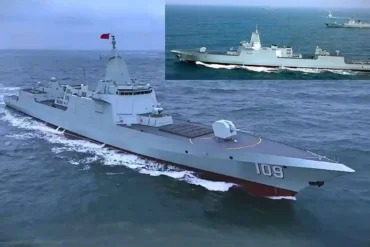
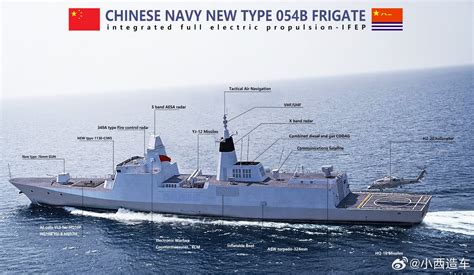
The CCG’s modernization isn’t limited to drones. In recent years, it has incorporated 10,000-ton cutters, Type 054A and 056A frigates, previously operated by the PLA Navy. This integration of ex-military hulls and platforms like the Wing Loong II transforms the CCG into a quasi-naval force, capable of prolonged blue-water operations and combat support roles.
The drone’s inclusion enhances this naval law enforcement ecosystem, enabling airborne ISR support for flotilla operations and over-the-horizon targeting. Strategically, it allows the CCG to operate in distributed maritime operations, extending China’s reach without triggering full-blown military confrontation.
Conclusion: A Subtle but Significant Escalation
The suspected deployment of the Wing Loong II drone by the China Coast Guard near Taiwan is not merely a technological milestone—it is a clear signal of Beijing’s evolving hybrid warfare strategy. By embedding military-grade assets within paramilitary structures, China gains operational flexibility while maintaining deniability and legal ambiguity.
In the ever-contested waters of the Taiwan Strait and South China Sea, the drone’s endurance, surveillance capabilities, and deterrent presence give China a strategic upper hand in maritime domain dominance. As the region enters 2026, the Justice Mission-2025 exercise may be remembered as the moment China’s coast guard truly transitioned from patrol force to instrument of geopolitical pressure.
Taiwan and its allies will need to recalibrate their detection, interception, and engagement protocols in light of this development. The battlefield of the future is already airborne—and it no longer wears a uniform.