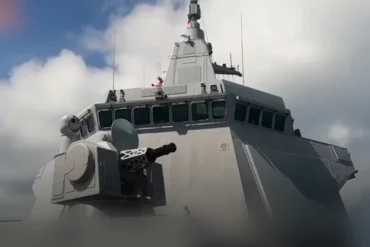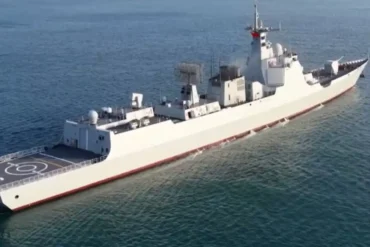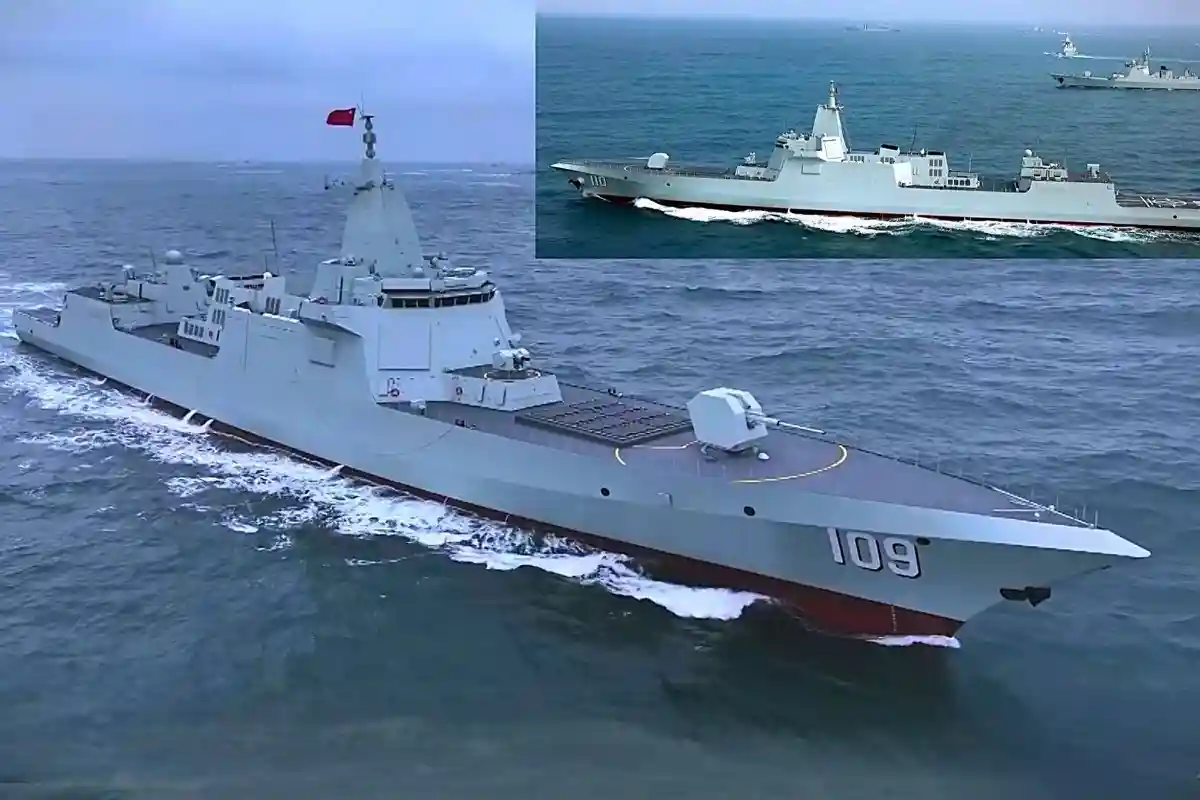
China has formally expanded the operational strength of the People’s Liberation Army Navy (PLAN) by commissioning two additional Type 055 guided-missile destroyers, Dongguan (Hull 109) and Anqing (Hull 110). The entry of these ships into active service increases the total number of operational vessels in this advanced class to ten, marking another milestone in China’s naval modernization program.
More importantly, both warships have been assigned to the Eastern Theater Command Navy, the formation responsible for maritime operations in the East China Sea and the Taiwan Strait. Their deployment significantly enhances the region’s air-defense, sea-control, and long-range strike capabilities, underscoring Beijing’s growing ability to project power in strategically sensitive waters.
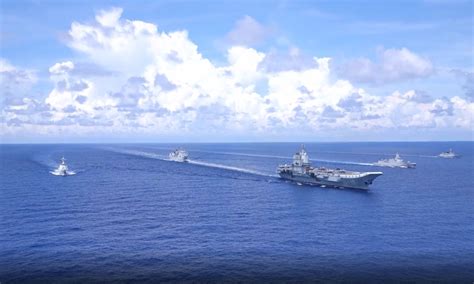
These ships were first publicly confirmed in service when China Central Television’s Xinwen Lianbo broadcast aired footage on March 8, 2026, showing the destroyers participating in joint training exercises at sea. Their appearance alongside other PLAN vessels indicates that the ships have already transitioned from initial commissioning phases to operational integration with larger naval formations.
By bringing the number of operational Type 055 vessels to ten, China now fields one of the largest modern fleets of cruiser-scale surface combatants in the Indo-Pacific, with additional ships reportedly under construction.
Expanding the Fleet of China’s Most Powerful Surface Combatants
The addition of Dongguan and Anqing completes the current operational lineup of Type 055 destroyers, which now includes the following vessels:
- Nanchang (101)
- Lhasa (102)
- Anshan (103)
- Wuxi (104)
- Dalian (105)
- Yan’an (106)
- Zunyi (107)
- Xianyang (108)
- Dongguan (109)
- Anqing (110)
Earlier units were distributed between the Northern Theater Command Navy and the Southern Theater Command Navy, providing coverage over the Bohai Sea, Yellow Sea, and South China Sea. The newest ships extend the presence of this powerful class into the Eastern Theater Command, completing a tri-theater distribution of the vessels.
This arrangement allows China to maintain large surface combatants capable of escorting aircraft carriers, amphibious task groups, and major naval formations across all major maritime directions.
Chinese naval planners reportedly envision a total fleet of up to sixteen Type 055 destroyers, suggesting that the program will remain a core component of the country’s surface warfare strategy well into the next decade.
The Type 055: A Cruiser-Scale Destroyer
The Type 055 Renhai-class destroyer represents the largest and most capable surface combatant currently operated by the Chinese navy. Due to its size and command facilities, many analysts—including those in the United States—consider the vessel closer in capability to a modern guided-missile cruiser than a traditional destroyer.
The ship measures roughly 180 meters in length with a beam of about 20 meters. Its full-load displacement is estimated between 12,000 and 13,000 tons, placing it among the largest non-aircraft-carrier warships operating in Asia.
Propulsion comes from a COGAG (Combined Gas and Gas) system powered by four QC-280 gas turbines, enabling the vessel to achieve speeds of around 30 knots while maintaining a range of approximately 5,000 nautical miles at cruising speed.
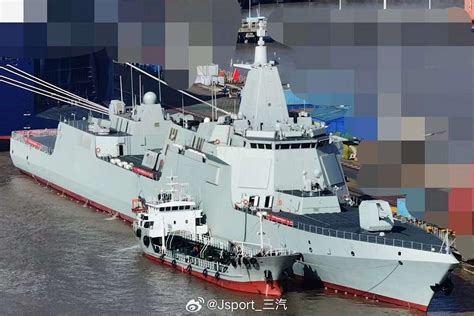
The ship’s design incorporates stealth-influenced features, including a smooth continuous deckline and a streamlined superstructure that minimizes radar reflections. The forward structure integrates advanced sensors within an enclosed mast, reducing external clutter while enhancing survivability and detection performance.
Advanced Radar and Sensor Architecture
At the core of the Type 055’s combat system is the Type 346B “Dragon Eye” radar, an advanced active electronically scanned array (AESA) system. AESA radars use thousands of small transmit-receive modules to electronically steer radar beams without moving parts, allowing extremely rapid scanning of the surrounding airspace.
This radar works in conjunction with X-band radar panels, fire-control systems, and electronic warfare equipment integrated throughout the ship’s sensor suite.
Together, these systems provide the ship with long-range detection and tracking capabilities against:
- Combat aircraft
- Cruise missiles
- Maritime patrol aircraft
- Potential ballistic missile trajectories
The radar network feeds into the ship’s command-and-control architecture, allowing the Type 055 to function as a central air-defense coordinator within larger naval task groups. In essence, the vessel acts as the digital brain of a fleet formation, linking sensors and weapons across multiple ships and aircraft.
A Massive Vertical Launch Missile Arsenal
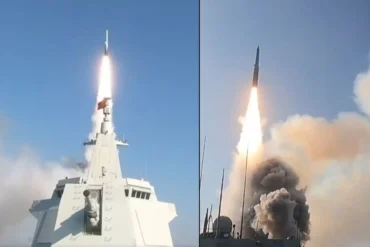
One of the defining features of the Type 055 is its large universal Vertical Launch System (VLS). The destroyer carries 112 launch cells, arranged in two sections: 64 cells forward and 48 cells aft.
These launch tubes are designed to accommodate multiple types of weapons, enabling the ship to adapt its loadout depending on mission requirements.
Missiles that can be deployed from the VLS include:
- HHQ-9 long-range surface-to-air missiles for fleet air defense
- YJ-18 anti-ship cruise missiles capable of high-speed terminal attacks
- CJ-10 land-attack cruise missiles designed for precision strikes against ground targets
- CY-5 or Yu-8 anti-submarine rocket torpedoes
This flexibility allows the Type 055 to carry out simultaneous air-defense, anti-ship, land-attack, and anti-submarine missions, making it one of the most versatile warships currently in service.
Complementary Weapons and Aviation Capability
Beyond its missile arsenal, the Type 055 carries a diverse set of defensive and offensive systems.
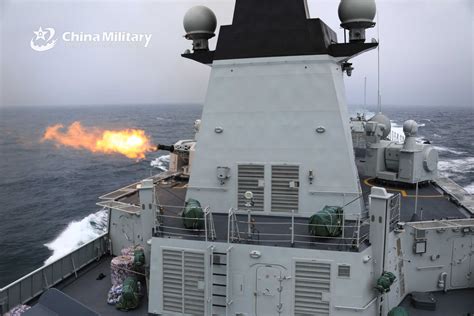
The ship is equipped with a 130-millimeter main naval gun, suitable for surface engagements and naval gunfire support during amphibious operations. Close-range defense is provided by a close-in weapon system (CIWS) designed to intercept incoming missiles or aircraft at short distances.
A HHQ-10 short-range surface-to-air missile system adds another protective layer against high-speed threats approaching the ship.
For underwater warfare, the vessel includes torpedo launchers and supports anti-submarine helicopters from its aft flight deck and hangar. The hangar can accommodate two medium naval helicopters, which can conduct submarine detection, maritime patrol, and over-the-horizon targeting.
The aviation component greatly extends the ship’s operational awareness, allowing it to detect threats far beyond the range of onboard sensors.
Potential Role in Long-Range Maritime Strike
Chinese sources have suggested that the Type 055 could also become a launch platform for very long-range anti-ship weapons, including a potential anti-ship ballistic missile variant designated YJ-20.
Ballistic anti-ship weapons travel on high-altitude trajectories before descending toward targets at extreme speeds, making them difficult to intercept. If such systems become operational from surface ships, they would dramatically expand China’s maritime denial capabilities, potentially allowing naval forces to engage adversary fleets at ranges far exceeding those of traditional cruise missiles.
While operational deployment of such systems remains uncertain, the possibility illustrates the growth potential built into the Type 055’s design.
Integration Into Carrier Strike Groups
Since the commissioning of the first ship Nanchang in 2020, Type 055 destroyers have already participated in several major naval activities.
These include:
- Carrier escort missions with Chinese aircraft carriers
- Long-range deployments into the Western Pacific
- Joint exercises in the South China Sea focusing on missile defense and strike operations
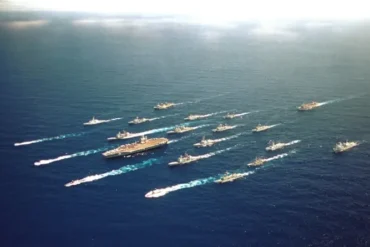
In carrier strike groups, the Type 055 functions as the primary air-defense shield, using its radar and missile systems to protect the carrier and other vessels from aerial threats.
The newly commissioned Dongguan and Anqing appear to be following the same operational path. Their first appearance in media footage showed them participating in formation training exercises with other PLAN ships, indicating that they are being incorporated directly into multi-ship combat formations rather than operating independently.
As more units enter service, the Chinese navy will likely maintain at least one Type 055 escort for each aircraft carrier task group, while still retaining several ships for independent surface action groups.
Strategic Importance of the Eastern Theater Command
Assigning Dongguan and Anqing to the Eastern Theater Command Navy carries significant strategic implications.
This command oversees military operations in the East China Sea, the Taiwan Strait, and nearby waters where interactions with Japan, Taiwan, and the United States Navy frequently occur.
Deploying two of the PLAN’s most capable warships to this region provides several operational advantages:
- Enhanced long-range air defense for naval formations
- Greater anti-ship strike capacity in contested waters
- Expanded land-attack capabilities from the sea
- Improved command-and-control for joint naval operations
In practical terms, these ships could provide layered missile defense coverage for amphibious forces, carriers, or key shipping lanes, while also possessing the ability to strike distant targets if required.
A Growing Blue-Water Navy
The deployment of Type 055 destroyers across all three theater commands highlights the transformation of the PLA Navy from a coastal defense force into a true blue-water navy.
A blue-water navy refers to a maritime force capable of operating globally across deep oceans, far from its home bases.
With large destroyers, aircraft carriers, modern submarines, and long-range logistics vessels, China is steadily building the components required for sustained operations in distant waters. The presence of advanced command ships like the Type 055 ensures that these forces can coordinate complex operations across vast maritime regions.
Implications for the Indo-Pacific Naval Balance
The steady expansion of the Type 055 fleet is likely to influence naval planning throughout the Indo-Pacific.
Regional navies and defense planners are closely monitoring the class because of its combination of large missile capacity, advanced sensors, and command capabilities. Ships with such features serve not only as combat platforms but also as force multipliers, coordinating air, sea, and missile defenses across entire fleets.
As China continues producing additional hulls, the cumulative effect will be a larger pool of high-end surface combatants capable of operating simultaneously in multiple regions. This growing presence will shape naval deployments, strategic calculations, and security discussions across the Pacific.
The Future of the Type 055 Program
The commissioning of Dongguan and Anqing signals that the Type 055 program has moved beyond experimental status and is now a central pillar of China’s naval force structure.
With ten ships already active and more under construction, the class is expected to remain the backbone of the PLAN’s surface fleet for decades. These destroyers will serve as carrier escorts, missile defense hubs, long-range strike platforms, and command ships for large naval formations.
As their deployment patterns evolve and new weapons systems are integrated, the Type 055 fleet will continue shaping the operational dynamics of maritime security in the Indo-Pacific region.
The arrival of Dongguan and Anqing in the Eastern Theater Command therefore represents more than a simple fleet expansion—it reflects the steady emergence of a navy designed to operate across entire oceans, not merely along coastal waters.