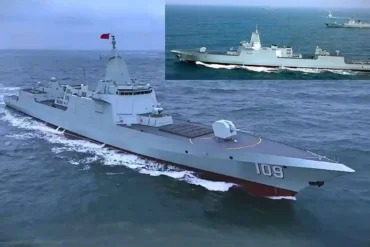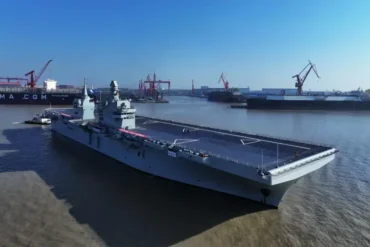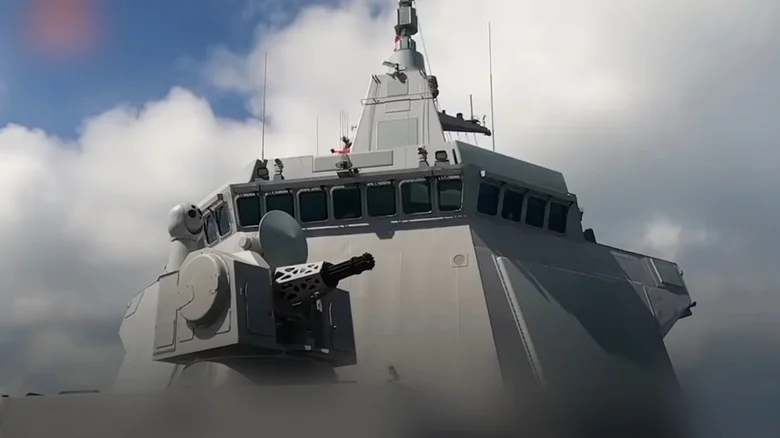
China’s Type 055 destroyers have rapidly emerged as one of the most formidable surface combatants afloat, blending sheer scale, cutting-edge electronics, and overwhelming firepower into a platform designed for dominance across multiple domains. With the commissioning of newer vessels like Anging and Dongguan, the People’s Liberation Army Navy (PLAN) is signaling a decisive shift toward blue-water capability, where these ships act not merely as escorts but as central nodes in a highly networked fleet.
A New Benchmark in Size and Firepower
At approximately 10,000 tons displacement, the Type 055 stands among the largest destroyers ever built, often blurring the line between destroyer and cruiser. This size is not cosmetic—it enables a level of weapons integration and survivability that smaller ships simply cannot match. The vessel’s design supports up to 112 vertical launch system (VLS) cells, giving it the flexibility to deploy a wide spectrum of munitions tailored to evolving threats.
This immense missile capacity allows the Type 055 to conduct layered air defense, long-range strike missions, anti-submarine warfare, and anti-ship engagements simultaneously. Unlike legacy destroyers optimized for a narrow mission set, these ships are built for multi-domain supremacy, ensuring operational versatility in high-intensity conflict scenarios.
Advanced Sensors and Battlefield Awareness
One of the defining features of the Type 055 is its dual-band radar system, a technological leap that enhances both detection range and tracking precision. This system enables the destroyer to monitor hundreds of aerial targets at once, dramatically improving situational awareness in contested environments.
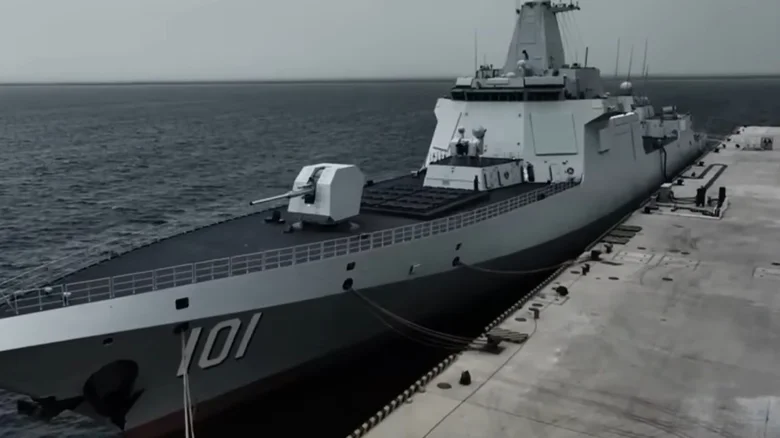
The radar’s ability to operate across multiple frequency bands ensures resilience against stealth aircraft and electronic countermeasures. In modern naval warfare—where the first to detect often gains the decisive advantage—this capability transforms the Type 055 into a command-and-control powerhouse, capable of coordinating fleet-wide defensive and offensive actions with remarkable efficiency.
Hypersonic Threat: The YJ-20 Advantage
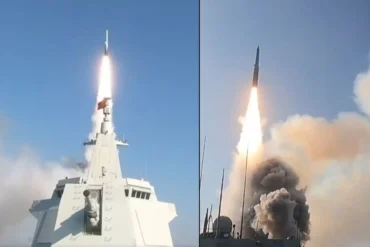
Perhaps the most alarming aspect of the Type 055’s arsenal is its compatibility with the YJ-20 hypersonic anti-ship ballistic missile. Traveling at extreme speeds and capable of maneuvering during flight, this weapon significantly reduces interception windows for enemy defenses.
The integration of hypersonic strike capability gives the Type 055 a strategic edge in anti-access/area denial (A2/AD) operations, allowing it to threaten high-value targets such as aircraft carriers from extended ranges. This shifts the balance of naval engagement, forcing adversaries to operate farther from contested zones or risk catastrophic losses.
Evolving Design and Continuous Upgrades
The latest ships in the class, including Anging and Dongguan, reportedly feature enhanced reconnaissance systems and upgraded onboard weaponry, although many specifics remain classified. What is clear is that the Type 055 platform is designed with modularity and future growth in mind, ensuring that each new batch improves upon the last.
Chinese naval strategists have already indicated that current iterations are not yet sufficient for the country’s expanding far-seas ambitions. This suggests a pipeline of even more advanced variants, potentially incorporating next-generation sensors, directed-energy weapons, and improved propulsion systems.
How Type 055 Stacks Against U.S. Counterparts
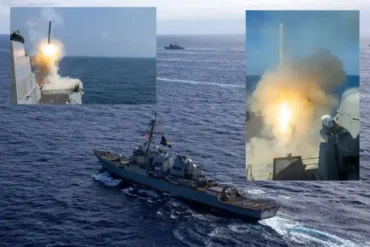
Comparisons between the Type 055 and U.S. vessels such as the Zumwalt-class destroyer and Ticonderoga-class cruiser reveal both strengths and trade-offs. While the Zumwalt emphasizes stealth through its unique hull design and reduced radar signature, it carries only 80 VLS cells, significantly fewer than the Type 055.
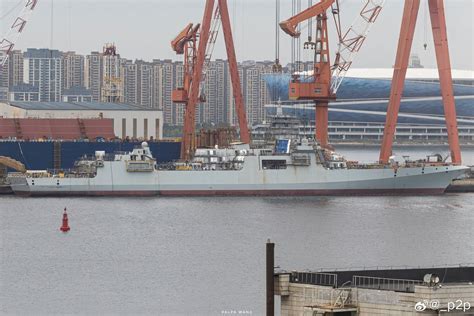
Meanwhile, the Ticonderoga-class matches the Type 055 in launcher count but represents an older design philosophy. The Type 055’s integrated systems, modern radar, and broader mission profile give it a technological edge in many scenarios, particularly in fleet air defense and long-range strike coordination.
The Zumwalt program’s reduction from 32 planned ships to just three further underscores the challenges faced by the U.S. in fielding next-generation surface combatants at scale. In contrast, China’s steady production of Type 055 destroyers highlights a consistent and focused naval expansion strategy.
Strategic Implications in the East China Sea and Beyond
The deployment of newer Type 055 units to the East Sea Fleet marks a significant escalation in regional naval dynamics. Positioned near contested waters, these ships enhance China’s ability to project power and maintain persistent presence in areas of strategic importance.
Their combination of long-range strike capability, advanced detection systems, and fleet coordination roles makes them central to China’s evolving maritime doctrine. Rather than operating as standalone assets, Type 055 destroyers function as force multipliers, amplifying the effectiveness of carrier groups, submarines, and supporting vessels.
In an era defined by rapid technological change and intensifying naval competition, the Type 055 stands as a clear indicator that the future of sea power will be shaped not just by numbers, but by the integration of advanced systems, adaptability, and overwhelming offensive potential.