The U.S. Navy has surged six independently operating Arleigh Burke-class guided-missile destroyers into the Arabian Sea, establishing a distributed surface strike force capable of executing sustained Tomahawk land-attack missile operations under Operation Fury. The deployment signals a deliberate expansion of sea-based precision firepower beyond the traditional carrier strike group construct, reinforcing long-range offensive capacity in a theater defined by dense air defenses, anti-ship threats, and escalating confrontation with Iran.
Rather than concentrating combat power around a single aircraft carrier, the Navy has dispersed six destroyers across the Arabian Sea, creating multiple launch vectors and complicating adversary targeting cycles. Fleet tracking data first reported by USNI News indicates the ships are operating outside a carrier strike group framework, functioning instead as a flexible surface action network. Each vessel fields a Mk 41 Vertical Launch System with between 90 and 96 cells, configurable for Tomahawk cruise missiles capable of striking targets more than 900 miles inland. The result is a distributed architecture of mobile precision strike nodes capable of maintaining operational tempo while reducing reliance on land bases or carrier air wings.
The destroyers identified in theater include USS McFaul, USS John Finn, USS Milius, USS Delbert D. Black, USS Pinckney, and USS Mitscher. Drawn from homeports including Norfolk, Yokosuka, and San Diego, their convergence reflects cross-fleet surge integration from both Atlantic and Pacific commands. Their dispersion across open waters, rather than formation steaming, underscores a tactical shift toward distributed offensive surface warfare.
Distributed Maritime Strike Power in a Contested Theater
This posture embodies the Navy’s evolving concept of distributed lethality, a doctrine designed to spread offensive capability across multiple platforms rather than centralizing it around high-value units. In the Arabian Sea, that philosophy translates into overlapping missile engagement zones extending deep inland. By operating independently, each destroyer complicates adversary surveillance and targeting efforts, forcing opponents to track and neutralize multiple moving launch platforms instead of a single concentration of naval power.
The Arabian Sea provides geographic depth that allows ships to remain outside heavily defended littorals while still holding strategic targets at risk. From these waters, Tomahawk missiles can reach command-and-control facilities, integrated air defense nodes, logistics depots, and ballistic missile infrastructure well beyond the coastline. Dispersal also enhances survivability; if one ship must maneuver to counter a threat or replenish defensive interceptors, the remaining vessels sustain strike continuity without operational pause.
Confirmed Tomahawk Launches and Operational Transparency
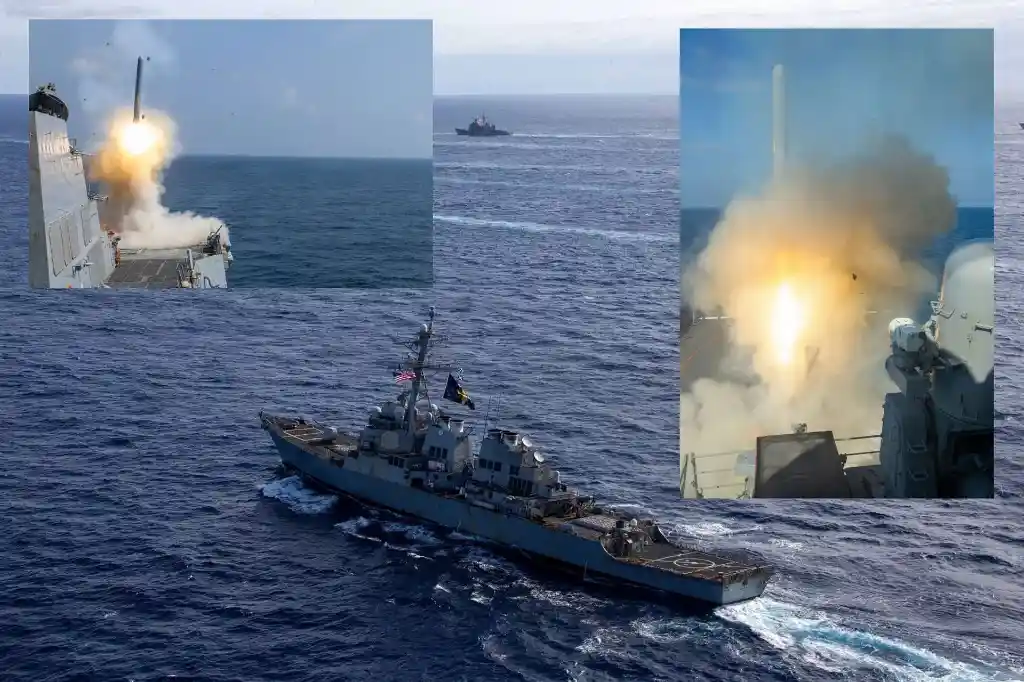
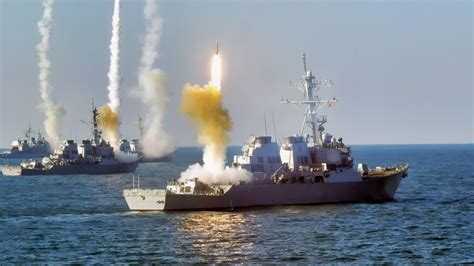
Official imagery released through U.S. defense channels provides rare visual confirmation of active strike execution by multiple ships. Photographs document live Tomahawk launches from both USS Delbert D. Black and USS Milius, clearly showing the Mk 41 Vertical Launch System hot-launch sequence. In these images, booster ignition propels the missile vertically from its cell before aerodynamic surfaces deploy and the engine transitions to cruise flight. The visual evidence confirms that the strike campaign is not reliant on a single firing platform but executed through a networked surface combatant force operating from separate maritime positions.
Such transparency serves both operational and strategic messaging purposes. Demonstrating simultaneous launch capability from dispersed ships reinforces deterrence by signaling depth of magazine and endurance. It also underscores the Navy’s ability to execute precision strikes without forward basing aircraft within range of hostile missile systems.
The Tomahawk: Networked Precision at Extended Range
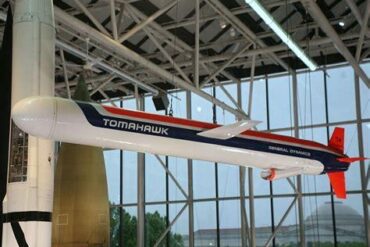
At the core of this strike architecture is the Tomahawk Land Attack Missile, the Navy’s principal long-range precision weapon. Modern destroyers deploy a mix of Block IV Tactical Tomahawks and upgraded Block V variants. Block IV introduced two-way satellite communications via the Tactical Tomahawk Weapons Control System, enabling in-flight retargeting, mission abort options, and loiter capability over designated coordinates. This transforms the missile from a pre-programmed projectile into a dynamic, networked strike asset responsive to evolving battlefield intelligence.
Block V enhancements focus on survivability and versatility. Upgraded navigation systems improve resilience against GPS jamming, a growing threat in contested electromagnetic environments. The Block Va Maritime Strike Tomahawk adds an anti-ship capability, allowing engagement of moving surface vessels at long range. Block Vb integrates a joint multi-effects warhead optimized for hardened or semi-hardened structures. Collectively, these upgrades extend service life while broadening mission profiles, ensuring that each destroyer’s missile inventory remains adaptable to both land and maritime targets.
With effective ranges approaching 1,000 miles depending on flight profile, Tomahawk missiles employ inertial navigation supplemented by GPS updates, terrain contour matching, and digital scene-matching area correlation. Flying at low altitude, they minimize radar exposure while maintaining precise terminal guidance. The standard 1,000-pound-class warhead is engineered for high-value targets, including fortified command centers and missile storage complexes.
Magazine Depth and Sustained Strike Cycles
The operational weight of six Arleigh Burke-class destroyers lies in cumulative magazine depth. Each ship’s 90 to 96 vertical launch cells are typically apportioned among air-defense interceptors, anti-submarine rockets, and potentially ballistic missile defense systems. A strike-focused configuration can dedicate a substantial percentage to Tomahawks while retaining layered defensive coverage.
Across six hulls, this equates to dozens of ready-to-fire cruise missiles available without immediate replenishment. Commanders can sequence salvos across multiple nights, varying timing and direction to maintain pressure on designated targets. Unlike aircraft, which require sortie generation cycles and vulnerable forward bases, sea-based launchers operate continuously, limited primarily by inventory and maintenance cycles.
Strategic Implications for Regional Security
The deployment unfolds amid heightened tensions and a broader joint campaign framework that reportedly began with cyber and space-domain operations before transitioning to kinetic strikes. Sea-based Tomahawk employment aligns with doctrinal priorities to degrade integrated air defenses and missile launch infrastructure prior to expanded manned aircraft penetration.
By positioning destroyers as primary strike assets, the Navy highlights the evolution of the Arleigh Burke class from air-defense escort to central offensive platform. Historically designed to shield carriers and amphibious groups, these ships now project independent, campaign-level firepower. Their Aegis combat systems provide advanced sensor fusion and missile defense, ensuring that offensive operations occur within a robust protective envelope.
The distributed model also mitigates risk concentration. A single carrier represents immense combat capability but also a strategic focal point for adversary targeting. Six dispersed destroyers, by contrast, dilute that focus while preserving aggregate striking power. The approach reflects a broader recalibration toward survivability and flexibility in high-end conflict environments dominated by anti-access and area-denial systems.
A Mobile Strike Backbone for Operation Fury
As Operation Fury progresses, the six destroyers stationed in the Arabian Sea form a persistent maritime strike backbone capable of calibrating force from limited precision engagements to sustained campaign operations. Confirmed Tomahawk launches demonstrate that distributed lethality has transitioned from conceptual doctrine to operational reality.
Each vessel functions as a mobile long-range strike node integrated into a joint fires network spanning sea, air, cyber, and space domains. In an era where strategic targets can be engaged from hundreds of miles offshore, the Arabian Sea deployment illustrates how surface combatants have become pivotal instruments of precision warfare. The convergence of networked missiles, dispersed maneuver, and deep magazine capacity signals a defining shift in how naval power is projected in contested regions—measured not by proximity alone, but by reach, resilience, and sustained precision.