The U.S. Navy’s Zumwalt-class destroyers were once seen as futuristic warships searching for a mission. Today, that uncertainty is gone. With the integration of hypersonic strike weapons, the three stealth destroyers—USS Zumwalt (DDG-1000), USS Michael Monsoor (DDG-1001), and USS Lyndon B. Johnson (DDG-1002)—are being transformed into some of the most heavily armed surface combatants ever to sail under the American flag. This evolution reflects not a revival of the canceled program, but a deliberate recalibration of naval power for high-end conflict.
Conceived during an era focused on littoral warfare, the Zumwalt-class was originally meant to deliver overwhelming naval gunfire support close to shore. The Navy envisioned a fleet of 32 ships, but spiraling costs and shifting strategic priorities reduced the class to just three hulls. Despite that abrupt contraction, these vessels were never abandoned. Instead, they became ideal candidates for experimentation—large, stealthy, electrically powerful platforms ready to host weapons no other destroyer could easily carry.
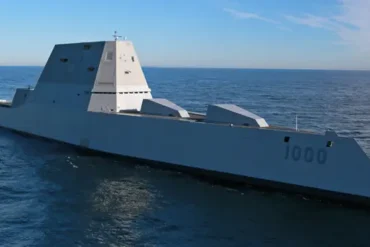
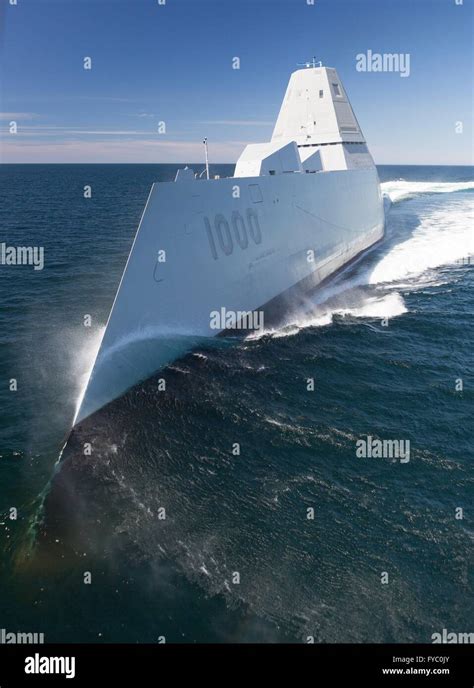
At 610 feet long and displacing over 15,000 tons, the Zumwalt-class remains the largest destroyer design ever built. Its angular tumblehome hull and radar-absorbing surfaces dramatically reduce its radar cross-section, allowing it to approach contested coastlines with a level of stealth unmatched by conventional surface ships. That stealth is now paired with striking power that fundamentally alters the ship’s role in future naval warfare.
From Naval Guns to Strategic Strike Platforms
The Zumwalt’s original centerpiece, the Advanced Gun System (AGS), was technologically impressive but operationally doomed. Each fully automated 155mm gun could fire precision-guided rounds nearly 100 miles inland, yet the cancellation of its specialized ammunition rendered the system impractical. After years of uncertainty, the Navy made a decisive move: remove the guns entirely and replace them with something far more consequential.
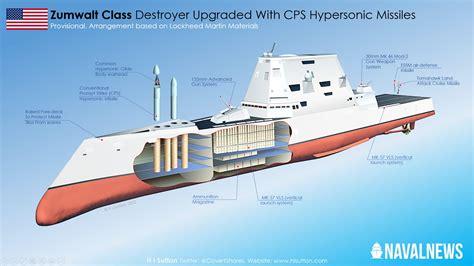
That decision led to a three-year refit process, concluding in late 2025, during which the AGS mounts were removed, internal structures rebuilt, and extensive software and combat system modifications completed. This was not a cosmetic upgrade. It was a structural transformation that redefined the Zumwalt-class as a strategic strike asset rather than a niche fire-support ship.
Hypersonic Weapons Change the Zumwalt’s Mission Profile
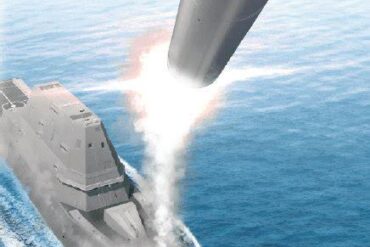
At the heart of the transformation is the Conventional Prompt Strike (CPS) system. CPS is not a single missile, but a broader U.S. Department of Defense program designed to deliver conventional hypersonic weapons capable of striking targets anywhere on the globe within roughly an hour. Installing this system aboard surface combatants marks a major escalation in naval offensive capability.
Each Zumwalt-class destroyer will be equipped with 12 CPS launch tubes, installed in the ship’s forward section where the AGS once sat. The launcher architecture closely mirrors that planned for Block V Virginia-class submarines, underscoring the Navy’s intent to field a common hypersonic strike capability across multiple domains.
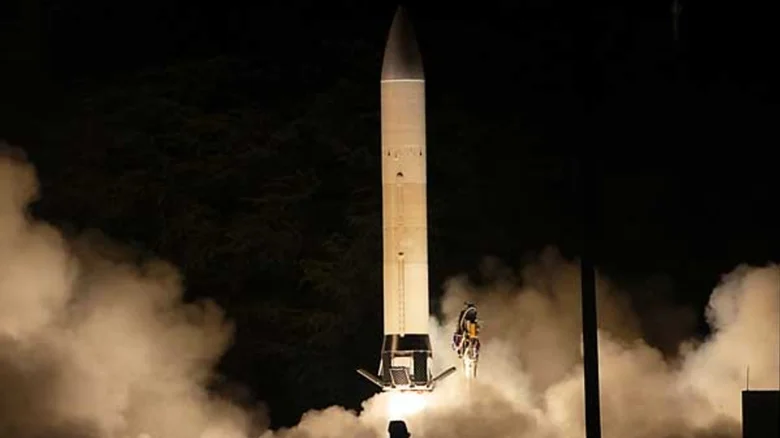
The CPS missile uses a Common Hypersonic Glide Body (CHGB)—a maneuverable, unpowered vehicle that separates from its booster and glides toward its target at extreme speeds. Traveling at greater than Mach 5, these weapons are exceptionally difficult to intercept and derive much of their destructive power from sheer kinetic energy rather than explosives.
Why These Three Ships Matter More Than Ever
Although limited in number, the Zumwalt-class now occupies a unique strategic niche. Their combination of stealth, range, and hypersonic lethality allows them to operate as forward-deployed strike platforms capable of holding high-value targets at risk from vast distances offshore. Unlike traditional destroyers focused on air defense or escort duties, Zumwalts can deliver deep inland strikes without relying on carrier air wings or land-based bombers.
The precise range and targeting details of CPS remain classified, but the implications are clear. These destroyers can penetrate anti-access/area-denial environments, launch hypersonic weapons with minimal warning, and complicate enemy defense planning across entire theaters of operation. In an era defined by great-power competition, that capability is invaluable.
Far from being relics of a canceled vision, the three Zumwalt-class destroyers have become testbeds for the future of naval warfare. Armed with hypersonic weapons and wrapped in stealth, they are no longer ships in search of relevance—they are platforms designed to redefine how sea power is projected in the 21st century.