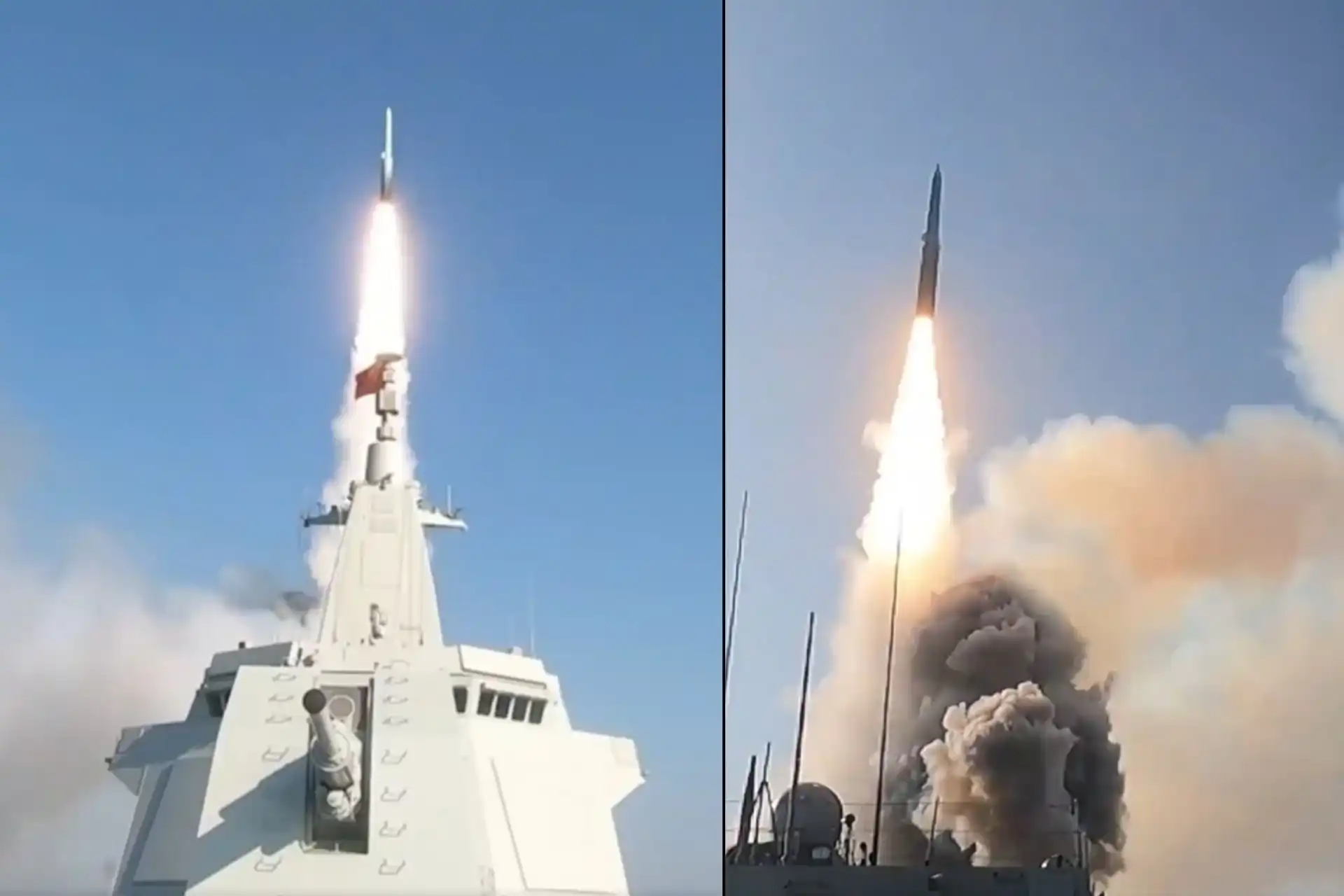
China has reached a significant milestone in hypersonic weaponry with the successful test launch of the YJ-20 hypersonic anti-ship missile from the Type-055 Renhai-class destroyer. The test, which marks the finalization phase before mass production, underscores a major advancement in China’s blue-water naval capabilities and signals a clear strategic message to rival navies, particularly those operating carrier strike groups in the Western Pacific.
YJ-20: China’s Next-Gen Hypersonic Anti-Ship Weapon
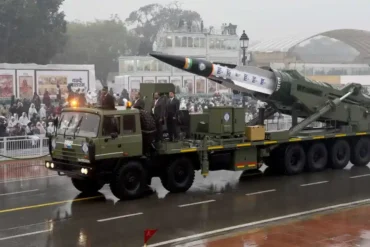
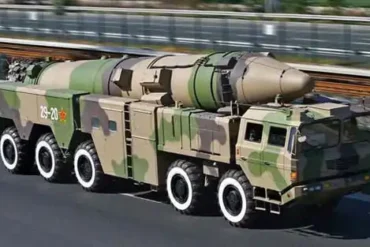
The YJ-20, also known as Eagle Strike-20, represents a new chapter in Chinese missile technology. First publicly revealed during the Victory Day military parade on September 3, 2025, the YJ-20 was shown to possess characteristics designed explicitly for high-speed precision strikes against major naval targets.
The missile utilizes a bi-conic aerodynamic design, a configuration often seen in traditional ballistic missiles but optimized here for sustained hypersonic speeds. This structure allows for boost-glide capability, where the missile is propelled initially by a rocket before gliding at hypersonic velocity toward its target. Chinese analysts estimate its range between 1,000–1,500 kilometers, placing critical assets like aircraft carriers, amphibious groups, and logistics hubs within striking distance.
Revolutionary Design and Tactical Advantage
Chinese military expert Zhang Junshe elaborated on the missile’s engineering, explaining that the forward cone of the YJ-20 generates shockwaves that shield the missile’s body and its air rudders from the intense pressure and thermal stress of hypersonic flight. These protected control surfaces enable the missile to retain maneuverability, especially during the terminal dive phase.
This tactical maneuver is particularly notable. Unlike sea-skimming missiles that fly low to avoid detection, the YJ-20 dives on its target from a near-vertical trajectory, combining ballistic missile-like descent patterns with hypersonic speeds. This results in several key advantages:
- Enhanced kinetic energy on impact
- Decreased reaction time for enemy defenses
- Difficult flight path for interception systems
Such a steep, high-speed approach renders most traditional naval defense systems—designed to counter slower, more predictable threats—ineffective.
Launch Platform: Type-055 Renhai-Class Destroyer
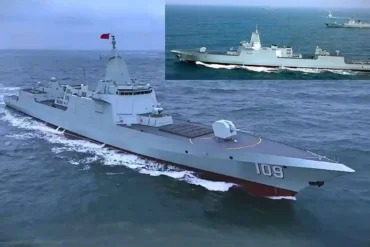
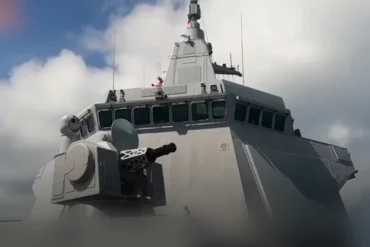
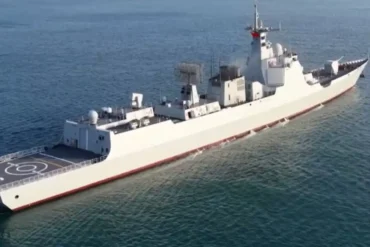
The test was conducted from the Type-055 destroyer Wuxi, one of the largest and most advanced surface combatants in the People’s Liberation Army Navy (PLAN). With a displacement of 10,000 to 13,000 tons, the Renhai-class is regarded by NATO as a cruiser due to its command-and-control capabilities, sensor suites, and firepower.
The Type-055’s Vertical Launch System (VLS), particularly in the aft section, was used for this trial. The YJ-20 was launched using a cold-launch technique, where the missile is expelled using gas pressure before its engine ignites. This reduces wear on the launch tube and allows for safer, more reliable launches.
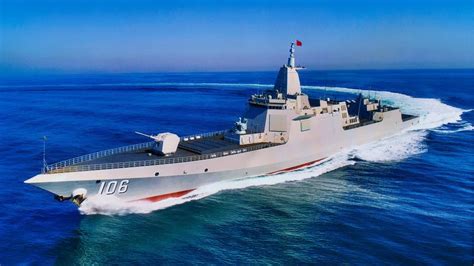
Integrating a hypersonic missile of this caliber onto the Type-055 elevates the vessel from a formidable combat platform to a strategic-level deterrent, capable of projecting lethal force over vast maritime expanses.
Strategic Implications in the Indo-Pacific
The deployment of the YJ-20 follows a consistent trend in China’s military doctrine, emphasizing anti-access/area denial (A2/AD) strategies aimed at deterring external naval forces, especially those of the United States. The YJ-20’s long range and high probability of target destruction complicate the calculus for any adversary planning operations within the First and Second Island Chains.
Moreover, with the Type-055 reportedly able to carry 112 VLS cells, a portion of which can now house YJ-20 missiles, China’s maritime strike envelope has grown exponentially. This reduces the operational freedom of large naval vessels—particularly U.S. Navy aircraft carriers, which serve as central nodes of American naval power.
Layered Hypersonic Arsenal and Doctrinal Shift
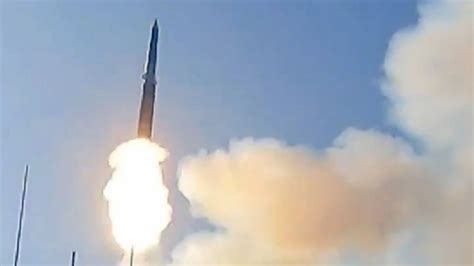
The YJ-20 is not an isolated development. It joins a growing family of Chinese hypersonic weaponry that includes the YJ-21, YJ-17, and YJ-19, all in varying stages of deployment across platforms—surface ships, submarines, and aircraft. This layered and diversified approach allows China to overwhelm or confuse defensive networks with multi-directional, high-speed threats.
This shift reflects a broader change in the PLAN’s doctrine, which increasingly favors long-range precision strikes and asymmetric warfare tools. The integration of hypersonic missiles marks a transition from traditional blue-water navy goals to a force capable of conducting pre-emptive or retaliatory anti-ship strikes far from the Chinese coastline.
Operational Maturity and Production Readiness
The recent release of multi-angle launch footage by China Military Bugle, an official PLA channel, strongly suggests that the YJ-20 has either entered or is about to enter serial production. The timing, just months after its public unveiling, is indicative of rapid prototyping-to-deployment cycles facilitated by China’s increasingly agile defense industrial base.
Analysts believe the “finalization test” confirms that the missile has cleared its design and performance validation checkpoints, transitioning from developmental curiosity to a frontline capability. The visual confirmation of the missile successfully striking and destroying a target cements its operational credibility.
Carrier Groups Now Under Threat
The central narrative of the YJ-20’s development is clear: neutralize or degrade the effectiveness of aircraft carriers. These naval assets, while highly capable, are also large and relatively slow-moving, making them ideal targets for long-range hypersonic systems.
Unlike traditional subsonic or even supersonic threats, hypersonic missiles like the YJ-20 are extremely difficult to intercept because:
- Their speed exceeds 5 Mach, giving minimal reaction time.
- They maneuver unpredictably during flight.
- Their terminal dive presents a unique intercept geometry.
For U.S. and allied forces, this means reevaluating current Aegis-based defense systems and developing directed-energy weapons, railguns, or enhanced interceptor missiles just to have a chance at defense. This arms race dynamic only intensifies the already fragile military balance in the Asia-Pacific region.
Global Reactions and Geopolitical Ramifications
The test is expected to draw intense scrutiny from Washington, Tokyo, and Canberra, all of whom operate large surface fleets within the YJ-20’s projected range. It raises the stakes for future regional crises, such as potential flashpoints in Taiwan Strait, South China Sea, and the East China Sea.
Western military analysts may need to accelerate plans for distributed lethality, where firepower is spread across more numerous, smaller platforms instead of relying on large, centralized vessels. It also increases the emphasis on hypersonic countermeasures and space-based sensors, which are more capable of early detection and tracking.
Conclusion: The Hypersonic Era Arrives at Sea
The successful YJ-20 test from a Type-055 destroyer is more than a technical feat—it is a strategic signal. China is not just developing new weapons; it is fielding them with speed and precision, transforming its navy into a platform capable of dominating regional waters and challenging global naval supremacy.
As the YJ-20 transitions from prototype to operational deployment, the nature of maritime warfare in the Indo-Pacific has changed irrevocably. Surface fleets, long considered symbols of dominance, must now contend with a new generation of hypersonic threats that leave little margin for error and even less time to react.
The future of naval warfare has arrived—and it is moving at hypersonic speed.