In the modern era of naval warfare, the United States Navy’s aircraft carriers have long been regarded as the crown jewels of maritime dominance. Towering symbols of American power, these floating airbases project influence across every ocean. Yet, a silent shift is underway in the Indo-Pacific. While the U.S. Navy maintains technological superiority in carrier design and combat experience, China has cultivated a decisive advantage that transforms the rules of engagement — and it’s not in the steel of its hulls, but in the precision of its missiles.
U.S. Carriers: Majestic Titans with Strategic Limits
The USS Gerald R. Ford (CVN-78) stands as the embodiment of U.S. naval might. At 1,106 feet long and weighing over 100,000 tons, it hosts cutting-edge defensive systems and a full complement of strike aircraft. Its nuclear propulsion allows it to stay at sea indefinitely, making it a formidable force multiplier.
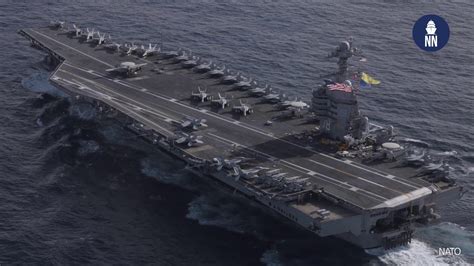
However, this dominance comes with vulnerabilities. Despite their invincibility aura, U.S. carriers are dependent on a well-coordinated Carrier Strike Group (CSG) for protection. Destroyers and cruisers carry Vertical Launch Systems (VLS) loaded with interceptors and missiles, but those magazines are limited. When faced with a massed attack — or salvo mass — even the most advanced carrier can be forced into retreat.
China’s Missile Salvo Strategy: The DF-Based Advantage
China’s People’s Liberation Army Rocket Force (PLARF) doesn’t aim to match America ship-for-ship. Instead, it focuses on an asymmetric warfare model built around its missile arsenal. This is where the People’s Republic holds its crucial edge.
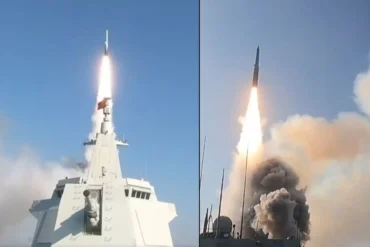
China has fielded a triad of land-based anti-ship missiles that change the calculus of power projection:
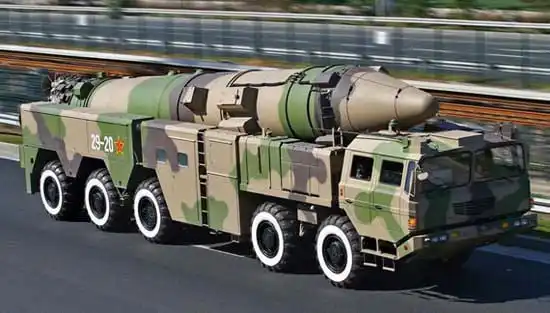
- DF-21D: Known as the “carrier killer,” this medium-range ballistic missile can strike moving naval targets at sea with precision.
- DF-26: A dual-use missile capable of both conventional and nuclear strikes, with a range up to 2,485 miles, threatening bases as far as Guam.
- DF-17: A hypersonic glide vehicle, designed to evade modern missile defenses by flying at low altitudes with unpredictable trajectories.
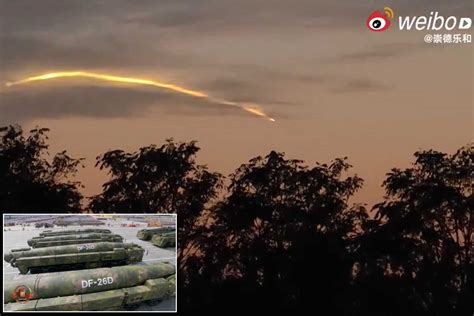
Each of these missile systems costs a fraction of what it takes to defend against them. In stark contrast, a single U.S. Standard Missile-3 (SM-3) interceptor used for ballistic missile defense can cost up to $4.3 million. China can unleash dozens of missiles in waves, saturating U.S. defenses and forcing naval commanders to think twice before approaching within range.
The Power of the Kill Chain: Detection to Destruction
China’s superiority does not stem from missile numbers alone, but from the integration of its targeting network. This so-called “kill chain” combines space, air, and terrestrial systems into a unified tracking mechanism. It includes:
- Reconnaissance satellites to detect and track ship movements.
- Over-the-horizon radar systems providing early warning beyond line-of-sight.
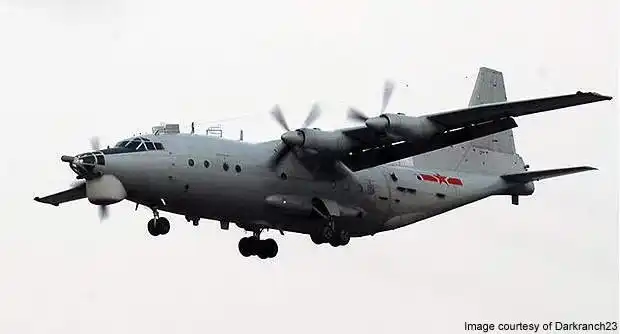
- Recon drones and manned surveillance aircraft for confirmation and post-strike damage assessment.
- Command centers linked with land-based missile brigades ready to launch in coordinated salvos.
This interconnected ecosystem gives Chinese commanders real-time situational awareness and the ability to launch precise, synchronized missile attacks at long range. A carrier operating in the Western Pacific can be seen, tracked, and attacked before it ever reaches within strike distance of Chinese shores.
Saturation Warfare: The Cost-Benefit Disruption
Where U.S. naval forces rely on expensive, limited defensive capabilities, China banks on volume. In a hypothetical conflict, American warships would expend their limited interceptors quickly trying to block a wave of Chinese missiles. Once their magazines are depleted, the entire carrier group becomes vulnerable.
Furthermore, cost asymmetry plays directly into China’s hands. While the U.S. may spend billions on carrier strike groups, China can invest a fraction of that on mobile missile launchers and strike platforms. This creates an unsustainable economic imbalance in prolonged conflict scenarios.
Strategic Geography: The Home Turf Advantage
China’s advantage is bolstered by geographic positioning. All its land-based missile forces operate on or near its territory, allowing for easy resupply, maintenance, and rapid redeployment. The U.S., meanwhile, must maintain extended supply chains across the vast Pacific, relying on bases in Japan, Guam, or Hawaii — all of which are now within range of DF-26 missiles.
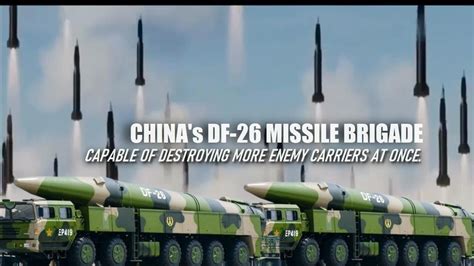
This home-field advantage ensures that China can fight from fortified positions while the U.S. must project power from vulnerable, distant platforms.
U.S. Response: Distributed Maritime Operations and Stealth Platforms
Acknowledging the reality of China’s missile dominance, the U.S. Navy has shifted toward Distributed Maritime Operations (DMO). Rather than tightly clustered battle groups, naval assets are now dispersed over larger areas. This distribution reduces the effectiveness of a single missile strike, complicates enemy targeting, and enhances survivability.
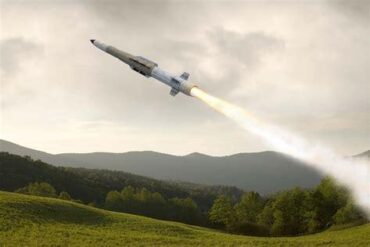
Additionally, the U.S. is placing strategic emphasis on submarine warfare and long-range unmanned systems. The Virginia-class attack submarines, fitted with Virginia Payload Modules, allow for the deployment of dozens of Tomahawk cruise missiles from stealthy underwater platforms.
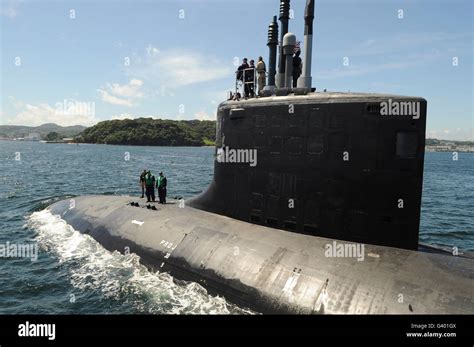
Unmanned aerial vehicles (UAVs) and autonomous surface ships are also being developed to extend sensor networks and provide resilient communications in contested environments.
The Future of Naval Deterrence: Range, Stealth, and Integration
The key to offsetting China’s missile advantage lies in out-ranging and out-hiding. Future U.S. strategies will prioritize:
- Longer-range strike capabilities, allowing American platforms to remain beyond Chinese missile envelopes.
- Stealth technologies, especially for drones and submarines, that can evade detection within the kill chain.
- Integrated battle networks, merging air, sea, space, and cyber domains to improve survivability and strike precision.
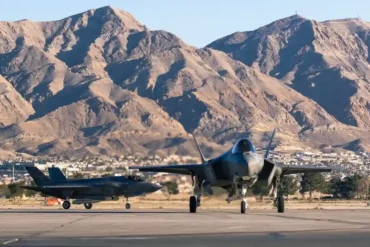
Developments like the B-21 Raider stealth bomber, F-35C Lightning II, and hypersonic missile prototypes will likely become pillars of next-generation naval power.
Implications for Global Naval Power Dynamics
The presence of China’s missile forces has fundamentally altered how carriers can be used in the Indo-Pacific. A carrier that cannot approach within 1,500 miles of Chinese shores without risking destruction is no longer a decisive power projection tool — unless paired with long-range strike and effective missile defense.
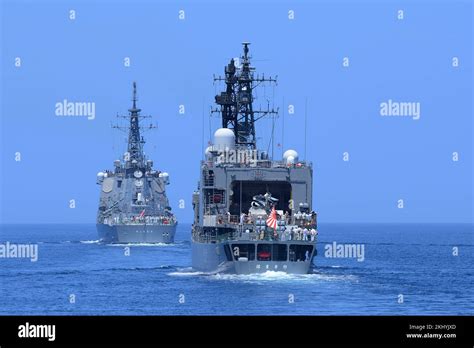
Allied nations, particularly Japan, Australia, and South Korea, are watching this shift closely. Japan is investing in counterstrike capabilities, while Australia boosts its submarine fleet. The U.S., for its part, continues to revamp its Pacific posture and deepen regional military cooperation.
Conclusion: Carrier Power in the Age of Missile Dominance
China’s most crucial advantage over U.S. aircraft carriers does not lie on water but on land — in its expansive, integrated, and cost-effective missile network. While U.S. carriers remain awe-inspiring platforms of war, their freedom to operate is increasingly constrained by a threat that is cheaper, faster, and harder to stop.
If a confrontation were to ignite in the Taiwan Strait or South China Sea, it is this salvo mass capability, enabled by a robust kill chain and economic efficiency, that may set the tempo of battle — forcing the U.S. and its allies to evolve faster than ever before to maintain freedom of navigation and strategic deterrence in an increasingly contested maritime domain.