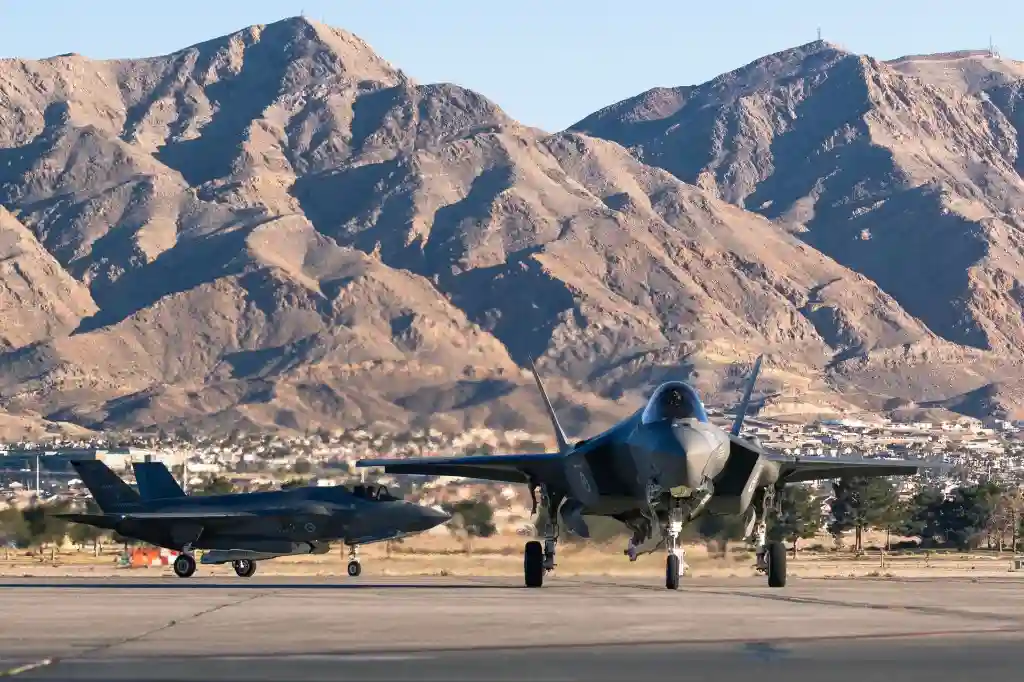
Exercise Red Flag 26-1 concluded at Nellis Air Force Base in early February 2026 after nearly two weeks of intensive, large-scale combat training across the 12,000-square-mile Nevada Test and Training Range. Bringing together approximately 3,000 personnel from 32 units representing the United States, United Kingdom, and Australia, the exercise recreated the opening stages of a high-end conflict against advanced and layered threats. The focus was clear: sharpen allied interoperability, validate joint command and control, and stress-test air combat proficiency in a contested battlespace designed to replicate peer-level adversaries.
The Nevada Test and Training Range provided a uniquely complex environment where fighters, tankers, intelligence aircraft, space components, and ground-based threat simulators converged in realistic operational scenarios. U.S. Air Force, U.S. Space Force, U.S. Marine Corps, U.S. Navy, Air National Guard, the Royal Air Force, and the Royal Australian Air Force operated as an integrated coalition force. Missions unfolded under compressed timelines and operational friction, forcing planners and aircrews to adapt dynamically while sustaining high sortie generation rates.
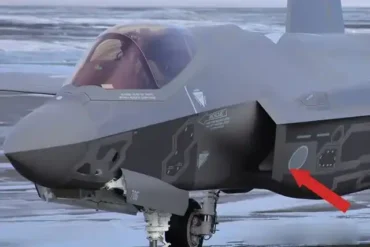
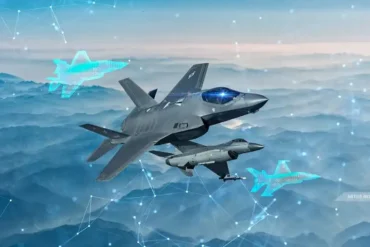
For the Royal Australian Air Force, Red Flag 26-1 marked a significant deployment of six F-35A Lightning II aircraft from No. 75 Squadron. The F-35A, powered by the Pratt & Whitney F135 afterburning turbofan engine producing roughly 43,000 pounds of thrust, demonstrated sustained supersonic performance and high-energy maneuvering while carrying weapons internally to preserve its low-observable profile. Its AN/APG-81 active electronically scanned array radar delivered long-range detection and precision targeting, complemented by the Distributed Aperture System, which provides 360-degree infrared coverage for missile warning and tracking.
These advanced systems require disciplined maintenance and logistics, particularly during daily large-force employment sorties. Compressed turnaround timelines tested sustainment practices as much as tactical execution. In high-end warfare simulations, readiness is not theoretical; it is measured in minutes between landing, refueling, rearming, and relaunching.
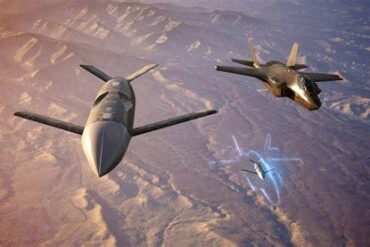
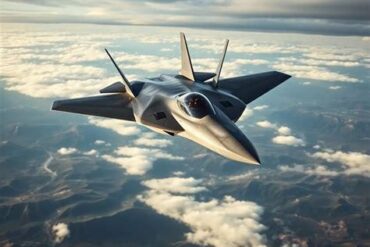
United States Air Force F-35A units operated alongside their Australian counterparts, forming mixed fifth-generation elements within coalition strike and defensive counter-air packages. This blending of forces illustrated the operational maturity of allied stealth integration. Alongside them, the F-22 Raptor played a dual role. As a force multiplier, it contributed unmatched air superiority capabilities, including supercruise above Mach 1.5 without afterburner and the formidable AN/APG-77 radar. As a high-end threat surrogate, it compelled opposing formations to confront a low-observable aircraft capable of detecting and engaging adversaries long before being detected itself.
While fifth-generation platforms dominated the sensor and stealth spectrum, fourth-generation aircraft remained indispensable. F-16 Fighting Falcon jets from Nellis-based aggressor squadrons, including the 64th Aggressor Squadron, replicated peer adversary tactics with precision. Equipped with pulse-Doppler radar and compatible with a broad range of air-to-air missiles, the F-16 adapted to simulate agile interceptors or multirole fighters depending on configuration. Their distinct visual schemes and dissimilar tactics injected unpredictability into every mission, sharpening coalition response under uncertainty.
Air refueling formed the backbone of the exercise’s operational reach. The KC-135 Stratotanker and KC-46A Pegasus extended the endurance of fighters, intelligence platforms, and command aircraft across the vast Nevada range. The KC-46A, featuring a fly-by-wire refueling boom, defensive systems, and secure communications, demonstrated compatibility with both legacy and fifth-generation fleets. Sustained tanker availability ensured that composite air operations maintained tempo and depth; without it, even the most advanced fighters would be constrained by fuel rather than capability.
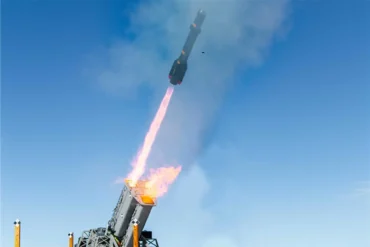
The Royal Air Force contributed twelve Eurofighter Typhoon FGR4 aircraft deployed from RAF Coningsby and RAF Lossiemouth. Powered by twin Eurojet EJ200 turbofan engines, the Typhoon exceeds Mach 2 and carries advanced air-to-air munitions. Integrated with the Meteor missile, which employs ramjet propulsion to retain energy deep into its engagement envelope, the Typhoon can prosecute targets beyond 100 kilometers under favorable conditions. This long-range lethality added significant reach to coalition defensive and offensive counter-air missions.
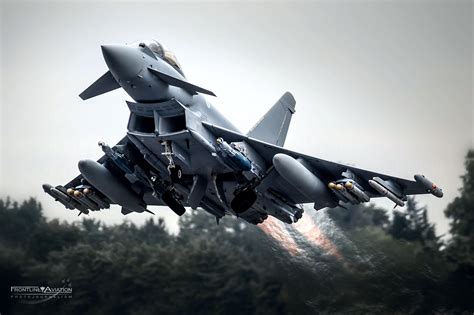
Supporting the Typhoon fleet, the Airbus Voyager KC2/KC3 provided air-to-air refueling, reinforcing sortie persistence within complex coalition packages. The combination of stealth fighters, advanced fourth-generation aircraft, and tanker support illustrated a layered force structure capable of adapting to diverse threat sets.
Intelligence and command assets further elevated realism. The Royal Air Force deployed the RC-135 Rivet Joint, a signals intelligence platform capable of collecting and analyzing electronic emissions across wide frequency ranges. By mapping radar networks and communications nodes, the aircraft contributed to a dynamic picture of the simulated adversary’s integrated air defense system. United States units integrated the MQ-9 Reaper, whose endurance—exceeding 24 hours depending on payload—enabled persistent surveillance and, when required, precision strike. Equipped with electro-optical sensors and precision-guided munitions, the MQ-9 added depth and continuity to the battlespace.
Red Flag 26-1 rehearsed the opening phase of a high-intensity campaign against a layered integrated air defense system (IADS). Fifth-generation aircraft functioned as distributed sensor nodes, sharing data via Link 16 and the Multifunction Advanced Data Link (MADL). This connectivity enhanced situational awareness across coalition formations, enabling synchronized suppression of enemy air defenses and coordinated defensive counter-air operations. Ground-based threat emitters, simulated surface-to-air missile systems, cyber elements, and space components created a contested environment where timing, electronic warfare, and precision targeting determined mission success.
Sortie generation rates became a decisive variable. Maintenance reliability, logistics efficiency, and command coordination directly influenced available combat mass. The exercise demonstrated that air superiority in modern conflict is not secured solely by advanced platforms but by the seamless integration of sensors, weapons, data networks, and sustainment systems across allied forces.
The convergence of U.S., British, and Australian air power at Nellis underscores a broader strategic alignment among Western nations facing increasingly sophisticated anti-access and area-denial capabilities worldwide. Red Flag 26-1 did more than refine tactics; it validated that allied forces can deploy, integrate, and sustain high-end combat power under realistic and demanding conditions. In an era defined by rapid technological advancement and strategic competition, such exercises reinforce deterrence by proving that coalition air power remains cohesive, adaptable, and prepared for the most complex operational challenges.